


The silent sacrifices behind the white coat

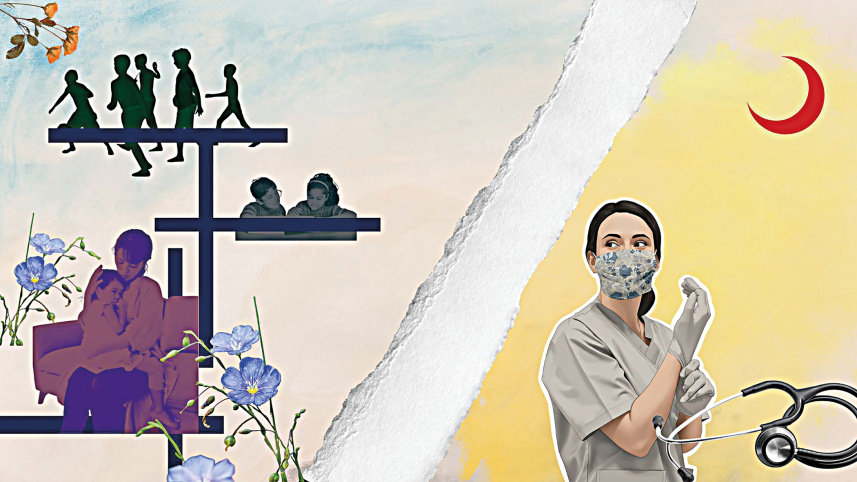
For many of these children, the concept of a “normal” 9-to-5 parent didn’t exist. Instead, they were “trained” from infancy to handle the sudden absence of a mother or father.
“My mom used to go on duty very early in the morning. I gradually got used to it,” says Tabassum Reza Dewan, now a doctor herself. “I was trained for that from a very early age. I understood that she was doing something very important. That’s why I convinced myself that her leaving in the morning was more important than her staying home.”

Saima Ahmed Joya, an architect, shares a similar sentiment of mental preparation. “Actually, my mother managed everything very beautifully, we were mentally prepared that she had to go for such emergency work. Knowing my mother was involved in something so good, helping people, made us feel proud from childhood.”
However, this preparation didn’t always mask the sting of a parent’s absence. For Abrar Ahmed, a Computer Science student at IUB, the earliest memories are colored by the heartbreak of separation. “My mom would take me to class, and she would be with me for some while and then leave for work. I cried whenever she left.”
The Siren and the Sacrifice
The pager or the ambulance siren often stole precious family time. Children of doctors often struggled with the feeling of sharing their parents with the world. Abrar notes candidly that “When my mother would work night shifts during my childhood, it made me feel like the patients were more important than me.”
Tabassum recalls the visceral fear associated with the job. “Sometimes I used to be scared when she’d go on night shifts, an ambulance with a siren would come to pick her up. Seeing the ambulance and her leaving at night made me feel afraid for her.” Even when the parents returned, the hospital followed them home. “When she’d return with an anxious face, I’d be scared,” Tabassum remembers.
How does a doctor-parent manage?
From grandmothers to nannies, the “extended” family is what kept the household running. “Our grandmother would come stay with us, or we went to my aunt’s house,” says Saima. Tabassum adds that her grandmother was her primary caregiver. For Abrar, it was the househelps who filled the gaps, though he notes he didn’t feel lonely because other family members were present to take care of me.
Pride Overcomes All
Despite the missed moments, a deep sense of awe prevails. Abrar reflects, “I feel proud and so happy for everything she has accomplished. I feel relieved that all those sacrifices paid off.” Saima echoes this gratitude, noting, “Knowing my mother was involved in something so good, helping people made us feel proud from childhood. We never felt bad about her leaving. She balanced things so perfectly.” Ultimately, life as a doctor’s child is a lesson in empathy, the realisation that a missed bedtime story often means a better ending for someone else’s life.
 For all latest news, follow The Daily Star's Google News channel.
Comments