


Iraq's move catches US 'by surprise'
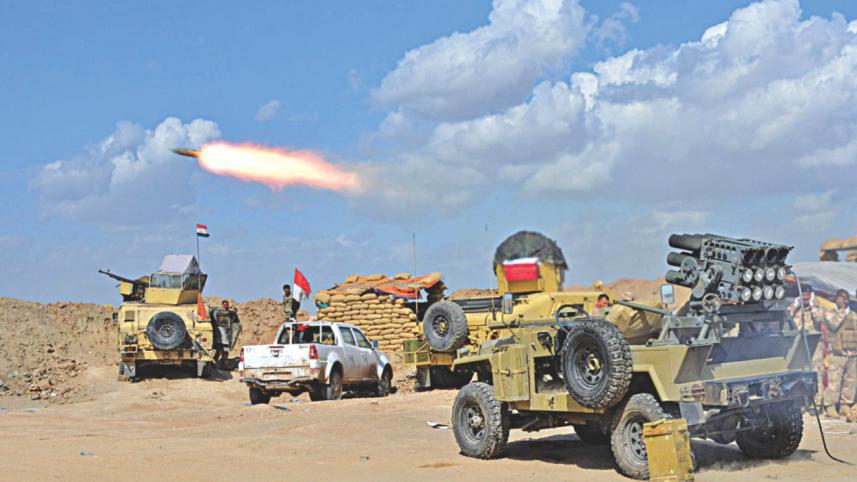
The Iraqi military launched a major campaign to take back a key city from the self-proclaimed Islamic State over the weekend—a move that caught the US "by surprise," in the words of one American government official.
The US-led coalition forces that have conducted seven months of airstrikes on Iraq's behalf did not participate in the attack, defense officials told The Daily Beast, and the American military has no plans to chip in.

Instead, embedded Iranian advisors and Iranian-backed Shia militias are taking part in the offensive on the largely Sunni town, raising the prospect that the fight to beat back ISIS could become a sectarian war.
The news is the latest indication that not all is well with the American effort against the terror group. On Friday, US defense officials told The Daily Beast that a planned offensive against the ISIS stronghold of Mosul had been indefinitely postponed after Iraqi officials argued that the timing was theirs to decide. Over the weekend, an American-backed rebel group in Syria announced that it was dissolving, and joining an Islamist faction.
Then there was the unexpected battle for Tikrit. Over the weekend, a reported 30,000 troops and militiamen—mostly Shias —stormed the Sunni dominated city of Tikrit, former Iraqi President Saddam Hussein's hometown and the symbolic birthplace of his three decades of repressive practices against the majority Shiapopulation.
US officials were largely left in the dark of the planning and timing of the operation, defense officials said. The Pentagon said Monday it was not conducting airstrikes in support of the Tikrit offensive because the Iraqi government did not ask for such help.
The US had seen the prospect of strikes in Tikrit for a while but the timing and nature of the attack "caught us by surprise," one government official explained to The Daily Beast.
The Iraqi decision to cut out the US-led coalition turned the war against ISIS in Iraq into a dual track approach—one carried out by the US-led coalition another directed by the Iranians. Each has its own military strategy.
And there were several reports that Maj Gen Qassem Soleimani, the shadowy commander of the Iranian Revolutionary Guards' overseas operation arm is also on the ground near Tikrit.
"As long as the Iranians perceive that what we're doing comports with their objectives—which is eliminating ISIL—we're on a parallel course there," Director of National Intelligence James Clapper told an audience at the Council on Foreign Relations in New York on Monday.
There are already fears that the Iraqi effort, backed by their Iranian supporters, will decimate parts of the city, defense officials said. Such actions would have great symbolic effect and make it increasingly unlikely of mending sectarian tensions between the minority Sunnis and their Shia-dominated government.
"This is a real bellweather," said a second defense official. "If this becomes a sectarian battle, we will shift to simply counter terrorism, and away from training Iraqi forces. And the coalition will come apart."
On the ground, Iraqi forces closed in on Tikrit yesterday, their progress slowed by jihadist snipers and booby traps.
The recapture of Tikrit is of both strategic and symbolic importance.
Military commanders have said Tikrit is a stepping stone for an even more ambitious operation aimed at retaking Mosul, the large northern city which has been the main Iraq hub of ISIS.
 For all latest news, follow The Daily Star's Google News channel.
Comments