


China intimidating neigbours: Mattis
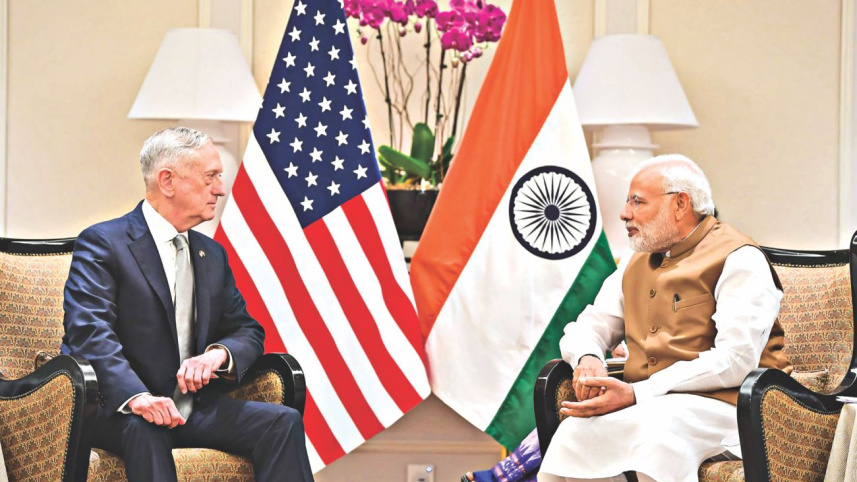
♦ US willing to work with China on a 'result-oriented' relationship
♦ US troops presence in S Korea will not be discussed in Trump-Kim meet

The United States is willing to work with China on a "results- oriented" relationship, but Beijing's actions in the South China Sea were coercive and the Pentagon would "compete vigorously" if needed, US Defense Secretary Jim Mattis said yesterday.
The comments by Mattis, speaking at the annual Shangri-La Dialogue in Singapore, come at a time of increased tension between the two nations in the South China Sea and highlight how President Donald Trump's administration is looking to balance China's cooperation on North Korea while dealing with its activities in the disputed sea.
"China's policy in the South China Sea stands in stark contrast to the openness that our strategy promotes, it calls into question China's broader goals," said Mattis, who said he would be travelling to Beijing this month.
"The US will continue to pursue a constructive, results-oriented relationship with China, cooperation whenever possible will be the name of the game and competing vigorously where we must ... of course we recognise any sustainable Indo-Pacific order has a role for China," he said.
Last month, China's air force landed bombers on disputed islands and reefs in the South China Sea as part of a training exercise, triggering concern from Vietnam and the Philippines.
Satellite photographs taken on May 12 showed China appeared to have deployed truck-mounted surface-to-air missiles or anti-ship cruise missiles at Woody Island in the disputed sea.
"Despite China's claims to the contrary, the placement of these weapon systems is tied directly to military use for the purposes of intimidation and coercion," Mattis said.
He Lei, the head of the Chinese delegation to the dialogue, said the islands were Chinese territory and it was "a sovereign and legal right for China to place our army and military weapons there."
"We see any other country that tries to make noise about this as interfering in our internal affairs," said He, who is deputy president of the Academy of Military Sciences at the People's Liberation Army.
Mattis acknowledged that China's militarisation of islands was a reality but warned of further consequences.
"I believe there are much larger consequences in the future when nations lose the rapport of their neighbours ... eventually these (actions) do not pay off," Mattis said.
He also reiterated that the Pentagon was committed to working with Taiwan to provide articles and services needed for its self defence, comments that are likely to anger China.
Trump said on Friday an unprecedented nuclear arms summit with North Korean leader Kim Jong Un that the United States pulled out of will now go ahead as scheduled on June 12 in Singapore, adding another twist to a high-stakes diplomatic dance.
Mattis only made a glancing reference to North Korea, reiterating that it was a diplomatically led effort and the objective remained the "complete verifiable, and irreversible denuclearisation of the Korean Peninsula."
He added that the status of US troops in South Korea was not on the table when Trump and Kim meet, but left the door open to the issue being discussed down the road between Seoul and Washington if certain conditions were met.
Mattis also sought to calm nervous allies in the region.
"Make no mistake, America is in the Indo-Pacific to stay, this is our priority theatre, our interests and the region's are inextricably intertwined," he said.
 For all latest news, follow The Daily Star's Google News channel.
Comments