


N Korea stokes Japan's fury
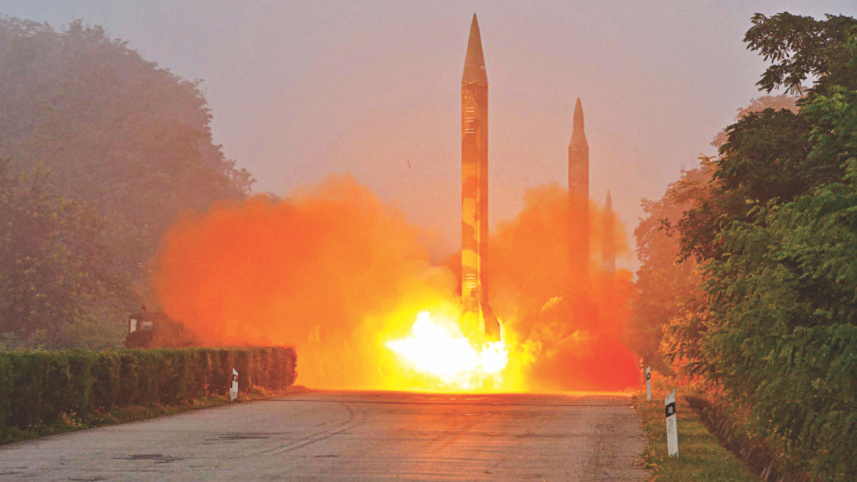
North Korea fired a ballistic missile directly into Japanese-controlled waters for the first time yesterday, drawing an outraged response from Tokyo and ramping up tensions with the United States and South Korea.
The US military said the North had actually launched two Rodong intermediate-range missiles simultaneously, but one appeared to have exploded on take-off.

The launches followed a North Korean threat of "physical action" over the planned deployment of a sophisticated US anti-missile system in South Korea, and came just weeks before the start of large-scale, joint South Korea-US military exercises.
Japan said the one missile had landed in the Sea of Japan, some 250 kilometres (155 miles) off its northern coast and within the country's Exclusive Economic Zone (EEZ).
"It's a serious threat against our country's security," Prime Minister Shinzo Abe told reporters. "This is an outrageous act that cannot be tolerated."
The United States condemned what it called a clear violation of UN Security Council resolutions explicitly prohibiting North Korea's use of ballistic missile technology.
US Strategic Command said the two missiles were launched from a site in western North Korea at around 7:50am Seoul time.
It was the first time a North Korean missile has been fired direct into Japanese waters. Japan's top government spokesman Yoshihide Suga slammed Pyongyang for providing no advance warning of the test.
The Rodong is a scaled-up Scud variant with a maximum range of around 1,300 kilometres (800 miles).
Pyongyang has conducted a series of missile tests this year in defiance of UN sanctions imposed after its fourth nuclear test in January.
On July 19 it launched three ballistic missiles -- including one Rodong -- in an exercise that the North said simulated a nuclear strike on the South.
That came just days after Washington and Seoul announced an agreement to deploy the US Terminal High Altitude Area Defence, or THAAD, system in South Korea by the end of next year -- a move condemned by Pyongyang and also vehemently opposed by China and Russia.
 For all latest news, follow The Daily Star's Google News channel.
Comments