Historical glimpses of Eid processions in Dhaka
In the nineteenth century, three processions—Eid, Muharram, and Janmashtami—were particularly prominent in Dhaka. These processions often transcended strict religious boundaries and became occasions for broader communal celebration and social interaction. In this context, the Eid procession in Dhaka was not merely a religious event; rather, it functioned as a social gathering, a cultural festival, and the vibrant pulse of the city.
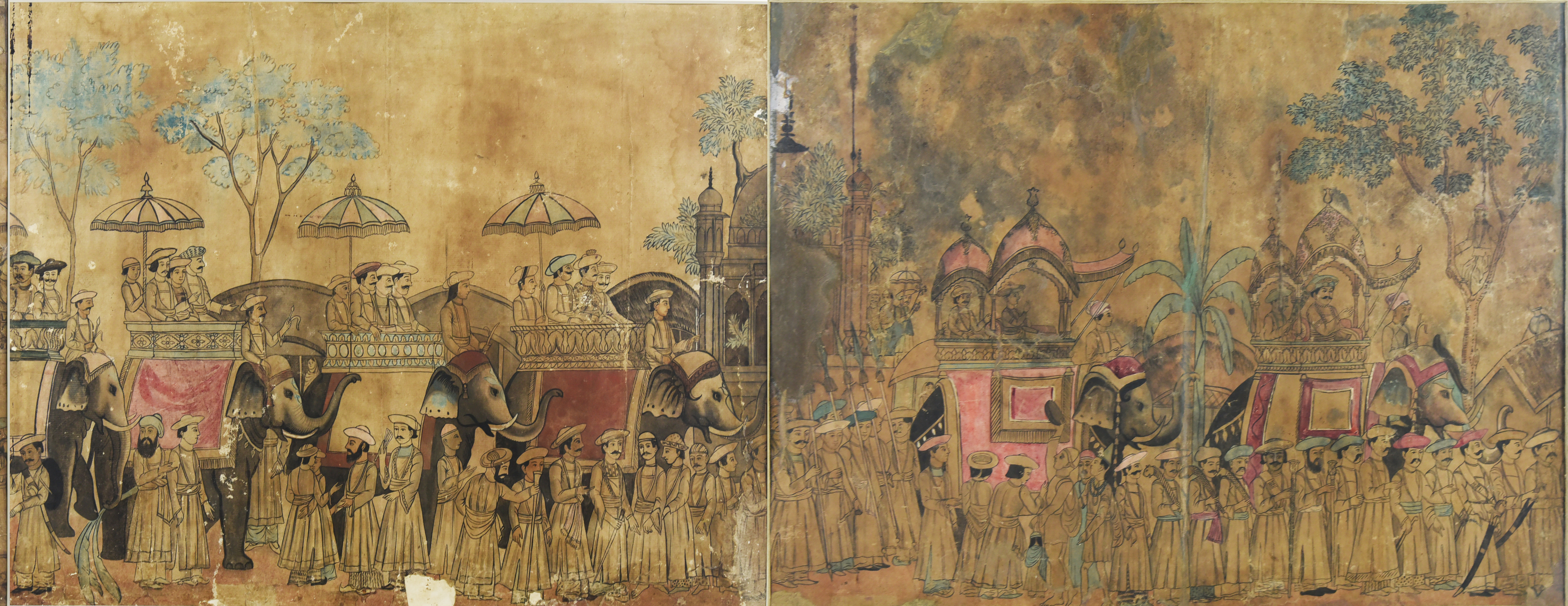
Historically, the Eid procession can be traced in the paintings of the artist Alam Musawwir. In the first half of the nineteenth century, he painted thirty-nine images of Dhaka’s Eid and Muharram processions, which are now preserved in the Bangladesh National Museum. The paintings depict the grandeur of the Nawabi-era procession: elephants, camels, palanquins adorned with colourful canopies, and vibrant banners. The Naib-Nazims occupied the front rows, while spectators lined both sides of the streets and rooftops. Among them were locals, Mughals, and English gentlemen. Fakirs and street performers were also present.
However, the exact date of the procession's beginning remains unknown. The Naib-Nazims likely initiated it after taking residence in the Nimtali Palace in the eighteenth century. The Nawabs may have drawn inspiration from Dhaka’s famous Janmashtami procession and started this event to display their authority and grandeur during Eid. It is also unclear when the Eid procession ended in Dhaka; however, based on the watercolours of Alam Musawwar, it probably ceased in the mid-nineteenth century after the decline of the Naib-Nazim lineage, as organising such events without wealthy patronage became difficult.
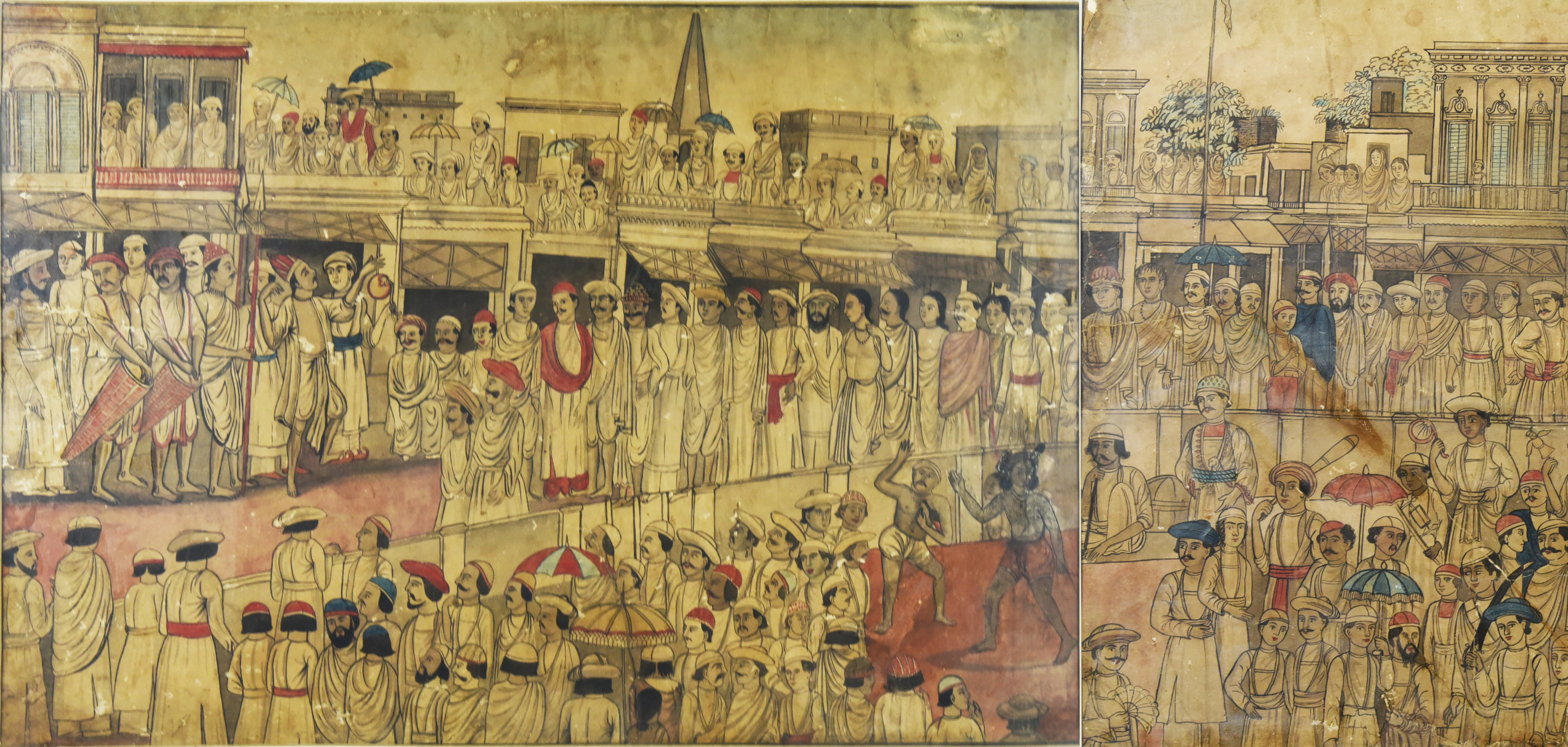
Syed Ali Ahsan gave lively accounts of the Dhaka Eid processions in the early 20th century. The main venue for the Eid procession was the present stadium area and the surrounding grounds. From early morning, men from different areas, dressed in new clothes, arrived with drums for the procession. They placed their banners outside the designated enclosure for the imam. Large processions came from Churihatta, Banshal, and Nawabpur. The most beautiful and organised procession came from Salimullah Muslim Hall. Muslim students and teachers of Dhaka University, led by Dr. Hasan, raised flags and marched to the Eidgah ground. Dr. Hasan walked at the front of the procession wearing white pyjamas, a white sherwani, and a white turban. Participants shouted “Allahu Akbar” in unison.
On Eid morning, Hindu and Christian spectators stood along the roads, and foreign visitors in Dhaka rushed to take photographs of the procession. Eid prayers were held at three locations: the largest at Purana Paltan, the second at Lalbagh Shahi Mosque, and the third at Chawkbazar Mosque. Fairs were organised across the city on Eid day and the following day. The tradition of stick fighting was widespread, and trained fighters gave demonstrations in akharas. One person could defend against multiple attacks. Additionally, there was a social custom of carrying food from one house to another in decorated containers.
James Wise noted, “Just as Hindu landlords contributed financially during Muharram, Muslim landlords also assisted during Durga Puja.” From the mid- to late nineteenth century, Bengalis were not overly concerned with religious identity. Religious festivals were not only religious events but also joyous social gatherings. In the late British period, the seeds of religious fanaticism, division, and mutual suspicion were sown, mainly due to the ‘Divide and Rule’ policy.
The social and cultural impact of the Eid procession was particularly significant. During the procession, people temporarily set aside their daily work, social differences, and economic disparities to come together. It symbolised the city’s social cohesion and unity. In 1947, before the Partition of India, a tragic incident occurred in Nawabpur during the Pakistan movement. Nazir Hossain noted that on Nawabpur Road, bricks, wooden planks, benches, and heavy furniture rained down from Hindu houses over two days, injuring many Muslims. According to Mohammad Abdul Qayum, the police used tear gas, likely for the first time in Dhaka. Despite this, municipal chairman Bimala Nand Dashgupta, Dr. Mohini Babu Bachensi, and Dhaka Commissioner Larkin participated in the procession.
Eid and Janmashtami processions were, at times, affected by communal riots. Tensions arose when the Janmashtami procession passed near mosques during prayer times or Holi celebrations. James Wise noted, “Just as Hindu landlords contributed financially during Muharram, Muslim landlords also assisted during Durga Puja.” From the mid- to late nineteenth century, Bengalis were not overly concerned with religious identity. Religious festivals were not only religious events but also joyous social gatherings. In the late British period, the seeds of religious fanaticism, division, and mutual suspicion were sown, mainly due to the ‘Divide and Rule’ policy.
The Eid processions of 1952 and 1953 often presented political and social issues satirically. The procession was not only a festival of joy but also a platform for political and social critique. Since 1947, processions have gradually become a means for individual, group, and administrative criticism. According to reports of the 1952 procession, participating akharas humourously highlighted politics, corruption among government employees, municipal inefficiency, and international issues such as the Kashmir crisis. Two decorated elephants led the procession, and through various neighbourhood and club akharas, government corruption, social disorder, and economic irregularities were satirised. In 1953, the procession stretched nearly one mile and lasted three and a half hours, with police providing security.
Through colourful placards and creative decorations, participants from the front ranks to the general public actively observed and critiqued the city’s ongoing social and political conditions. The procession functioned as a symbol of civic awareness alongside celebration. In 1954, due to communal riots, political unrest, and security concerns, the Dhaka District Magistrate suspended the Eid procession. It was not held for the next 42 years. In 1991, some organisations in Hazaribagh began small, fragmented processions. In 1994, under the supervision of Nazir Hossain Nazir, the ‘Eid Joy Procession’ was reestablished. Youth from 30 neighbourhoods of Dhaka participated, with decorated placards, band parties, horse carts, stick fighting, embroidered songs, and traditional costumes.
In 2000, the Dhaka Association organised the first grand Eid Joy Procession of the new millennium. Thousands from 17 neighbourhoods and organisations participated spontaneously. Local administrators were present, and children enjoyed rides, traditional food, and band performances.
In the early years of the last decade, Eid processions resumed in Dhaka, but due to a lack of patronage and the challenge of keeping up with changing times, the tradition of Old Dhaka’s Eid processions has nearly vanished. In 2025, Dhaka North City Corporation organised Eid prayers, joy processions, cultural programmes, and fairs. Citizens of the city participated, reviving the tradition.
The Eid procession is not merely a religious event; it temporarily erases social, cultural, and economic differences in the city. Rich or poor, high or low, young or old—everyone participates, and neither daily routines nor social status affects participation. All come together to celebrate, making it a symbol of the city’s cohesion and solidarity.
Anjuman Ara is an MA sociology student at the South Asian University, New Delhi.
Send your articles for Slow Reads to slowreads@thedailystar.net. Check out our submission guidelines for details.
The Yellow Butterfly: How Sheba shaped my world growing up
What Bangladesh’s historic Test victory in Australia means for Bangladeshi-Australians
Remembering Sumit Sarkar, a historian who questioned orthodoxy
The unfinished histories of Partition
In conversation with William Dalrymple / ‘Britain didn't conquer India’
Sheikh Mujib’s killing: What the newspapers told and what they omitted
Mirrors of Empire / The bureaucrats and intellectuals who shaped the Mughal Empire
To feel Bengali, to think beyond Bengal: Dipankar Gupta in conversation
Bangladesh's visual history / The enduring allure of vintage photographs