


'Remorseful' for aggression
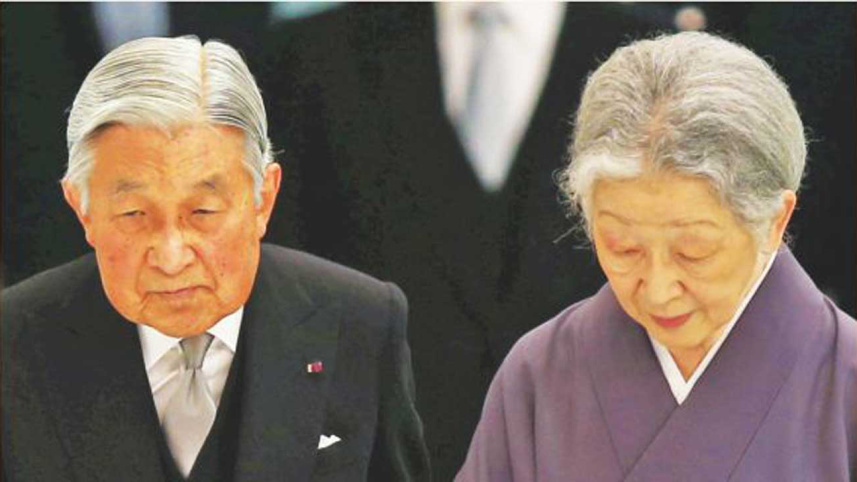
Japanese Emperor Akihito yesterday, for the first time, expressed "deep remorse" over Japan's role in World War Two.
He was speaking at a ceremony to mark 70 years since his country surrendered.

Further straining relations, a trio of cabinet ministers visited the controversial Yasukuni shrine -- which neighbouring countries see as a symbol of Tokyo's militarist past -- prompting China to voice its "strong dissatisfaction".
The memorial services marking the day Japan surrendered to the Allies in 1945 come after Abe on Friday delivered a closely watched speech that expressed regret -- but also said future generations need not apologise for Japan's war record.
His remarks were welcomed by the US but blasted by China as a non-apology, while Pyongyang derided it as "an unpardonable mockery of the Korean people".
South Korean President Park Geun-Hye said his remarks "left much to be desired" and stressed the need for Japan to resolve the long-simmering issue of Asian women forced to work as sex slaves in Japanese military brothels.
However the Philippines, another wartime foe, said it had rebuilt a "strong friendship" with Tokyo.
Britain applauded the statement, while Australian leader Tony Abbott said Abe's remarks "should make it easier for other countries to accept Japan's commitment to a better future for all".
Emperor Akihito struck a more apologetic tone than Abe, with an expression of remorse for the nation's wartime aggression.
"I attend this memorial ceremony with a deep and renewed sense of sorrow... I earnestly hope that the ravages of war will never be repeated," he added.
Some Japanese media said it was the first time the 81-year-old had used those words at the annual memorial.
At the memorial service in Tokyo on Saturday, Abe and Emperor Akihito observed a minute's silence.
A service was also held at the US naval base of Pearl Harbor, where the conflict began in the Pacific. More than 2,000 people were killed in the surprise Japanese attack in 1941, which drew the US into the war.
 For all latest news, follow The Daily Star's Google News channel.
Comments