


US, China on collision course
US seeks more support, action from Asian allies; China says US threatening 'chaos' in Asia-Pacific
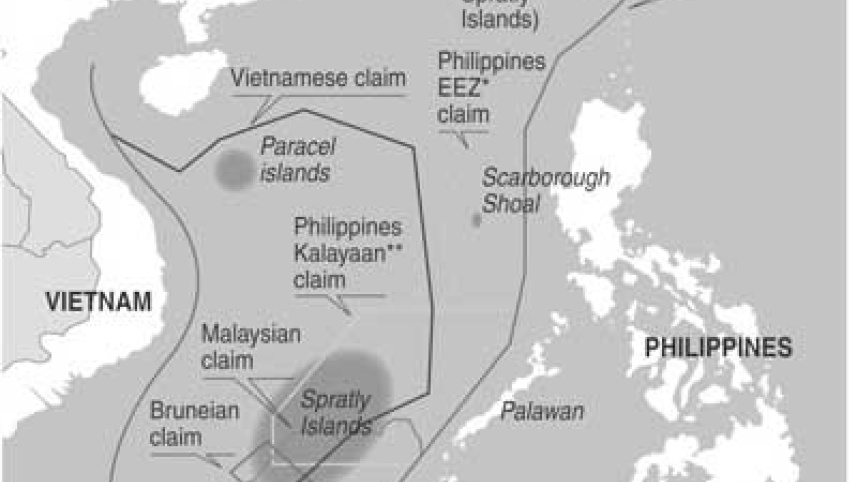
China yesterday accused the United States of threatening to sow "chaos" in the Asia-Pacific region by inciting countries whose territorial claims in the South China Sea clash with those of Beijing.
It is the latest round in a war of words over the area, where tensions are mounting and rhetoric escalating.

China is rapidly building artificial islands in the disputed waters, and US Defense Secretary Ashton Carter on Wednesday demanded an "immediate and lasting halt to land reclamation by any claimant".
Beijing's foreign ministry spokeswoman Hua Chunying told a regular briefing: "If the major powerhouse of world economic growth is thrown into chaos, will that serve the interests of the American side?"
The countries that make up the Asia-Pacific Economic Cooperation forum account for more than 50 percent of global GDP and nearly half of world trade.The South China Sea is a major shipping route for international trade.
Beijing insists it has sovereignty over nearly all of the South China Sea, including waters far from the Chinese mainland and near the coasts of the Philippines, Vietnam and other Asian neighbours.
Hua told Washington to "refrain from all the provocative words and deeds".
"A few countries keep stirring up troubles in the South China Sea for (their) own selfish gains and provoking China's territorial sovereignty and maritime rights and interests, while there are some other people who incite them to do so," she added.
Carter made his remarks in Hawaii as he prepared to embark on an Asian tour. It is his second tour of the region since taking over at the Pentagon in February and his itinerary includes Singapore, Vietnam and India.
Carter will hold the annual Shangri-La Dialogue in Singapore with China which is set to be overshadowed by the tensions in the South China Sea, where Beijing has added 1,500 acres to five outposts in the resource-rich Spratly islands since the start of this year.
"These countries need to own it (the issue)," one US defense official said on condition of anonymity, adding that it was counterproductive for the United States to take the lead in challenging China over the issue.
More unified action by the partners, including the 10-member Association of Southeast Asian Nations (Asean), needed to happen soon because "if you wait four years, it's done," the official said.
While some Asean members, including US ally the Philippines and fellow claimant Vietnam, have been vocal critics of Chinese maritime actions, the group as a whole has been divided on the issue and reluctant to intervene.
But in a sign of growing alarm, the group's leaders last month jointly expressed concern that reclamation activity had eroded trust and could undermine peace in the region.
Experts dismiss the idea of Asean-level joint action any time soon in the South China Sea. "It's absolute fantasy," said Ian Storey of Singapore's Institute on South East Asian Studies.
But stepped-up coordination between some states is possible.
China claims 90 percent of the South China Sea, which is believed to be rich in oil and gas, with overlapping claims from Brunei, Malaysia, the Philippines, Vietnam and Taiwan.
US officials have said Navy ships may be sent within 12 miles of the Chinese-built islands to show that Washington does not recognize Beijing's insistence that it has territorial rights there.
Washington is also pressing ahead with its rebalancing towards Asia, four years after President Barack Obama announced the strategic shift, even as some countries say it is slow to take shape.
The United States has updated its security agreements with treaty allies Japan and the Philippines and is bolstering missile defenses in Japan with an eye on North Korea.
 For all latest news, follow The Daily Star's Google News channel.
 Overall, defense officials said, the Navy will increase its footprint by 18 percent between 2014 and 2020. The aim is to have 60 percent of Navy ships oriented toward the Pacific by 2020, compared to 57 percent currently.
Military officials in the Philippines say the US shift has been noticeable, including military exercises, training and ship and aircraft visits. The emphasis has shifted from anti-terrorism to maritime security, one official said.
Comments