


New Scotland referendum 'highly likely': Sturgeon
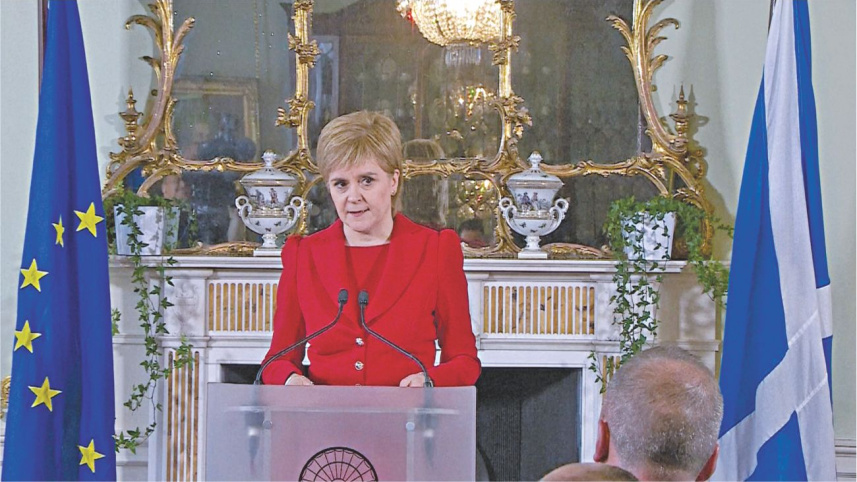
A second Scottish independence referendum is "highly likely", First Minister Nicola Sturgeon said on Friday, raising the prospect that the United Kingdom could tear itself apart after voting to leave the European Union.
Scotland, a nation of five million people, voted decisively to stay in the EU by 62 to 38 percent in a referendum on Thursday, putting it at odds with the United Kingdom as a whole, which voted 52-48 in favour of an exit from the EU, or Brexit.

"As things stand, Scotland faces the prospect of being taken out of the EU against her will. I regard that as democratically unacceptable," Sturgeon told a news conference in Edinburgh.
"I think an independence referendum is now highly likely."
A vote for independence would end the 300-year-old union between Scotland and England, its far bigger southern neighbour, dealing a body blow to the United Kingdom at a time when it is likely to still be dealing with the complex fallout from Brexit.
Meanwhile, Northern Ireland's Deputy First Minister Martin McGuinness has called for a border poll on a united Ireland, after the UK has voted to leave the EU.
Support for the EU is considerably higher in Northern Ireland than the rest of the UK.
As the region shares a land border with the Republic of Ireland, it is unknown how the relationship between the two countries will be affected by Brexit.
Scots rejected independence by 55 to 45 percent in a 2014 referendum, but since then Sturgeon's pro-independence Scottish National Party (SNP) has become much more powerful.
EU membership was one of the key issues in 2014, with those campaigning for Scotland to stick with the United Kingdom arguing that an independent Scotland would not be able to remain a member of the bloc.
Nevertheless, calling a new independence vote would not be straightforward and the SNP, tempered by caution since Sturgeon took over as leader from firebrand Alex Salmond, would want to first be sure that it would win.
Where the last independence campaign fell down is widely considered to be the economic argument. An independent Scotland would, it was projected at the time, stick with its old currency, Britain's pound, with national finances underpinned by an oil price then over $100 but now roughly half that level.
Sturgeon would have to build a robust economic independence strategy to convince those who in 2014 were emotionally inclined to leave the UK but voted to stay in because of the economics.
 For all latest news, follow The Daily Star's Google News channel.
Comments