


Putin points finger at US
Russia had nothing to do with a massive global cyberattack, President Vladimir Putin said yesterday, criticising the US intelligence community for creating the original software.
Hundreds of thousands of computers in more than 150 countries have been hit by the ransomware attack, which has been described as the largest-ever of its kind.

It began Friday and struck banks, hospitals and government agencies among a variety of other targets, exploiting known vulnerabilities in older Microsoft computer operating systems.
"As for the source of these threats, Microsoft's leadership stated this directly, they said the source of the virus was the special services of the United States," Putin said.
He was referring to a weekend blog post by Microsoft president Brad Smith stating that the US National Security Agency had developed the code being used in the attack.
It was leaked as part of a document dump, according to researchers.
"A genie let out of a bottle of this kind, especially created by secret services, can then cause damage to its authors and creators," Putin said on the sidelines of an international summit in Beijing.
"This completely doesn't concern Russia."
The US has accused Russia in the past of mounting several cyberattacks.
The cross-border police agency Europol said yesterday the situation was now "stable", defusing concerns that attacks that struck computers in British hospital wards, European car factories and Russian banks would spread further at the start of the working week.
"The number of victims appears not to have gone up and so far the situation seems stable in Europe, which is a success," senior spokesman for Europol, Jan Op Gen Oorth, told AFP.
"It seems that a lot of internet security guys over the weekend did their homework and ran the security software updates," he said.
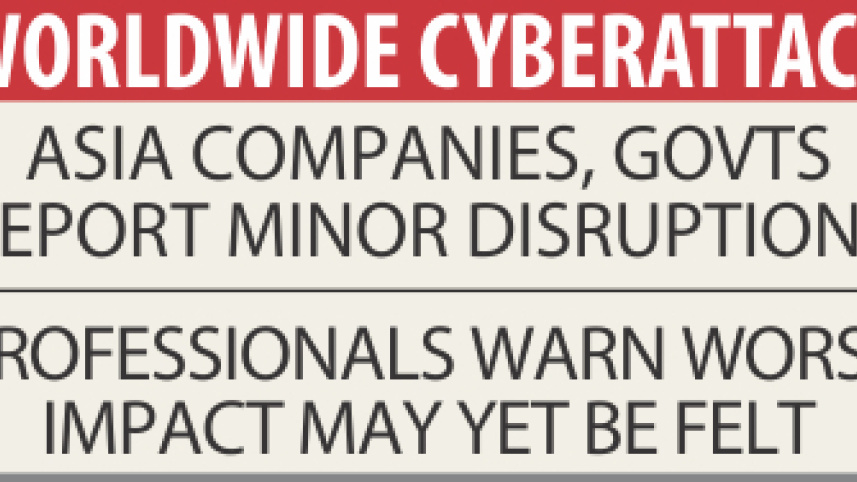
Meanwhile, Asian governments and businesses reported some disruptions from the WannaCry ransomware worm yesterday but cybersecurity experts warned of a wider impact as more employees turned on their computers and checked e-mails, reported Reuters.
"Most of the attacks are arriving via e-mail, so there are many 'landmines' waiting in people's in-boxes," said Michael Gazeley, managing director of Network Box, a Hong Kong-based cybersecurity company.
 For all latest news, follow The Daily Star's Google News channel.
Comments