


Japan 'expands military's role'
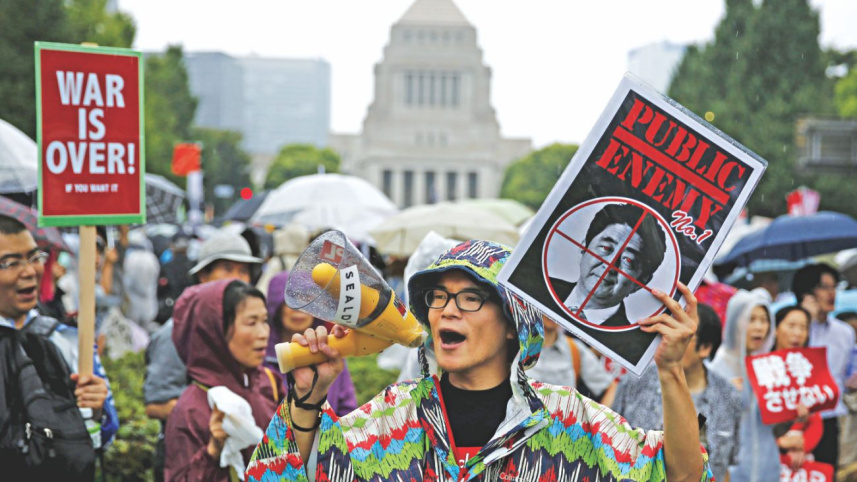
Japan's parliament yesterday voted into law a defence policy shift that could let troops fight overseas for the first time since 1945, a milestone in Prime Minister Shinzo Abe's push to loosen the limits of the pacifist constitution on the military.
China reacted strongly, accusing Tokyo of threatening regional peace, saying that its rival should learn "profound lessons from history".

Japan's ruling coalition, led by nationalist Prime Minister Shinzo Abe, pushed the laws through in the early hours yesterday after days of tortuous debate that at times descended into physical scuffles in parliament.
For the first time in 70 years, the new laws will give the government the power to send the military into overseas conflicts to defend allies, even if Japan itself is not under attack.
China's defence ministry yesterday said the reforms had "aroused grave concern among its own citizens, Asian neighbouring countries and the international society," state media reported.
A Xinhua editorial added that Japan's new security bills "not only broke Japan's promise to the world after World War II, but also betrayed its own people".
Japan's nationalist premier has argued the laws are necessary to protect against threats from what it views as an increasingly belligerent China and unstable North Korea, but opponents fear the vague wording could see Japan dragged into far-flung foreign wars.
But South Korea also called on Japan to remember the need for transparency in implementing its new defence policy "while maintaining the spirit of the pacifist constitution," its foreign ministry said in a statement cited by the Yonhap news agency.
Abe has faced bitter opposition at home over the changes, which have seen his popularity slump, and opposition lawmakers have vowed to do everything in their power to fight them.
"This is not an end," said Renho, a senior lawmaker from the main opposition Democratic Party of Japan, who goes by one name.
"Let's make it the beginning of the beginning," she said on Twitter.
Mizuho Fukushima, a senior lawmaker from the Social Democratic Party, told a crowd of more than ten thousand who gathered outside parliament during the debate: "Abe's cabinet criminals... Let's get them out of here."
Speaking after the vote, Abe said the changes were "necessary in order to protect people's lives and peaceful way of life".
"This is designed to prevent wars," he told journalists.
Abe had been unable to muster support to amend the pacifist constitution and instead opted to "re-interpret" the meaning of self-defence in order to push through the new laws, but the move has sparked a groundswell of opposition not seen for decades in Japan.
A hard-core group of some 300 protesters gathered outside parliament yesterday, calling for the legislation to be abolished and vowing never to stop their fight against Abe.
Legal scholars have argued the legislation violates Japan's pacifist constitution, imposed by the US after World War II, and several groups yesterday said they were preparing to challenge the new laws.
Susumu Murakoshi, chairman of the 36,000-strong national bar association, yesterday criticised the government for going against the will of the people and pledged to see the changes abolished.
The laws have "left a black stain on the history of Japan as a constitutional democracy," he said in a statement.
 For all latest news, follow The Daily Star's Google News channel.
Comments