


Pak PM Sharif meets Obama
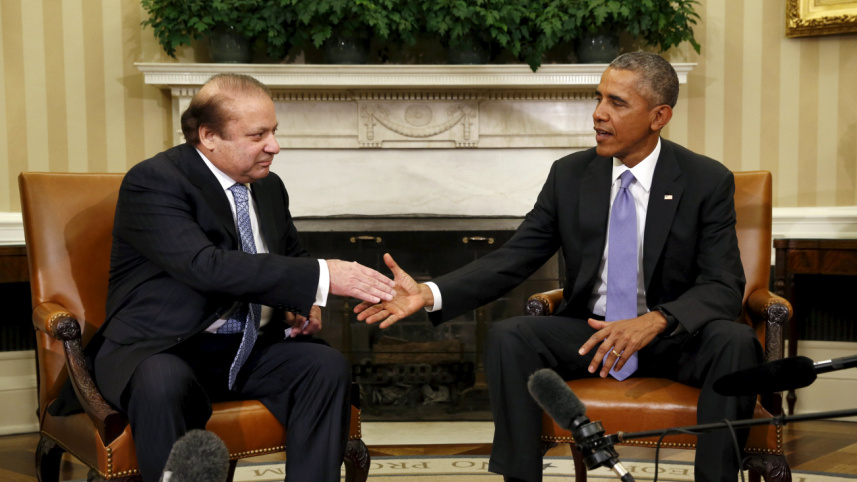
President Barack Obama yesterday pressed Pakistani Prime Minister Nawaz Sharif on ties with the Taliban, nuclear safety and a range of other fraught issues during a meet at the White House.
Despite efforts to smooth divisions behind handshakes, smiles and items of agreement, long-standing security concerns are likely to dominate the Oval Office discussions.

Islamabad's ties with the Afghan Taliban, support for terror groups that target India and the United States and its rapidly growing nuclear arsenal are seen by Washington as monumental security headaches.
The meeting comes as the White House increasingly shifts its focus in South Asia to Pakistan's bitter rival India.
But Pakistan remains a key player in the region.
Obama recently announced that US troops would be staying in Afghanistan longer than he had promised, but the White House is keen to get the Taliban to the negotiating table.
The US sees Pakistan as one of the few sources of influence over the extremists, and analysts say Washington will use the four-day trip to urge the prime minister to keep pushing for a new round of talks.
If cooperation is not forthcoming, it is likely to result in growing calls for Washington to limit the transfer of weapons and funds to Islamabad.
Washington has also pressed Pakistan to crack down on radical groups like the Haqqani network and Lashkar-e-Taiba.
Meanwhile, the Obama administration is preparing to sell eight new F-16 fighter jets to Pakistan, senior US officials said, an overture intended to bolster a tenuous partnership despite persistent concerns about Islamabad's ties to elements of the Taliban and quickly expanding nuclear arsenal.
Obama, like President George W Bush before him, is trying to balance pressure on Pakistan with signs that Washington still considers it a vital ally.
The Federation of American Scientists, a leading US group that monitors the spread of nuclear weapons, published a report on Wednesday that shows that Pakistan has expanded its arsenal to between 110 and 130 warheads, up from a range of 90 to 110 four years ago.
While those figures show a steady but expected increase, the group estimated that by 2025 the figure would rise to 220 to 250 warheads. That would make Pakistan the world's fifth largest nuclear power, behind the United States, Russia, China and France, but ahead of Britain, which is shrinking its arsenal.
 For all latest news, follow The Daily Star's Google News channel.
Comments