


The pen that pierced the purdah
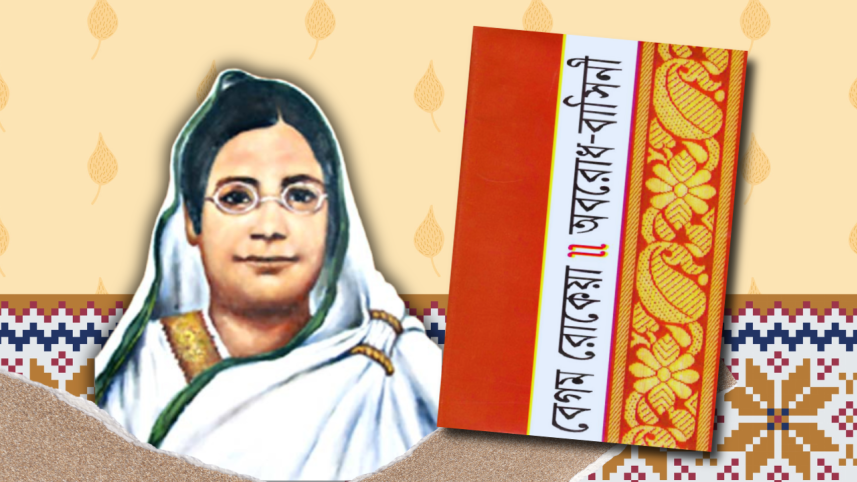
On Begum Rokeya Day, we do more than simply remember a historical figure; we associate with the spirit of a revolutionary writer. We celebrate a woman who, more than a century ago, stared down the twin fortresses of religious dogma and social norms, armed not with a sword but with a pen. Her seminal work, Oborodh Bashini, published in 1931, is often read as a critique of the oppressive purdah system. Yet, to confine it to that alone one would miss its intense literary and strategic genius. Oborodh Bashini is a monumental work in which the act of writing itself becomes an act of liberation.
Begum Rokeya Sakhawat Hossain weaponised language—using testimony, satire, and logic—not just to critique the confinement of women but to shatter this very foundation, by celebrating the voices it sought to silence, using a masterful act of defiance.
Begum Rokeya's primary weapon for this book was the power of testimony. Oborodh Bashini is a chorus of voices, a collection of stories that bring the private, invisible sufferings of the zenana (the private sphere) into the public sphere, making readers feel compassion for these women's silent pain. She fills her pages with emotional and personal testimonies and tales of women wasting away in airless rooms, denied sunlight, education, sometimes food, and dignity. This radical choice aims to stir empathy in the hearts of the audience and show them the human cost of social injustice.
One of the stories she recalls in her collection is of a woman so intellectually starved that she would secretly read the only material available to her—scraps of paper used to wrap groceries from the market. This image is more than just a story of somebody's life; it is a devastating failure of a culture that actively snatched away women's freedom of intellect. In another powerful testimony, Rokeya recounts the tale of a young girl confined within the walls of her home who only wanted to see a circus outside the window, only to be punished and have the window sealed with bamboo blinds. This story encapsulates the brutal absurdity of the social system: a child's naive observation becomes a punishable crime, and her world grows physically darker as a consequence. By meticulously documenting such claustrophobia, intellectual deprivation, and casual cruelties, Begum Rokeya forces the reader to see, to feel, and to be complicit. She was not merely describing a prison; she was, I suppose, handing the inmates of the prison a megaphone. Each story, each testimony, was a brick removed from the wall of silence that upheld the complexity of purdah. On this day, we celebrate Rokeya not just as a writer, but as a pioneer who taught us that the personal is inescapably political, and that the lived experience of the oppressed is the most powerful tool for social critique.
But how does one ensure these heartfelt testimonies are not dismissed as mere sentimental complaints? Begum Rokeya's satirical layout of stories appeals so sharply that it cuts through the false social order. Her satire dissects patriarchal absurdities with biting clarity, inspiring admiration for her cleverness and making her critique way more memorable. Her sharp humour invites the audience to respect her vision and see the system's flaws with new eyes. She masterfully employs this tool to pierce through the contradictions embedded in the practice of purdah.
One of the most biting examples is her critique of the treatment of male doctors. She highlights the absurd situation where women, secluded from all unrelated men, are forced in times of grave illness to be examined by these very men. Begum Rokeya exposes this not as devotion but as a theatrical ridicule designed to uphold a shallow form of "purity" while sacrificing actual well-being. This strategic use of humour is a mark of a superior intellect. By framing her arguments through satire, she undermined the authority of the male guardians (the "murubbis") who enforced these rules, portraying them not as wise protectors but as foolish architects of a barely unworkable social system. She engages directly with the arguments put forth by the murubbis. When they use metaphors to justify purdah, such as comparing a woman to a precious object that must be kept hidden, Rokeya counterattacks with impeccable reason. She questions the very foundation of the analogy, asking why a human being, created with intellect and soul, should be equated with an inanimate object. This was a high-stakes rhetorical gambit. By fighting the orthodoxy on its own ground, she robbed it of its primary defence. She demonstrated that the system was not only cruel and absurd but also, by its own claimed standards, fundamentally incorrect. This architectural use of logic gave her work a formidable credibility.
The ultimate triumph of Oborodh Bashini is not just a text; it is an event. In giving voice to the oborodh bashini, she ceased to be one. She implemented the solution she advocated, stepping out of the metaphorical and literary zenana to claim her space as a public intellectual and leader.
As we commemorate Begum Rokeya Day, Oborodh Bashini stands not as a relic of a bygone era but as a living blueprint for modern resistance. The stories she told are specific to a time, but the structures of silencing they represent are hauntingly familiar. The "veil" she sought to step out of was not merely representative of a cloth, but one of silence, ignorance, and intellectual submission. Her words—the testimony that validates, the satire that humiliates, and the logic that dismantles—continue to echo, reminding us that our voices, our stories, and our reason remain the most potent tools against the modern forms of confinement that persist in our society. To honour Begum Rokeya is to pick up the pen she so masterfully wielded, to continue the work of lifting every veil that dims the light of every single human potential.
 For all latest news, follow The Daily Star's Google News channel.
Nazmun Afrad Sheetol is an IR graduate and a contributor at The Daily Star. She can be reached at sheetolafrad@gmail.com.
Comments