


When the harvest rots: Bagerhat’s Boro farmers count losses after untimely rain

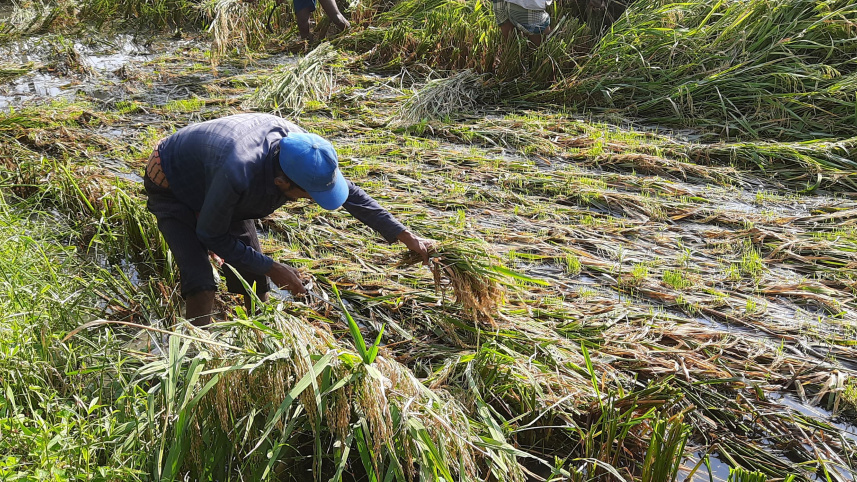
Sheikh Rustam Ali stood at the edge of his field in silence, watching workers wade through knee-deep water to salvage what little remained of his Boro crop.
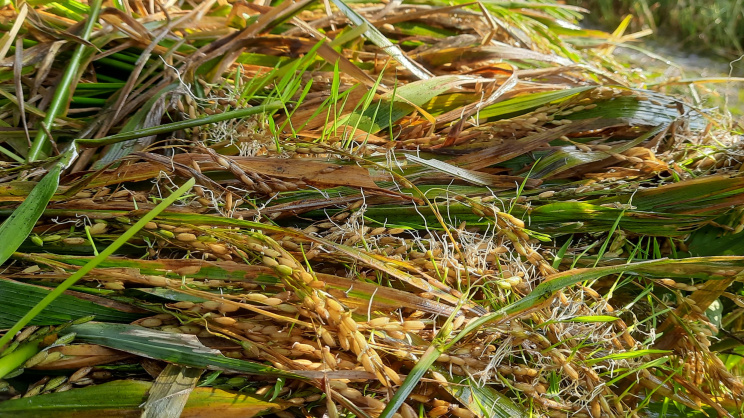
The paddy -- ripe enough for the granary just days ago -- had already sprouted green shoots while still on the stalk. The crop, which he had cultivated through loans and great hardship, is now being destroyed in the field itself.

“I spent over Tk 1.20 lakh cultivating this land,” the marginal farmer from Narendra Pur village in Bagerhat's Kachua upazila said. “Under normal conditions, harvesting and threshing would have cost me Tk 20,000 to Tk 30,000. Now I have to spend Tk 80,000 just to bring this ruined crop home.”
He paused, then added quietly: “I don't even own this land. I am facing total ruin.”
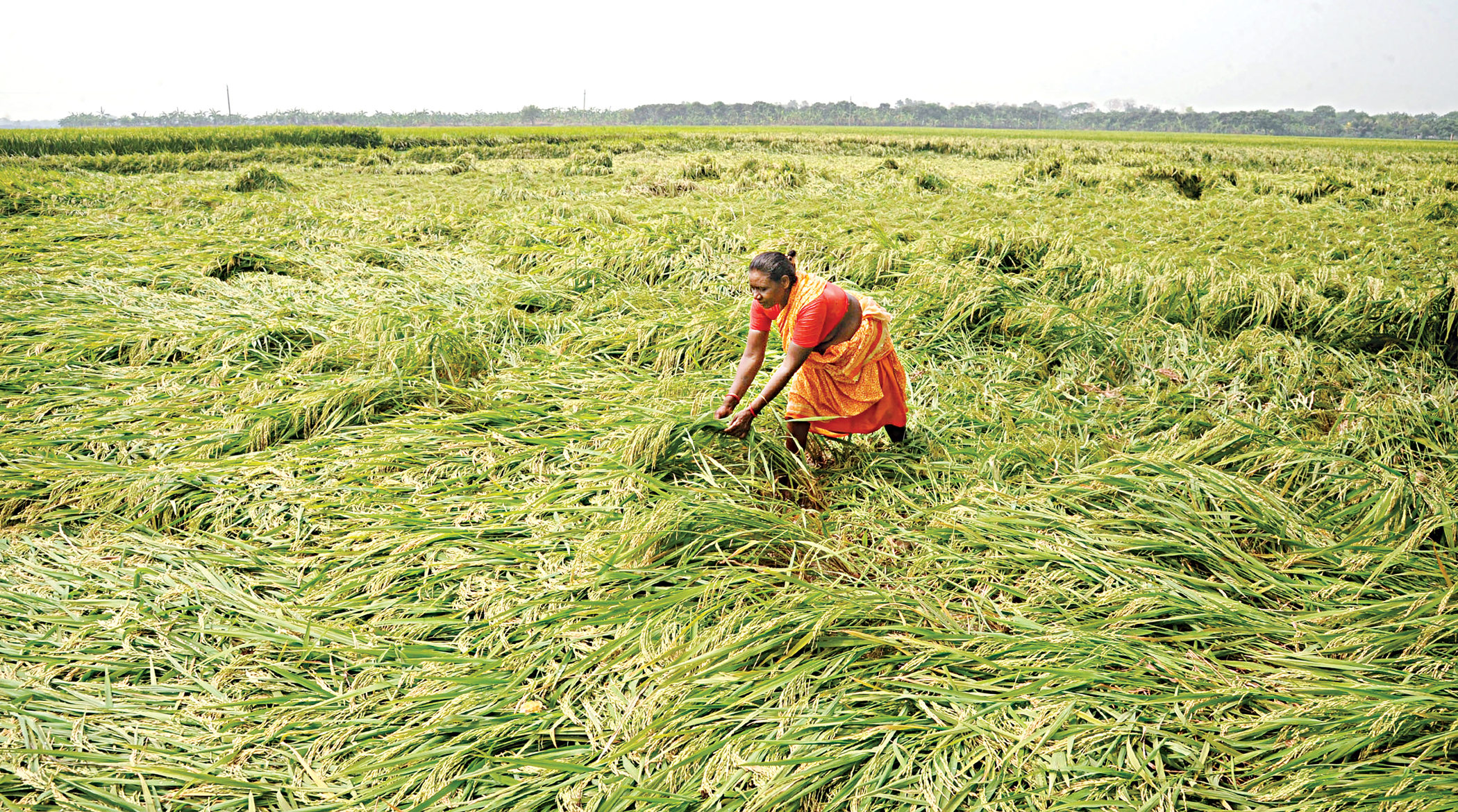
Rustam’s field is not an exception. Across Bagerhat, heavy rain and gusty winds have flattened paddy fields and left stagnant water sitting on ripe grain -- triggering widespread germination that has rendered the crop unfit for sale or consumption. What should have been the season's reward has become a liability.
In the same village, Mozaffar Molla was harvesting alongside his son, a madrasa student who had to help in the fields as hired labour had become impossible to find—even at Tk 1,000 a day. Mozaffar had leased one bigha of land for Tk 20,000, but the entire crop had already sprouted in the water.
The crisis has taken an uglier turn in Bagerhat Sadar upazila, where the damage has spilled beyond the fields. Humayun Kabir of Utkul village had planted Boro on 1.5 bighas inside his fish enclosure, or gher. Now, not only is the paddy gone -- the rotting stalks are poisoning the water.
"The paddy is gone, and the straw won't be usable either," Humayun said. "Now the shrimp and whitefish in my gher are starting to die because of the rotting plants. I've had to pull the nets early to sell whatever I can. This rain has finished us."
Even farmers who salvaged a portion of their harvest are finding little relief. Amir Hawladar harvested 80 maunds from two bighas -- but with the grain damp, buyers are offering a fraction of last year's price.
"I sold my paddy for Tk 750 per maund," Amir said. "Last year, the price was between Tk 900 and Tk 1,200. At this rate, I won't even recover my production costs."
Market prices for rain-soaked grain are currently hovering between Tk 600 and Tk 850 -- a collapse that is turning even a partial harvest into a loss.
According to the Department of Agricultural Extension, Boro was cultivated on 68,171 hectares across Bagerhat this season. Official data puts the completely destroyed area at 1,630 hectares -- but farmers say the true damage is far more widespread.
Md Motahar Hossain, deputy director of DAE Bagerhat, acknowledged the severity. "Farmers are facing a double blow of high labour wages and low market prices," he said, adding that officials were compiling a list of affected farmers.
"If the government provides any incentives or assistance in the future, these farmers will be given priority."
 For all latest news, follow The Daily Star's Google News channel.
Comments