


Tax breaks aim to revive investment

The proposed budget for FY2026-27 lays out an ambitious package of tax incentives, duty concessions and policy reforms aimed at attracting investment, diversifying industry and lowering the cost of doing business.
Analysts and business leaders, however, warn that the measures will matter only if they are implemented effectively, and the underlying factors suppressing private investment are addressed.

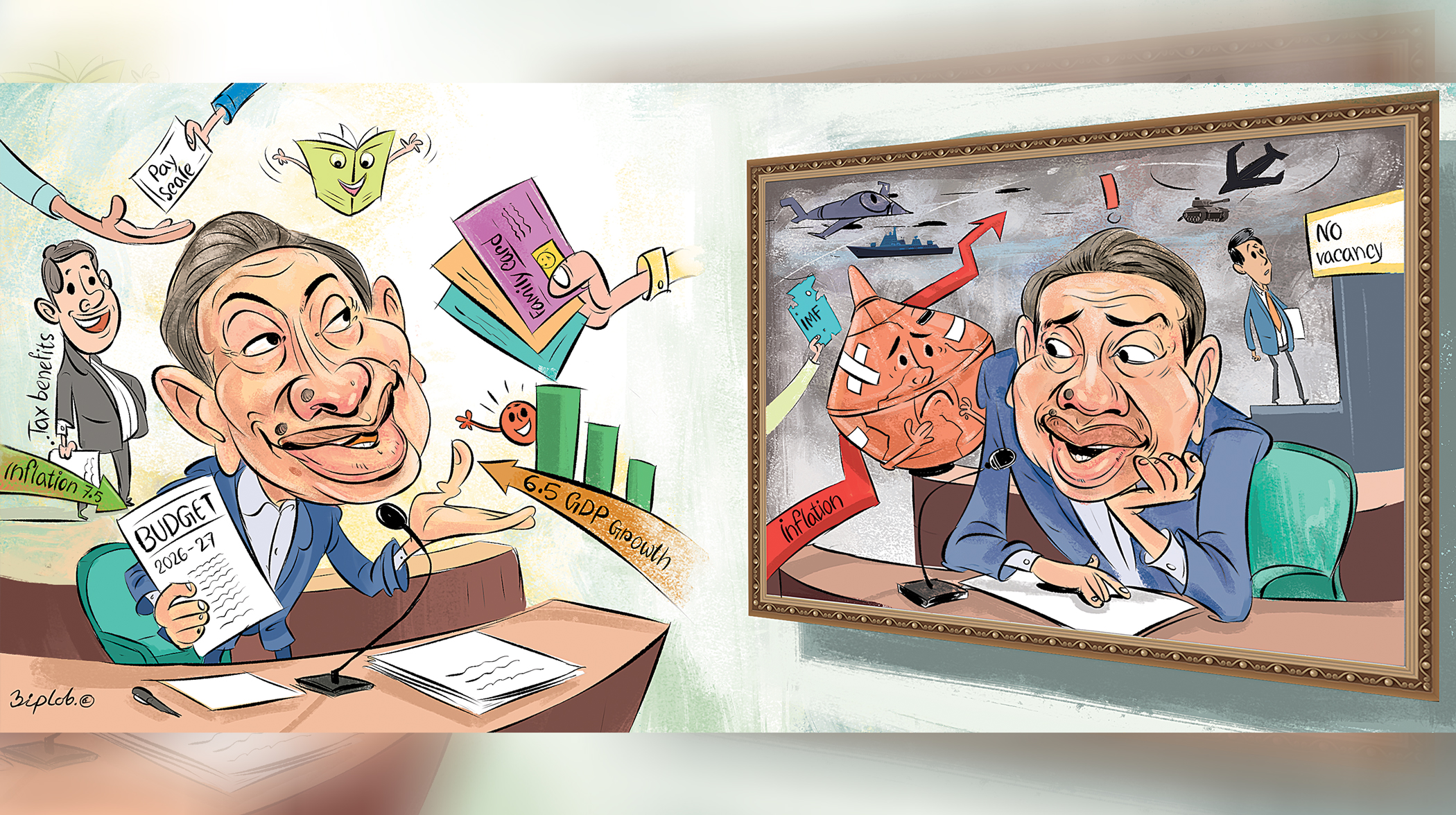
Presenting the budget in parliament yesterday, Finance Minister Amir Khosru Mahmud Chowdhury said revenue policies would support industrialisation, employment generation and foreign investment while maintaining fiscal discipline.
The measures come against the backdrop of a slowing economy marked by weak private investment, high inflation, uncertain demand and tight credit. Private-sector credit growth fell to 4.72 percent in March, the lowest since Bangladesh Bank began keeping records in 2003, down from 6.03 percent in February.
WHAT THE BUDGET PROPOSES
Among the headline measures are the establishment of Free Trade Zones with duty-free import facilities for export-oriented manufacturers and the removal of the 49 percent cap on foreign ownership in private off-docks and inland container depots, a move aimed at attracting foreign capital into logistics infrastructure.
The finance minister said the government would amend the Customs Act to create a legal framework for Free Trade Zones, allowing duty-free imports for export-oriented industries.
The plan comes as the government prepares to establish the first such zone in Anwara, Chattogram.
New frameworks for air cargo stations and private port operators are also planned, Khosru said.
Corporate tax rates remain unchanged at 22.5 percent for listed companies and 27.5 percent for non-listed firms. However, companies routing all income through banking channels will qualify for reduced rates of 20 percent and 25 percent respectively, an incentive designed to encourage greater financial transparency.
Khosru said maintaining a stable corporate tax structure would provide greater certainty for investors.
To reduce business costs, advance tax on imported industrial raw materials will be cut to 4 percent from 5 percent, while source tax on interest payments on foreign loans will be halved to 10 percent from 20 percent.
Tax deducted at source will be treated as advance tax rather than minimum tax, allowing businesses to adjust liabilities and claim refunds. Exporters will also see the advance income tax on export cash incentives reduced to 5 percent from 10 percent.
Sectors identified as potential growth drivers—electronics, semiconductors, electric vehicles, batteries, solar energy, shipbuilding and pharmaceuticals—will receive duty and tax concessions.
To encourage investment beyond Dhaka and Chattogram, accelerated depreciation benefits have been proposed for manufacturing, tourism and sports projects.
Hospitals and universities will continue to enjoy advance tax exemptions on imported capital machinery.
The budget also promises a mandatory online single-window system for approvals and licences, a measure the ruling BNP specifically pledged in its election manifesto. Approvals related to fire safety, environmental clearance, land use and building design will be integrated into a single platform.
Under the proposal, business licences would be issued within seven days, company registration completed within 48 hours, work permits for foreign experts granted within seven days and investor visas issued within 10 days. In some cases, applications may be deemed approved if agencies fail to meet prescribed deadlines.
GOOD STEPS BUT INSUFFICIENT: ECONOMISTS
 For all latest news, follow The Daily Star's Google News channel.
 Economists say the incentives are a step in the right direction, but insufficient on their own.
Abdur Razzaque, chairman of the Research and Policy Integration for Development (RAPID), said tax incentives alone would not be enough to revive investment if businesses remained uncertain about future demand and economic conditions.
He pointed to the erosion of purchasing power after years of high inflation.
“When consumers spend less, businesses see weaker demand and become reluctant to invest,” he said, calling for political stability and improvements in law and order to restore confidence.
He added that incentives for small businesses and lower borrowing costs may provide some support, but warned that excessive stimulus could add to inflationary pressures.
The economist also said subdued imports were constraining production and exports, while Bangladesh faces growing competition from India and Vietnam as domestic inflation erodes its price competitiveness.
Selim Raihan, executive director of the South Asian Network on Economic Modeling (SANEM), said the proposed measures send a positive signal to both local and foreign investors at a time when private investment remains weak.
Keeping corporate tax rates unchanged may help reduce policy uncertainty, he said.
Raihan welcomed reforms aimed at improving trade logistics, including the establishment of Free Trade Zones.
However, he cautioned that building sectors such as semiconductors and electric vehicles requires more than tax breaks. “It requires skilled workers, reliable power supplies, testing facilities, financing and predictable regulations.”
Without those foundations, incentives could encourage import-dependent assembly rather than genuine industrial upgrading.
POSITIVE BUT DEPENDENT ON IMPLEMENTATION: BUSINESSES
Taskeen Ahmed, president of the Dhaka Chamber of Commerce and Industry, said the proposed measures send a positive signal to the business community.
He welcomed plans to maintain stable corporate tax rates, lower financing costs, improve logistics and promote green energy through targeted incentives.
However, he said the success of the measures would depend on implementation and policy consistency. “Investors look not only at incentives but also at whether policies remain predictable and whether commitments are followed through.”
Rupali Chowdhury, president of the Foreign Investors’ Chamber of Commerce and Industry, acknowledged the challenge of balancing revenue mobilisation with growth objectives but stressed that broadening the tax base was as important as adjusting tax rates.
“It is not enough to state the objective. The key question is how it will be implemented,” she said, calling for greater automation and a more user-friendly tax administration.
She also urged policymakers not to apply new rules retroactively to existing inter-company loan agreements.
Comments