


BB waives merchant fees to boost Bangla QR adoption
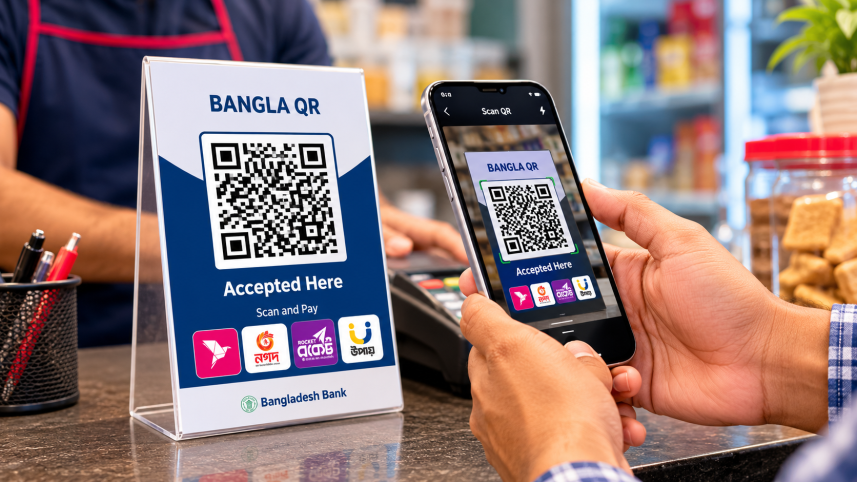
Bangladesh Bank is waiving the merchant fee for small shopkeepers, street vendors, and small businesses for accepting digital payments using Bangla QR codes.
In addition, the central bank is also offering incentives for banks and other payment service providers to encourage transactions through the national QR platform for purchases up to Tk 2,000.

These new measures were taken to promote digital payments and to encourage small vendors to adopt the national Bangla QR system.
The directives, issued in two separate circulars yesterday, are set to take effect on October 1, 2026.
Under the new regulations, the central bank has eliminated the Interchange Reimbursement Fee (IRF) for all Bangla QR transactions, setting the rate at zero.
Previously, banks and mobile financial service (MFS) providers charged an IRF ranging from 0.35 percent to 0.70 percent. Under the revised framework, acquiring institutions will no longer receive fees or service charges on these transactions.
Additionally, Bangladesh Bank has repealed its July 1 instruction that mandated a minimum Merchant Discount Rate (MDR) of 1 percent. Without a fixed floor, acquiring institutions may now negotiate rates directly with merchants or waive fees entirely.
To further accelerate adoption among small and marginal traders, the central bank is introducing an incentive scheme for Bangla QR-based transactions up to Tk 2,000 processed through the National Payment Switch Bangladesh (NPSB).
The scheme applies to purchases at merchant points of small and marginal product sellers and service providers onboarded through individual retail accounts.
Under the incentive model, acquiring institutions will receive 0.10 percent of the transaction value, while issuing institutions will receive 0.20 percent, subject to specific conditions.
To prevent abuse, Bangladesh Bank explicitly stated that single transactions cannot be split into smaller amounts to claim incentives. Failed, refunded, reversed, or disputed payments will be ineligible.
The central bank retains auditing authority over all transaction and settlement records, with powers to recover or adjust funds paid out on artificial or excessive transactions.
Acquiring institutions are required to actively monitor transaction patterns and prevent misuse, such as artificial transaction splitting or unauthorised cash-outs. Institutions found non-compliant may face penalties under the Payment and Settlement Systems Act, 2024.
These measures complement the government’s broader “Cashless Bangladesh” initiative. Last August, the Ministry of Local Government, Rural Development and Co-operatives instructed all city corporations and municipalities to require Bangla QR integration for trade licence issuance and renewal.
Furthermore, Bangladesh Bank directed all banks, MFS providers, and Payment Service Providers (PSPs) to replace proprietary QR codes with the standardised Bangla QR by June 30, 2026. A steering committee headed by the central bank governor has been formed to oversee nationwide merchant onboarding and public awareness campaigns.
To support these operational shifts, the central bank’s board recently approved a Tk 100 crore fund dedicated to subsidising merchant charges for small traders, aiming to build a more inclusive, transparent, and interoperable digital payment ecosystem.
 For all latest news, follow The Daily Star's Google News channel.
Comments