


Profit streak to cash crisis: BPC seeks Tk 18,699cr lifeline


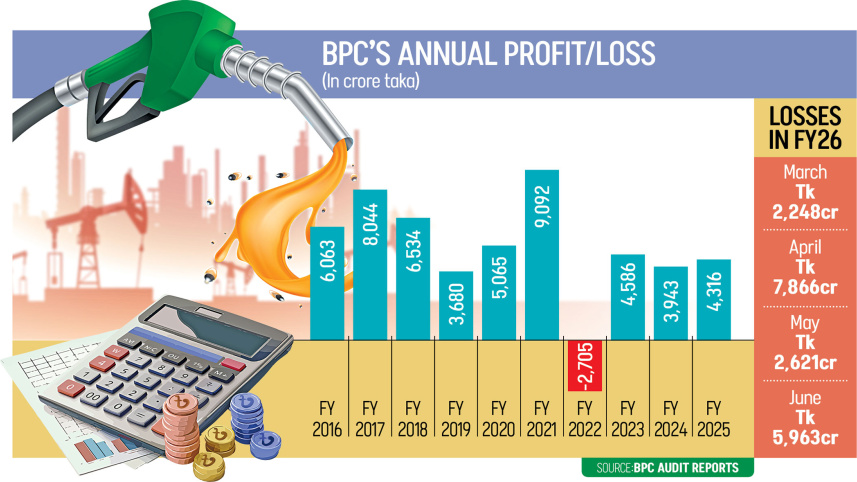
Although the Bangladesh Petroleum Corporation (BPC) raked in profits almost every year in the past decade, four months of the US-Israel war on Iran have upended the balance sheet of the government agency that imports, distributes and markets oil and petroleum products.
Just in the four months to June, the state-run fuel importer incurred a loss of Tk 18,699 crore, as it bought petroleum products at higher prices and sold them at lower rates. To cover the gap, the corporation has already drawn money parked with banks and spent funds earmarked for development projects.

Now the cash-strapped corporation estimates that it needs around Tk 20,000 crore as working capital to maintain the country’s mandatory 60-day fuel stock. Of that, it has asked the government for Tk 18,699 crore.
Citing the rapid depletion of its cash reserves, BPC said continued losses could affect its ability to open letters of credit (LCs) for future fuel imports, according to minutes of a BPC board meeting in July.
The scale of the cash squeeze is striking because BPC had built up a decade-long record of profits. It earned a cumulative Tk 48,618 crore in net profit from FY2015-16 to FY2024-25, making profits in nine of those 10 years.
Yet when the latest energy shock caused by the Middle East war struck, the corporation had no “General Reserve Fund” to fall back on.
BPC says no such fund has been created since its inception, despite provisions for one in the Bangladesh Petroleum Corporation Act. Now, after suffering an unprecedented loss, it has proposed to create a Tk 5,000 crore General Reserve Fund.
However, the proposal has not been approved. The board referred it to the internal Finance and Audit Committee for examination before bringing it back for a decision, according to the July meeting minutes.
The same meeting considered another proposal to use BPC’s existing Tk 1,579.71 crore Capital Reserve to meet fuel-import LCs. After not being approved at the meeting, that proposal was also sent to the Finance and Audit Committee for review.
DEV FUNDS SPENT, CAPITAL RESERVE UNDER PRESSURE
The cash shortage has already forced BPC to tap money set aside for development.
When the war began on February 28, the corporation had Tk 36,964 crore deposited with banks. By the end of June, that had fallen to Tk 18,524 crore, according to documents.
The deposits were held under various funds, including money earmarked for the proposed expansion of Eastern Refinery, show the papers.
BPC withdrew Tk 9,750 crore from the ERL Unit-2 project, Tk 3,000 crore from other development projects and Tk 2,250 crore from miscellaneous income to meet its working-capital needs. It also mobilised another Tk 640 crore from idle balances held in scheduled banks.
In all, BPC diverted or mobilised Tk 15,640 crore to keep its operations funded.
Now, BPC is considering its existing Tk 1,579.71 crore “Capital Reserve” as another source of working capital.
The reserve is invested in three-month fixed deposits with four state-owned banks. BPC proposed encashing the deposits upon maturity and using the money to meet working-capital requirements for fuel-import LCs.
The board, however, did not approve the proposal. It observed that the proposal required examination in light of international accounting standards and referred it to the Finance and Audit Committee before any final decision.
THE PRICE SHOCK
The sudden surge in international fuel prices wiped out more than four times BPC’s entire FY2024-25 profit in less than four months -- March, April, May and June.
 For all latest news, follow The Daily Star's Google News channel.
 According to the board documents, BPC’s loss reached Tk 18,691 crore through June 23. The monthly losses were Tk 2,248 crore in March, Tk 7,866 crore in April, Tk 2,621 crore in May and Tk 5,955 crore in June.
A subsequent calculation put the loss at Tk 18,699 crore.
April alone accounted for nearly 42 percent of the four-month loss, as the government kept domestic fuel prices unchanged despite the rise in international prices.
Although the government later raised fuel prices, they remained below the levels needed to reflect the global price shock, BPC says.
Muinul Islam, former economics professor at Chattogram University, said the sharp increase in Bangladesh’s fuel import bill was primarily driven by higher global oil prices rather than a significant rise in import volumes.
“Bangladesh is paying the price for a war it is not part of,” he told The Daily Star.
He said geopolitical conflicts can rapidly increase the import burden of middle and low-income countries, exposing their economic vulnerabilities.
YEARS OF PROFITS, BUT NO GENERAL RESERVE
The absence of a General Reserve Fund has now emerged as one of the biggest questions raised by the crisis.
BPC says no General Reserve Fund was created since its inception, although the Bangladesh Petroleum Corporation Act contain provisions for one.
According to it, the corporation may establish a Reserve Fund, subject to a ceiling determined by the government, and that the board may set aside part of its profits at the end of each year for the fund.
The Act also says the fund can be used for contingencies, liabilities, repair or replacement of equipment and property, and acquisition of new property.
From FY16 to FY25, BPC earned net profits in nine of the 10 years, with only FY22 recording a loss amid the global fuel-price surge following Russia’s invasion of Ukraine. Its net profit over the 10-year period totalled Tk 48,618 crore.
During that period, BPC paid Tk 1,150 crore in dividends to the government, according to the papers. Between FY20 and FY23, the government also took Tk 11,500 crore from BPC surplus funds, documents show.
Its board paper says comparable national oil companies maintain general reserves and argues that such a fund would help BPC deal with emergencies and maintain energy security.
It has therefore proposed an initial Tk 5,000 crore General Reserve Fund, to be formed from retained earnings or accumulated funds reflected in its FY2024-25 financial statements.
It has also proposed transferring Tk 500 crore or 20 percent of annual profit, whichever is lower, to the fund from FY2025-26 onwards.
The board decided that the proposal should first be examined by the Finance and Audit Committee before being brought back for a decision.
Comments