


FBCCI board reduced to 48 under new rules
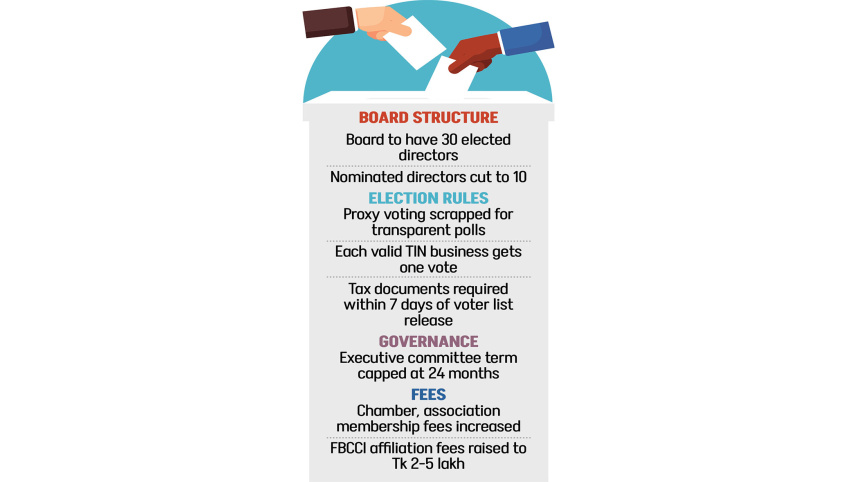
The government has reduced the board size of the Federation of Bangladesh Chambers of Commerce and Industry (FBCCI) from 80 to 48 members, tightened election rules and increased membership and affiliation fees through amendments to the Trade Organization Rules, 2025.
The changes were announced in a recent commerce ministry notification published on its website. Issued under Section 30 of the Trade Organizations Act, 2022, the notification introduces a series of reforms aimed at improving the governance of trade bodies.

The reforms come as FBCCI prepares to hold elections under a government-appointed administrator. After the fall of the Awami League government in August 2024, the commerce ministry dissolved the elected FBCCI board on September 11, 2024. Since then, the organisation has been run by government-appointed administrators.
On July 26, the ministry appointed Md Fazlul Hoque, managing director of Plummy Fashions Ltd and former president of the Bangladesh Knitwear Manufacturers and Exporters Association (BKMEA), as FBCCI administrator.
He has been tasked with completing the election process and handing over responsibilities to the newly elected board within 120 days.
Under the revised rules, the new FBCCI board will consist of the president, one senior vice-president, four vice-presidents, 30 elected directors from chambers and associations, 10 nominated directors, and one representative each from the Women’s Chamber and the Women’s Association.
The executive committee’s term has been fixed at 24 months, with an extension to 36 months allowed only in exceptional cases.
Former FBCCI president Mir Nasir Hossain welcomed the reforms, saying the revised structure was better than the previous rules because it significantly reduced the number of nominated directors.
“At one point, the number of nominated directors had risen to 80. It was ridiculous,” he said. “The number has now been reduced to a more reasonable level.”
He said the revised rules allow five nominated directors each from the chamber and association groups. The nominees will be selected from organisations listed in the constitution based on their contribution to the national economy.
Anwar-ul Alam Chowdhury Parvez, president of Bangladesh Chamber of Industries (BCI), said the FBCCI board should ideally have no more than 40 to 42 members to ensure effective participation.
“When the board is too large, meaningful participation becomes difficult,” he said.
The revised rules also seek to improve election transparency by abolishing proxy voting, introducing one vote for each business entity with a valid Tax Identification Number (TIN), and requiring candidates to submit tax compliance documents within seven days of the publication of the voter list.
Anwar-ul Alam said the apex trade body should have balanced representation from all major sectors, including cottage and small industries, heavy industries, exporters, healthcare and services, so the government can receive informed policy recommendations.
He also said many successful entrepreneurs avoid contesting elections because serving in trade bodies requires significant time away from their businesses.
“If experienced entrepreneurs come forward, the government will receive better policy support from the business community,” he added.
He called for clear eligibility criteria to ensure capable leadership and broad representation from different sectors.
The revised rules also raise membership and affiliation fees.
Category-A organisations will charge a one-time admission fee of Tk 15,000 for both general and associate members, while Category-B organisations will charge Tk 10,000. Annual membership fees have been set at Tk 5,000 for Category-A organisations and Tk 3,000 for Category-B organisations.
One-time FBCCI affiliation fees will range from Tk 200,000 to Tk 500,000, while annual affiliation fees will be between Tk 60,000 and Tk 100,000. General Council members will also have to pay a one-time registration fee of Tk 20,000.
 For all latest news, follow The Daily Star's Google News channel.
 Rizwan-Ur-Rahman, managing director of ETBL Securities & Exchange Ltd and former president of the Dhaka Chamber of Commerce and Industry (DCCI), said the higher membership fees were reasonable as they had remained unchanged for years despite rising operating costs.
“These fees go to the chambers and associations, not the government,” he said, adding that each organisation would continue to set its own membership fees through its governing process.
He said only organisations that fail to provide value to their members are likely to face resistance to the higher fees.
Asif Ibrahim, vice chairman of Newage Group, said the trade organisation reforms should go beyond administrative changes and help strengthen institutional governance and improve private sector competitiveness.
He welcomed measures such as direct voting, term limits and greater accountability, but said reducing the size of boards was one of the most important reforms.
According to Asif, smaller boards would improve efficiency, strengthen accountability and allow faster decision-making.
He also stressed the need for a predictable regulatory environment and warned against unnecessary government intervention.
Trade bodies, he said, should have greater freedom to contribute to export diversification, attract investment and support economic growth.
He added that the success of the reforms would depend on maintaining the right balance between regulatory oversight and institutional autonomy.
Comments