To feel Bengali, to think beyond Bengal: Dipankar Gupta in conversation

Distinguished sociologist and public intellectual Dipankar Gupta speaks to The Daily Star about growing up in a Bengali family away from Bengal, his unexpected journey into sociology, and the thinkers who shaped his intellectual life. A former professor at Jawaharlal Nehru University, Gupta reflects on Marxism and the evolution of his own thinking; the idea of the Bengali bhadralok and what it means to embody culture; the state of the social sciences in India; and his turn from academic writing to crime fiction.
The Daily Star (TDS): I would like to begin by going back to your early years and your family’s history. Although your family roots are in East Bengal, you were born in Patna after your father moved there around the time of Partition. Did you grow up with a sense of belonging to a refugee family, or did Partition shape your childhood and family life in other ways?
Dipankar Gupta (DG): I was born a couple of years after Partition because my father was already in Patna at that time. He had come west from what is now Bangladesh in the early 1940s. There was a small family bank, and he was tasked with expanding its operations and sent to Patna to open a branch there. My mother’s parents were already in Patna, and they were Bengalis too. My maternal grandfather was in the police, and a marriage was arranged between my parents.
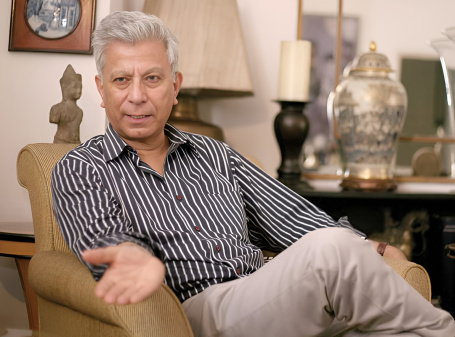
I was born in Patna but did not stay there for long. The bank branch my father had opened in Patna suffered during Partition, which meant he had to seek a job elsewhere. He was fortunate to find a position at the Reserve Bank of India. His first posting was in Madras (now Chennai), so the first five years of my life were spent in that city. I went to Good Shepherd’s Convent there, and my only memory of that school is of my class teacher in kindergarten, an English lady, who persuaded my parents not to force me to write with my right hand, as I was a natural leftie. I am grateful to her. My mother claimed that I could speak Tamil fluently as a child, but I suspect that was a mother’s boast. My father had a transferable job, which is why we moved to wherever the Reserve Bank of India had a branch.
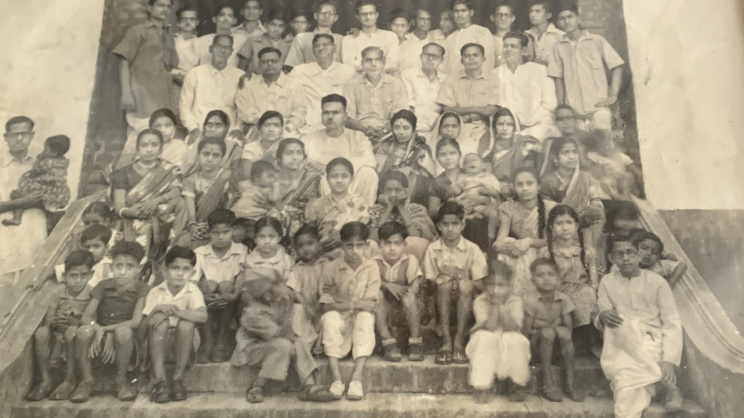
My father was a posthumous child, and his mother lived with us. My father’s oldest uncle brought him up, and my father used to address him as if he were his father. I believe their relationship was very close. My father’s uncle was a judge in Bengal, so Partition did not leave him homeless and without an occupation. My father never talked about Partition, and the only images I have of his pre-Partition life are a photograph of my paternal grandfather in his football jersey, posing with the other players on his team, and another photograph of my parents’ wedding. I am told my grandfather played as a full-back for Mohun Bagan. He died of pneumonia when he was 23. The other image I have is from when my parents got married and there was a big welcome for them at their ancestral home in Dinajpur. That picture was taken on the rather broad and expansive steps leading to their courtyard.

Otherwise, I know little about my father’s life in Dinajpur. He came to Calcutta (now Kolkata) for his Master’s in Economics at St Xavier’s College. I think, in retrospect, that separation from what used to be home was probably too traumatic for him, and that is why he never talked about it. We were too young to ask him about those days either, so my early years did not carry the “Partition Effect”.
That did not mean we were deracinated. Bengali was the language at home. There was a lot of Bengali music, especially Rabindra Sangeet. I did not like it that much as a child, but now I appreciate it a lot. While other children were playing cricket or marbles during the summer holidays, my father made sure that my older brother and I learnt to read and write Bengali. Once again, I am grateful to him for that. Unlike many other “probashi” Bengalis, my linguistic and cultural skills are not too bad. I can even speak in my grandmother’s dialect, and this trait helped me win several friends when I visited Bangladesh around 2004–2005.
I grew up in Delhi, Mumbai and Kanpur, and then moved back again to Mumbai and Delhi. My Hindi could be better, for I still cannot fathom why I get the genders wrong in that language. My uncle (my mother’s brother) was my childhood hero. He was a senior police officer in Bihar, like his father (my maternal grandfather), and I wanted to follow in his footsteps. This is reminiscent of the Hollywood serial Blue Bloods, except the third generation did not take to that service.
TDS: What first drew you to sociology, and which sociologists and anthropologists had the greatest influence on your intellectual development?
DG: I was keen to follow my grandfather and uncle and become a third-generation policeman in the family. That is when my enrolment at the Delhi School of Economics came in the way. At the age of 19, I drifted, literally drifted, into the Delhi School of Economics as an MA student in the Department of Sociology. When I joined that institution, I had no idea of the impressive scholarship of either M. N. Srinivas or André Béteille, or Amartya Sen, or J. P. S. Uberoi. My intention was very plain: get a Master’s degree, sit for the police service examination and, with some luck, make the cut.
Soon, my ambitions changed, and that was because I slowly fell under the spell of those utterly charismatic figures at the Delhi School of Economics, in both the Departments of Sociology and Economics. Almost instantly, my dreams for the future underwent a radical overhaul. I now wanted to be an academic, sit on the steps of the Delhi School of Economics, puff on a pipe and speak fluently on every subject.
While other children were playing cricket or marbles during the summer holidays, my father made sure that my older brother and I learnt to read and write Bengali. Once again, I am grateful to him for that. Unlike many other “probashi” Bengalis, my linguistic and cultural skills are not too bad. I can even speak in my grandmother’s dialect, and this trait helped me win several friends when I visited Bangladesh around 2004–2005.
All of this happened around 1970. Those were heady ideological times. Many of us were swayed by Marxism, and there were an equal number who were antagonistic to that persuasion. That made for perfect intellectual combat, and much of our time was spent reading and debating the finer themes of capitalism, socialism and Maoism too. All that passion was, however, built on a slight reading of Marx. I read Capital much later, and it was then that I realised that Marx had evolved over time and was much more than the person I had come to know after reading The German Ideology and the Manifesto.
Even so, it was Marx who first said that our social being determines our consciousness, a truth that everybody accepts today but for which nobody quotes Marx any longer; so deeply metabolised is this catechism in popular consciousness. As our sociology teachers were not inclined towards Marxism, we saw ourselves as young radicals. We did, however, find some sympathisers among those in the Economics faculty, which buoyed us a good deal. Still, I had not read Capital then and neither, I suspect, had many of the other partisans I associated with in those days.
While moral pronouncements are abundantly available in pre-modern societies, for they can be personalised, ethics could not be, as it was always about other people, and this brought in the public.
The good thing about this mix, and about having teachers who were quite unromantic, was that we had to read a lot of non-Marxist literature too. Today, I am so glad that we did. In those days, it felt like a bother, but I now realise that the progress of sociology occurred due to the contributions of non-Marxists as well. Talcott Parsons was a formidable force, and so were others like Robert Merton, Lewis Coser and a whole clutch of anthropologists, from Radcliffe-Brown to E. E. Evans-Pritchard. The person who left a lasting impression on me was Claude Lévi-Strauss, and I still quote him at every opportunity.
About 20 years ago, I went through another intellectual shift, and that happened when I found myself gravitating towards social policy studies. I rediscovered Hegel, especially his Elements of the Philosophy of Right. It was then that I realised the importance of the distinction between “morality” and “ethics”, without which my understanding of both modernity and citizenship would have been incomplete. While moral pronouncements are abundantly available in pre-modern societies, for they can be personalised, ethics could not be, as it was always about other people, and this brought in the public.
Anthropologists, then and even now, have a marked preference in the other direction, and in most cases they end up finely separating cultures on an enduring basis. I have spent a lifetime contesting such views.
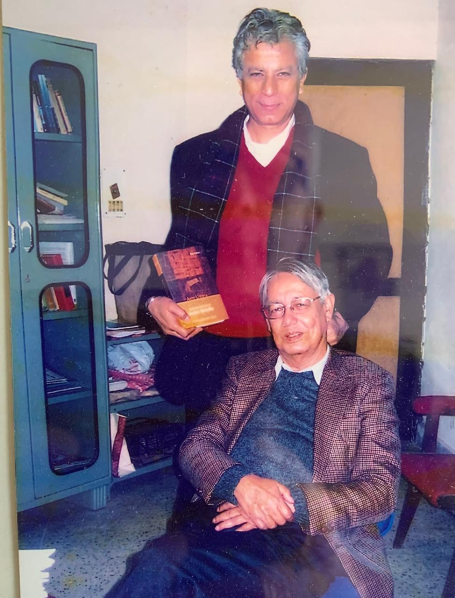
Professor André Béteille, another non-Marxist, introduced me to the writings of John Rawls, whose idea of the hypothetical “veil of ignorance” was simply brilliant. In fact, André Béteille’s writings on social policy and on caste reservations left a deep impression on me. This was particularly so in the way he set out the differences between issues that needed a “rights”-based approach and those that needed clear “policy” guidelines. Other than that, while I learnt a lot from scholars like M. N. Srinivas, Yogendra Singh and J. P. S. Uberoi, I can’t say if any other Indian sociologist impressed me very much. I took in a lot of valuable field data from Indian scholars, but it wasn’t as if they left a lasting impact on my thinking.
When I eventually became a teacher at Jawaharlal Nehru University, I enjoyed taking courses which featured theoreticians of all persuasions, and Marx was one of them, but not the only one. There was Habermas, G. H. Mead, Berger and Luckmann, Parsons, Edmund Husserl and, how can I ever forget, Claude Lévi-Strauss. I spontaneously warmed to those whose perspective was clearly slanted towards the view that human beings are all the same but circumstances make them different. Anthropologists, then and even now, have a marked preference in the other direction, and in most cases they end up finely separating cultures on an enduring basis. I have spent a lifetime contesting such views.
TDS: Do you think there is something distinctive about Bengal’s socio-economic and political trajectory—what might be called a form of “Bengali exceptionalism”?
DG: In states where the peasant castes have come to the fore in politics, one can easily discern that modernity did not come there through education but through recruitment into the army or, later, after land reforms. This is why, in several states in India, we have statues of heroes on horseback, whereas in Bengal, the heroes are seen holding a book. Education came early to Bengal because Kolkata was the capital of British India and not because Bengalis were genetically intellectual from the start. That is how the “bhadralok” category earned its first stripes. It later took on a broader cultural salience with Vidyasagar, Michael Madhusudan Dutt, Vivekananda, Tagore and Bankim, right down to Satyajit Ray.
Education came early to Bengal because Kolkata was the capital of British India and not because Bengalis were genetically intellectuals from the start.
Here we ought to pause and take stock. If I were to follow Pierre Bourdieu’s understanding of culture, then I would position today’s bhadralok in a fractured way. They have the objectified and institutional qualifications but fail the test when it comes to embodying culture. Objectively and institutionally, they can showcase books and degrees from renowned universities, and can recite poetry and classical texts extempore. In spite of all that, they lack embodied culture, which is so central. Bengalis worship Ramakrishna Paramahansa and Swami Vivekananda, but not always in terms of embodying their teachings or engaging with the deep philosophical issues they raised.
This is true of many of Rabindranath Tagore’s followers too. They can recite stanzas from his poetry but do not embody his teachings in their everyday lives. All the markers of Bengali bhadralok status, from the veneration of Vidyasagar to Satyajit Ray, are largely material but empty in terms of embodied culture. I am also a little surprised that Michael Madhusudan Dutt does not feature as prominently as he should in popular Bengali consciousness today. He was the ultimate iconoclast, for he blasted both traditional and British hypocrisy. When I meet official followers of Bengali cult heroes, I find their adoration alarmingly superficial. Bhadralok is what bhadralok does, and preening is not on the cards.
TDS: One of your friends once remarked that you “feel” like a Bengali but think like a non-Bengali. How do you understand that observation, particularly in relation to the way you have drawn on global traditions of social thought to reflect on inequality and the possibilities of building a more egalitarian society?
DG: I am not sure how to answer this question. Probably because I grew up in a very Bengali household, I imbibed many of the teachings of great Bengali reformers. I was introduced to them by my parents, but I followed them up by reading about their thoughts and achievements, which, sadly, are not really popular knowledge in terms of what I said earlier, namely, “embodied culture”. I suppose I got a fair amount of sentimentalism from some of Tagore’s lyrics and learnt about humanism from his lectures too. Schopenhauer was a philosopher I took to quite early because of Tagore.
I am also a little surprised that Michael Madhusudan Dutt does not feature as prominently as he should in popular Bengali consciousness today. He was the ultimate iconoclast, for he blasted both traditional and British hypocrisy.
In the initial phase, I was fully on Tagore’s side against Schopenhauer, though today I would hesitate to rush into that position. What really caught me by surprise was when I read Ramakrishna Paramahansa’s Kathamrita. He was much more than a mystic, and his message was essentially experimental; he had also been a tantric once. He openly accepted all religions and, as you know, at Belur Math, Christmas is celebrated with great fanfare, as Vivekananda started this practice in 1886. It is for these reasons that I feel blessed and fortunate to have been born in a setting where these great figures of history were household names, making it easier for someone like me to go deep into their thoughts.
At the same time, my distance from everyday life in Bengal gives me a certain perspective on what is popularly known as Bengali culture. I don’t mean to undermine it, but I think that one gets a more balanced view of what it is to be a Bengali if one lives outside Bengal, at least for a certain length of time. To quote Rudyard Kipling, “What should they know of England who only England know?”
TDS: How do you assess the state of the social sciences in India and South Asia today? As societies confront emerging challenges such as artificial intelligence, climate change and the possibility of recurring pandemics, what should the next generation of social scientists prioritise while continuing to grapple with enduring questions of class, caste and inequality? And on a more personal note, after a lifetime in academia, what drew you towards literature and fiction?
DG: As I have already mentioned in my earlier communication, I am more drawn towards scholarship whose basic assumption is that human beings are all equal, so now it is a challenge to understand why they behave differently.
The easier route that many others take, Dumont included, is to proceed in the opposite direction. That is why their works are characteristically prejudicial and innocent of critical details. One of these is their ignorance of caste origin tales, and another is their inbuilt inability to put themselves in the shoes of others. As a result, they tend to view the world they are studying as if it were populated by ‘respondents’ and not by people like themselves.
On climate change and AI, I am afraid I am not an expert, though I have definite views on these subjects.
About my turn towards fiction: some years ago, I was quite sick and bedridden, and that is when I thought I would give in to my secret ambition to write a crime novel. Over the years, I have consumed a lot of literature in this genre and found that some crime novelists like Dashiell Hammett should have won the Nobel Prize in Literature. There is an unfortunate tendency to view books of this genre as not quite serious.
There was no question that I would, of course, write in English. The crime fiction I read was in English too. Moreover, truth be told, English is the only language I have published in, other than a few articles in my favourite Bengali newspaper. My reading, too, has been overwhelmingly of English books, and my professional life was also conducted in that language.
So, if I were to write in English, an Indian theme would look out of place. I had read a few English novels by Indian authors and was struck by a certain superficiality in some of them. It is difficult to write novels in English with a purportedly Indian plot and with Indian characters because our expressions here are so different. Indian novelists writing in English, therefore, try to compensate for this lack of authenticity by aspiring to appear learned instead.
The other great thing about writing a crime novel is that you are in charge and you can kill anyone you want. In academic writing, one has to justify one’s move every step of the way. Fiction is, in that sense, an egotistical adventure. You don’t have to answer to anybody.
I have always felt there was something jarring when literature has more intelligence than inspiration. Such works are either heavily researched or they depend on real life and people but dress them up in fictional robes. The French call this genre roman à clef, and it never interested me.
I also thought that if foreigners can write novels and plays, even operas, on India after a brief stay, why can’t I write about America? Think of E. M. Forster and his A Passage to India. The theme of this book and the cave scene came to him within a few weeks of his trip to India. H. R. F. Keating wrote his popular Inspector Ghote series without ever even visiting India.
I, on the other hand, have been to the USA and Europe a few times. My son lives in North America, and we go there quite often to meet him. That then qualifies me to write an American story much more fully than many Europeans whose storyline is Indian. The plots of all three crime novels I have written are based in America and have Americans doing all kinds of things in them.
Plotting a story in a different setting also acted like a huge release. I was free and on my own and could give myself over to pure imagination and be in another world. I used a pseudonym for my novels, which is D. G. Rae, and now my imaginary world was complete.
The other great thing about writing a crime novel is that you are in charge and you can kill anyone you want. In academic writing, one has to justify one’s move every step of the way. Fiction is, in that sense, an egotistical adventure. You don’t have to answer to anybody.
The interview was taken by Priyam Paul.
Send your articles for Slow Reads to slowreads@thedailystar.net. Check out our submission guidelines for details.
Bangladesh's visual history / The enduring allure of vintage photographs
The enduring legacy of the 2nd Bangladesh Liberation War Course
In conversation with Harbans Mukhia / Beyond kings and dynasties: Rethinking medieval Indian history
Reading Ardhakathanak / What a 17th-century merchant's autobiography reveals about Mughal governance
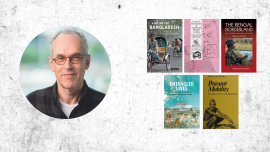
The blind spots of Bangladesh studies
Rediscovering Santal history through Scandinavian archives
Asma Abbasi: The essence of orange
Tigers and the empire: A history of hunting, power and resistance
25th Death Anniversary / A life so full: Remembering Ahmed Sofa