


Broadband sector set for major overhaul
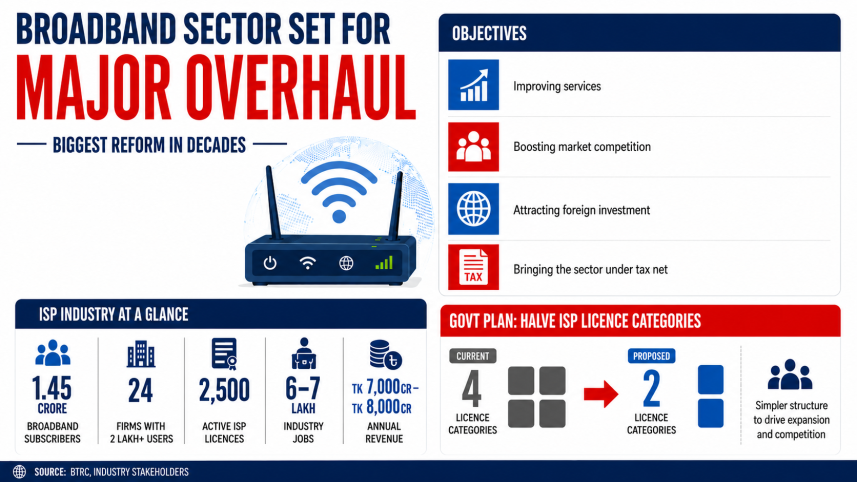
- Govt plans massive overhaul of broadband internet sector
- Licensing categories set to be halved for efficiency
- New reseller model proposed to regulate illegal operators
Bangladesh is preparing a massive overhaul of the broadband internet sector in decades, as the government moves to dismantle a complex licensing regime, introduce a reseller model and attract foreign investment.
In this regard, top government officials have been holding a series of meetings with the Bangladesh Telecommunication Regulatory Commission (BTRC) on broadband reform guidelines prepared under the interim government, according to half a dozen people involved in the process.

The new government is broadly accepting the policy reforms proposed by its predecessor, though it is also introducing several significant changes of its own, according to documents seen by The Daily Star.
Bangladesh ranks near the bottom globally in terms of broadband service quality. Rehan Asad, the prime minister’s adviser on telecom and ICT, recently said the government aims to ensure broadband connectivity with speeds of up to 1 Gbps.
Such speeds are usually available in countries, including Singapore, the United Arab Emirates, Hong Kong and France.
Officials said the planned broadband overhaul is a part of that broader push to raise service standards and modernise the country’s digital infrastructure.
One of the major changes under consideration is halving the number of ISP licensing categories.
Bangladesh currently has four tiers of ISP licences. Those are national, divisional, district and upazila-level licences. Under the proposed framework, the government plans to consolidate these into just two: national and district-level.
Existing divisional and upazila operators would be allowed to migrate into the new structure.
Bangladesh currently has around 2,500 ISP licences. Just before the fall of the Awami League in August 2024, the total had nearly reached 3,000, contributing to market disorder, fragmented infrastructure and inconsistent service quality.
Industry insiders say indiscriminate licence approvals over the years, often by political considerations, caused the number to balloon.
A SECTOR BUILT ON RAPID GROWTH
The country’s broadband industry has expanded rapidly over the past two and a half decades, driven by government digitisation projects and rising internet demand. As of March this year, subscriber numbers stand at around 1.45 crore.
In Bangladesh, internet services formally began in 1999, when the then Bangladesh Telegraph and Telephone Board (now the Bangladesh Telecommunications Company Limited) introduced dial-up services.
Private ISPs began deploying their own infrastructure in the early 2000s, and by the end of 2004, cyber cafés had spread across urban areas.
Many operators gradually extended Ethernet connections directly to homes and businesses, effectively functioning as local ISPs. Internet speeds accelerated significantly after Bangladesh was connected to the SEA-ME-WE-4 submarine cable in 2006.
However, the Covid-19 pandemic proved to be the single biggest catalyst for broadband expansion.
It had taken nearly two decades for the subscriber base to reach 50 lakh. But within roughly a year of the pandemic, the number crossed 1 crore as people turned to the internet for remote work, online education, digital commerce and entertainment.
That surge helped many small and medium ISPs grow into large-scale operators, creating employment for engineers, technicians and support staff.
Aminul Hakim, president of the Internet Service Providers Association of Bangladesh (ISPAB), said at least seven or eight companies now directly employ more than 1,000 people each.
 For all latest news, follow The Daily Star's Google News channel.
 “If you include their partner companies, more than two dozen companies now have over 1,000 employees each,” he said.
According to industry estimates, the sector now supports around 6 lakh to 7 lakh jobs, including graduate engineers, technicians, customer support staff and field workers.
Hakim said the number of authorised ISP connections stands at around 48 lakh, though the actual broadband footprint is considerably larger owing to unauthorised operators.
Industry stakeholders estimate Bangladesh has nearly 90 lakh broadband connections serving more than 3 crore users, consuming around 60 percent of the country’s nearly 10 Tbps international internet bandwidth and generating annual revenues of Tk 7,000 crore-Tk 8,000 crore.
THE RESELLER PROPOSAL
According to BTRC officials, between 7,000 and 8,000 unlicensed ISP operators are currently active across Bangladesh, leaving much of the sector unregulated and depriving the state of significant tax revenue.
To streamline the sector and attract investment, the BTRC and the telecoms division have agreed in principle to introduce a reseller model.
Under the proposed framework, unlicensed operators could register with the BTRC and operate legally without holding a full ISP licence.
Maj Gen (Retd) Md Emdad Ul Bari, chairman of the BTRC, said that resellers would not own licences, they would simply sell services provided by licensed ISPs.
However, several industry leaders are unconvinced.
ISPAB President Hakim said legalising resellers could allow politically connected illegal operators to rapidly capture local markets, undermining compliant ISPs.
He said the model could also reduce service quality in remote areas, create pricing irregularities and expose customers to exploitation. Small and medium entrepreneurs who had invested heavily over the years might struggle to survive against locally influential groups.
“I believe introducing a reseller model at this stage could create long-term instability in the broadband sector,” he said.
He added that unclear accountability between ISPs and resellers could complicate maintenance, technical support and cybersecurity management. Without strong regulation the model risks producing unhealthy competition, fragmented infrastructure and reduced network reliability.
However, a senior BTRC official said many of the unregulated small ISPs, including politically connected ones, are already purchasing bandwidth and riding on the infrastructure of larger ISPs.
“In reality, they already exist in the ecosystem. Bringing them under at least a minimum regulatory structure would improve oversight and accountability,” the official said, preferring anonymity.
Comments