


Ensure level playing field, policy support for local fashion brands

Despite a growing consumer market, the country’s domestic fashion brands are struggling with structural and policy constraints that could hinder long-term growth.
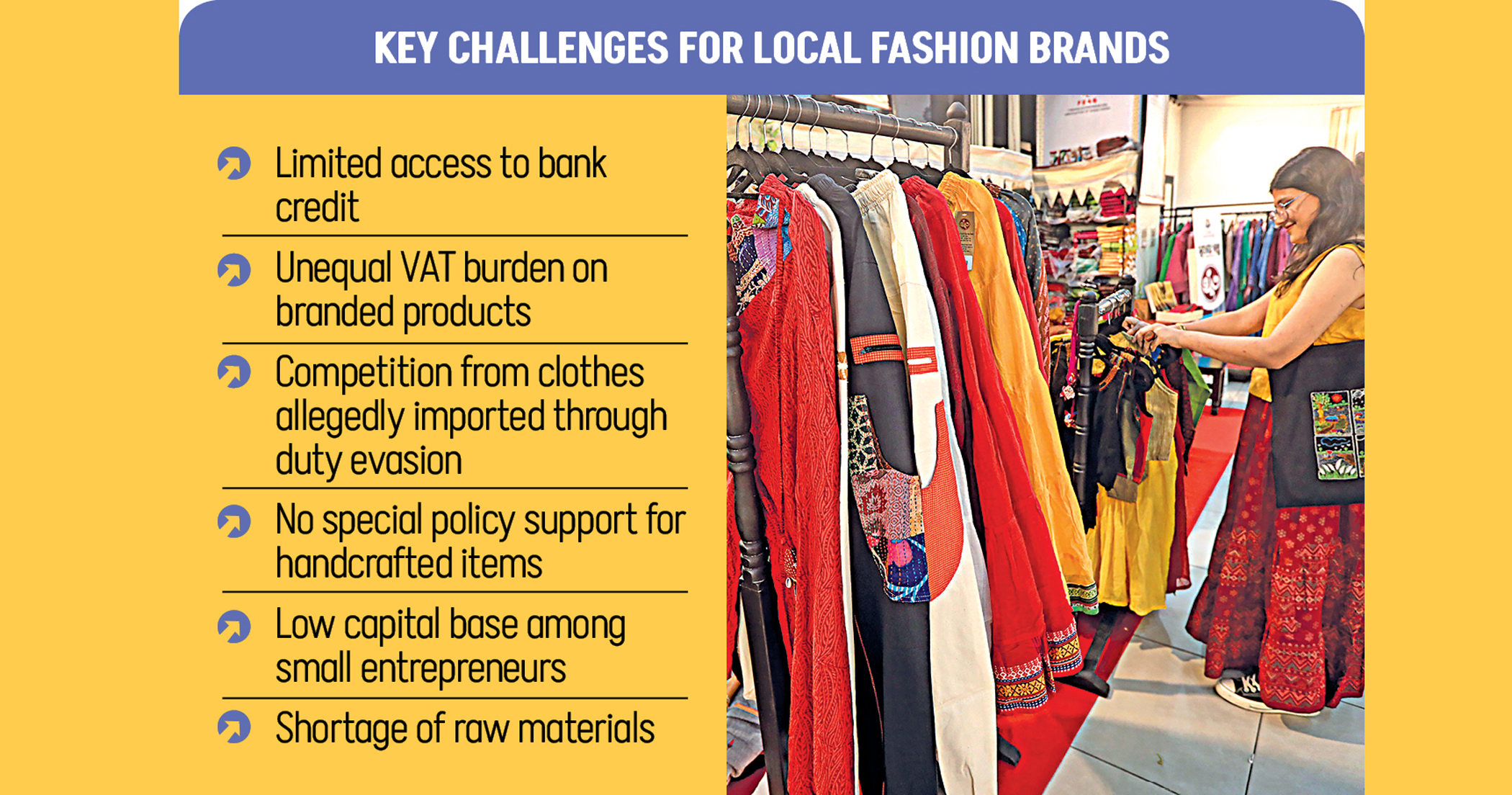
Entrepreneurs cite limited access to bank loans, an uneven tax system, strict regulations, competition from “illegal” imports, political uncertainty, and a shortage of skilled workers as key concerns. They warn that these issues could affect the sector’s sustainability and its role in promoting cultural identity and domestic enterprise.

Amid these pressures, a three-day fair titled “Sutor Golpo - Nijoshshotay Bona Utsob”, organised by the Fashion Entrepreneurs Association of Bangladesh (FEAB) ahead of Eid-ul-Fitr at Midas Center in Dhanmondi, concluded yesterday, showcasing the resilience and creativity of local brands.
In an interview with The Daily Star, Azharul Hoque Azad, president of FEAB and managing director of Sadakalo Ltd, said that although Bangladesh’s garment exports are expanding globally, grassroots domestic brands -- many rooted in handloom and indigenous craftsmanship -- are struggling to survive.
“Political and economic stability is vital for our business,” he added.
Azad said since the Covid-19 pandemic, they faced repeated disruptions, including global shocks and domestic instability. “Since Covid, we’ve faced instability. Retail is usually the first to feel the shock,” he said.
He added that domestic fashion products are non-essential items, so demand declines when household budgets tighten. “If someone already has two shirts, they won’t buy another unless necessary. That has affected our sector,” he said.
Azad cited a lack of supportive government policies, saying small and medium fashion brands have to operate under a complex and outdated regulatory system that requires them to pay VAT and secure multiple licences, including trade licences and other permits introduced decades ago.
Referring to a 1972 “dealing licence” law, which was originally meant to regulate warehouses and prevent food hoarding but is now applied to fashion outlets, he said, “There are many regulations that are not fully relevant to our production reality.”
He further questioned testing standards for handcrafted goods, explaining that handloom fabrics and hand-dyed yarn cannot always meet uniform factory standards. “When you dye yarn by hand, colour consistency will not be 100 percent identical every time,” he said, adding, “But there is no special consideration for handcrafted products.”
TAX IMBALANCE AND UNFAIR COMPETITION
Tax differences, he said, create unfair competition. Consumers pay 10 percent VAT on branded clothing stores, while non-branded products are taxed at 7.5 percent, according to the National Board of Revenue.
“So why would a customer be more interested in buying from us?” Azad asked, adding that informal sellers may pay less or avoid compliance altogether.
He alleged that some importers bring foreign garments -- particularly from India and Pakistan -- through under-invoicing and sell them at lower prices without paying full taxes.
“We prepare the whole year for Eid, investing in design and production. But some traders import products just days before the season and flood the market,” he said.
He questioned whether such imports are properly taxed and monitored. “There is no level playing field,” he added.
CAPITAL GAPS AND COMPETITION
Azad said competition from large domestic retail chains is also significant but structurally different. Major brands, including those linked to garment exporters, have stronger financial capacity and supply chains. Many benefit from greater capital access and infrastructure.
“Our entrepreneurs are mostly small-scale. They face capital shortages,” he said. “If they try to take loans, they face numerous requirements and complications.”
 For all latest news, follow The Daily Star's Google News channel.
 He explained that stronger firms can maintain competitive pricing longer due to higher production volumes and better financing, while smaller designers struggle with rising costs.
Targeted credit support for domestic fashion entrepreneurs, he said, is essential for growth and sustainability.
RAW MATERIAL ACCESS AND PRICING CHALLENGES
Access to raw materials remains a challenge, as yarn and other inputs are not always readily available locally. This limits consistent use of high-quality domestic fabrics. “We want to use more local materials. But availability is a challenge,” Azad said.
He stressed that higher prices for local brands reflect craftsmanship and quality. “People need to understand the value of a handloom product or a Jamdani,” he said. “If something is handcrafted, it may cost a bit more.”
Price comparisons, he argued, are often unfair. Imported garments are mass-produced at scale, reducing costs, while domestic brands operate on smaller volumes and prioritise design. “Our brands focus heavily on design. They do not produce thousands of identical pieces…because production volume is lower, it is not possible to reduce prices to the same level as mass industrial producers,” he said.
He added that comparing mass-market imports with local designer products is misleading. “If you bring a mass-market product from abroad and compare it with a local designer brand, that is not an equal comparison. Compare mass-market to mass-market, designer to designer -- then it becomes fair.”
He acknowledged the need to balance affordability with quality but said pricing is not the industry’s main obstacle.
INDUSTRY SIZE AND CONTRIBUTION
Azad said there is no precise database for the boutique and fashion-house segment, but estimates suggest more than 5,000 fashion houses and entrepreneurs operate using local products.
Around five to six lakh people are directly employed in the ecosystem, with many more working indirectly. The supply chain includes weavers, block and batik artisans, embroidery workers and handicraft specialists. “A large population is directly or indirectly connected to this industry,” he said.
Comments