


Exports drop for 7th straight month on garment slump

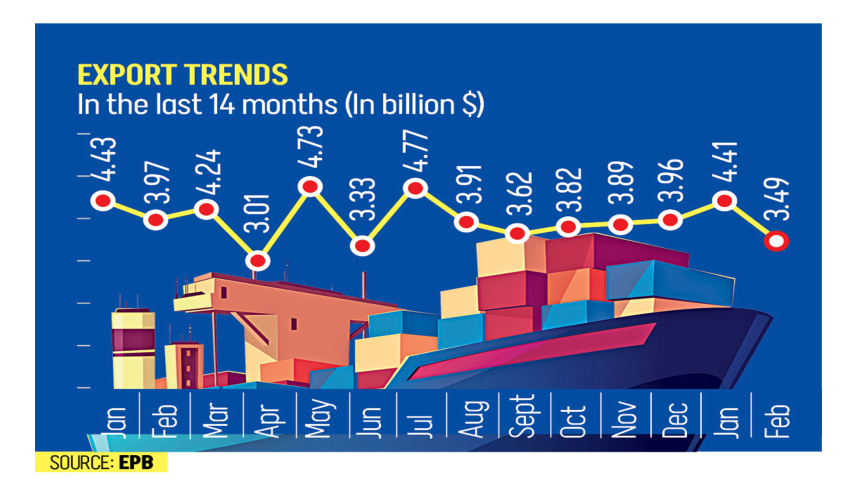
Bangladesh’s merchandise exports fell for the seventh consecutive month in February, declining 12.03 percent year-on-year (YoY) to $3.49 billion, driven primarily by weakening garment shipments.
For the first eight months of the fiscal year 2025-26 (FY26), exports dropped 3.15 percent to $31.90 billion, according to Export Promotion Bureau (EPB) data released yesterday.

BAD PERIOD FOR RMG
Readymade garments (RMG), which account for over 80 percent of national exports, recorded $25.79 billion during July-February, a 3.73 percent decline from the previous year.
February alone saw garment exports plunge 13.21 percent YoY to $2.81 billion, and 22.10 percent month-on-month from January’s $3.61 billion.
Within the sector, knitwear exports fell 4.56 percent to $13.68 billion, while woven garments declined 2.79 percent to $12.10 billion during the eight-month period.
The EPB attributed the export decline to temporary factors including port disruptions, the national election, and subdued global demand. Agricultural products, cotton, jute goods, non-leather footwear, and ceramics all underperformed during the period.
Garment exporters cited multiple headwinds behind the drop in the sector.
Faruque Hassan, managing director of garment exporter Giant Group, identified the United States’ reciprocal tariffs as a major factor for the slowdown over the last few months.
In addition, he said, uncertainty ahead of the February national election prompted international retailers and brands to adopt a wait-and-see approach in the earlier months, slowing order placements.
Strained relations with India, an emerging export market for Bangladesh, have also weighed on performance.
Hassan said he does not expect exports to rebound in March as election-related and other holidays alongside a shorter month of 28 days in February significantly reduced working days.
FEAR OVER IRAN WAR
On top of these, Hassan said the US and Israel’s ongoing war against Iran “will also affect the export of garment items from Bangladesh as the price of oil will also escalate the cost of production in the country.”
Mahmud Hasan Khan, president of the Bangladesh Garment Manufacturers and Exporters Association (BGMEA), said garment exporters had anticipated a recovery as global supply chains revived.
However, echoing Hassan, he also said a prolonged US-Iran war could derail this optimism as higher oil prices are likely to push up production costs and affect the consumers’ spending capacity.
“The war will increase spending, and consumers will buy less garment items for which shipments from Bangladesh may fall,” he added.
Masrur Reaz, chairman of Policy Exchange Bangladesh, also warned that the conflict may affect the shipment to Western countries, including the two prime destinations – Europe and the US.
He explained that conflict near the Suez Canal, a vital shipping artery between Asia and the West, could force vessels to reroute via Africa’s Cape of Good Hope, adding nearly 5,000 kilometers to journeys.
This would significantly increase shipping costs and maritime insurance premiums, he added.
 For all latest news, follow The Daily Star's Google News channel.
 “The ultimate sufferers will be the cost of transportation of goods and will also affect the country’s competitiveness in the global supply chain,” Reaz said.
However, BGMEA chief Khan confirmed that so far, no exporters have reported stuck shipments due to the war.
BRIGHT SPOTS
Despite the overall decline, several sectors showed resilience. EPB data shows that pharmaceuticals, home textiles, leather and leather goods, and frozen fish all posted positive growth during July-February.
China emerged as the fastest-growing major export destination, with a 19.12 percent year-on-year increase. The US remained the largest market at $5.87 billion, registering modest 0.74 percent growth.
Comments