


Foodpanda Bangladesh incurs €111m losses since 2016
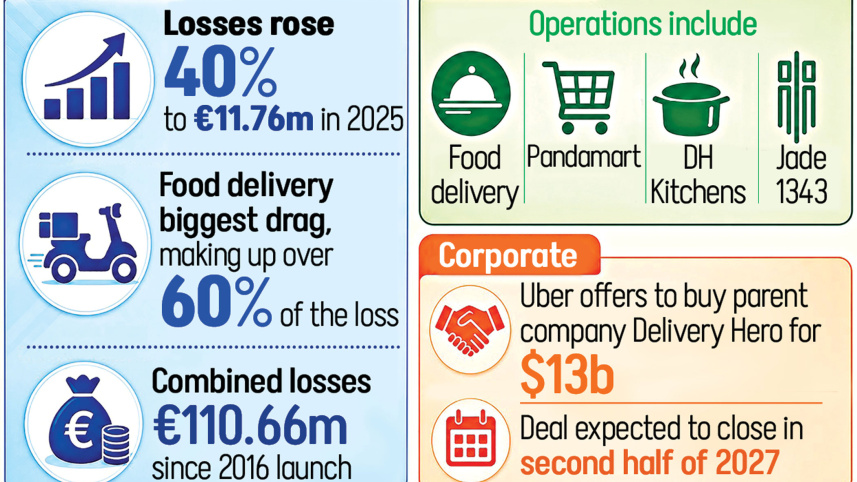
Foodpanda Bangladesh’s losses rose 40 percent to €11.76 million last year, extending a losing streak that now stretches back a full decade, according to parent company Delivery Hero’s annual financial statements.
The Bangladesh operations of the German company comprise four entities: the core food delivery business; the quick-commerce arm Pandamart; cloud kitchen unit DH Kitchens; and a holding company, Jade 1343 GmbH & Co Vierte Verwaltungs KG.

Together they have lost €110.66 million since 2016 and have yet to turn a profit in any year, the statements show.
Food delivery accounts for the largest share of that total, with cumulative losses of €79.22 million. Its losses widened 65 percent last year to €7.14 million, accounting for over 60 percent of the group’s total loss.
Among the other entities, Pandamart logged a loss of €2.27 million last year, reaching a total of €20.27 million since its launch in 2020. DH Kitchens narrowed its losses by 15 percent to €0.34 million, with €2.28 million lost since 2020. Jade 1343 lost €2.01 million last year, taking its cumulative losses since 2021 to €8.89 million.
THE UBER DEAL
Foodpanda has yet to turn a profit in Bangladesh since entering the market in 2013. Its decade of losses now intersects with Uber’s $13 billion acquisition offer for Delivery Hero, announced last week.
The logic behind the deal, according to Uber, is to cross-sell by gaining access to takeaway customers in markets where it offers rides but not food, such as South Korea and the Middle East, and converting them into users of both.
Uber reckons that its cross-platform users generate roughly three times the gross bookings and higher profits than single-product users.
But in the case of Bangladesh, Uber exited the food delivery business within 14 months in June 2020 after failing to gain any ground despite considerable cash burn in the intensely competitive market.
There are two possible scenarios regarding the acquisition, said AKM Fahim Mashroor, former president of the Bangladesh Association of Software and Information Services. One possibility is that Uber retains the Foodpanda brand and the business continues to operate largely as it does now, he said.
The other scenario is that Uber discontinues the brand altogether, said Mashroor, also the chief executive officer of BDjobs.com. “Since Bangladesh is not a particularly lucrative market, that is also a real possibility -- everything could change.”
Meanwhile, responding to queries from The Daily Star, Foodpanda Bangladesh said it is yet to receive any indication of changes to its operations following the acquisition announcement.
“Nothing changes today. Any organisational decisions and specific branding decisions will be worked through after closing, which is expected in the second half of 2027,” the company said in a statement.
“Bangladesh is one of Delivery Hero’s most dynamic markets, possessing immense potential for long-term growth. Our focus and investments over the last decade have been dedicated to building cutting-edge technology, empowering communities economically and fostering ecosystem development for customers and partners,” the company added.
Uber did not respond to The Daily Star’s request for comment.
 For all latest news, follow The Daily Star's Google News channel.
Comments