


Geopolitical oil shocks may weigh on importing economies: WB report
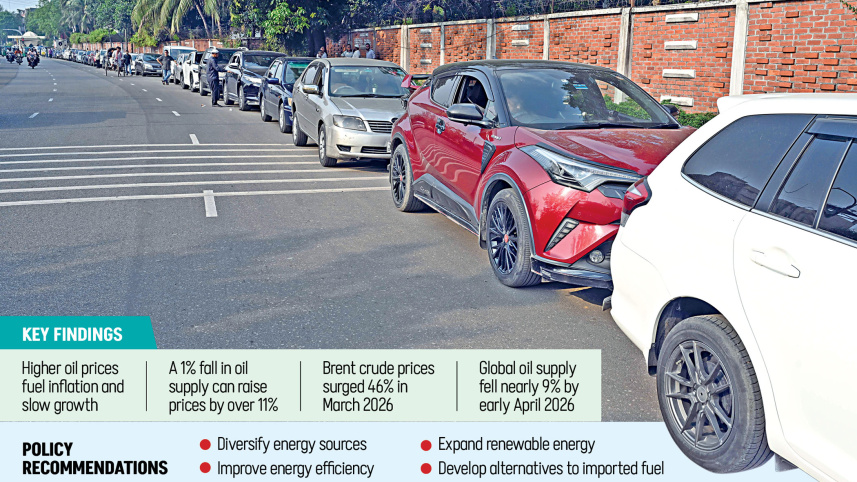
- Oil supply shocks threaten growth and inflation
- Brent crude jumps 3.3 percent to $107.68
- High oil prices raise energy costs by $3bn
Geopolitically driven oil supply disruptions could create severe headwinds for oil-importing economies through higher inflation, tighter financial conditions, and pressure on trade balances, according to a recent World Bank (WB) report.
The report comes at a time when the oil market has been volatile due to supply disruptions from Gulf nations, key oil-producing countries, amid the Middle East conflict.
 For all latest news, follow The Daily Star's Google News channel.
 Oil prices rose by more than 3 percent yesterday as stark differences between the US and Iran on a proposal to end the war in the Middle East pushed supply concerns back into the spotlight, Reuters reported.
Brent crude futures gained $3.47, or 3.3 percent, to $107.68 a barrel at 1045 GMT, according to Reuters.
The Asian Development Bank (ADB) last week said the pre-war average oil price was $69 per barrel during the January-February period of this year.
Bangladesh meets almost all its petroleum requirements through imports. The spike in oil prices has increased its energy expenditures by an estimated $3 billion, finance minister said recently
The WB report on the effects of geopolitical oil supply shocks, published on April 28, said heightened geopolitical tensions can lead to actual, previously unexpected physical disruptions in oil supply.
The report cited Iraq’s invasion of Kuwait in August 1990 as an example, which caused about a 6 percent decline in oil output and led to a roughly 33 percent surge in oil prices within a month.
The conflict in the Gulf region of the Middle East, which started in March 2026, is another such instance, and may amount to the largest supply shock on record, with estimates by the International Energy Agency (IEA) suggesting a reduction of close to 9 percent in global oil supply by early April 2026, it said.
Correspondingly, the average Brent oil price climbed 46 percent in March 2026 compared with February, it said, adding that anticipation of possible supply disruptions may also trigger price hikes.
Bangladesh meets almost all its petroleum requirements through imports. The spike in oil prices has increased energy-related expenditures by an estimated $3 billion, Finance Minister Amir Khosru Mahmud Chowdhury said at the annual meeting of the ADB last week.
The World Bank report estimates that during times of surging geopolitical risk, a 1 percent reduction in oil production generates a peak oil price increase of more than 11 percent on average, nearly twice the increase reported in previous studies for oil supply shocks in general.
“Oil supply shocks arising out of conflict have significant and persistent spillover effects on other commodity markets—particularly natural gas and fertilisers.”
The report said a 10 percent oil price increase due to a geopolitical oil supply shock has been associated, on average, with increases in natural gas prices that peak at about 7 percent after 11 months and increases in fertiliser prices that peak at a little over 5 percent after 12 months.
Bangladesh is also reliant on the imports of fertiliser and gas to meet its demand, and prices of fertiliser have already risen following the US-Israel war on Iran.
“Overall, geopolitically driven oil supply disruptions tend to be especially destabilising for commodity markets, with likely knock-on consequences for inflation, growth, and poverty,” it said.
The report said oil price movements spread to other commodity markets through several channels.
“Oil and gas are frequently jointly produced because their reserves are co-located, so supply disruptions in one market naturally spill over to the other.”
The report also said energy prices exert broad cost-push pressures across the commodity complex.
“As a key input into transportation, processing, and the production of intermediate goods such as fertilisers and petrochemicals, higher energy costs raise marginal production costs in agriculture, metals, and other sectors, transmitting oil shocks broadly.”
The World Bank said geopolitical shocks to oil prices tend to be comparatively severe, and their macroeconomic consequences for growth, inflation, and poverty are likely to be especially adverse.
“Challenging macroeconomic repercussions are likely to be particularly pronounced among oil-importing countries, where pressure on the terms of trade and sharp increases in import prices could lead to financial or fiscal destabilisation.”
The report suggested that energy-importing economies should proactively pursue policies to reduce exposure to commodity market disruptions by diversifying energy sources and suppliers, promoting energy efficiency, and developing domestic alternatives to energy imports.
The declining costs of renewable energy technologies and storage solutions reinforce the case for expanding renewable electricity generation, helping reduce geopolitical vulnerability as well as carbon emissions.
“When energy shocks occur, well-designed fuel pricing frameworks and targeted support for vulnerable households can help limit the pass-through of oil price spikes to domestic inflation and activity.”
Comments