


Govt begins mapping 10.13 lakh food businesses

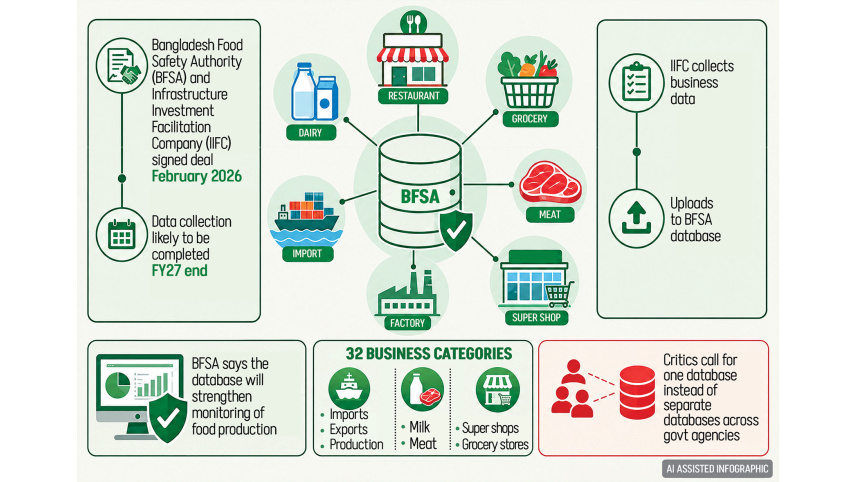
The government has begun collecting data on 10.13 lakh food businesses across the country to provide training on safe food production and supply and improve monitoring to ensure access to safe food for people from all walks of life.
Md Anwarul Islam Sarker, member for enforcement at Bangladesh Food Safety Authority (BFSA), said the initiative was launched because the country lacks a nationwide list of food businesses.

“Our primary goal is to maintain a comprehensive database of all active food businesses in the country,” he said.

A senior official at the BFSA told The Daily Star that the authority has signed an agreement with the Infrastructure Investment Facilitation Company (IIFC), an organisation under the Ministry of Finance.
According to the agreement signed in February this year, IIFC will appoint data collectors to gather information from food businesses across the country. The work will likely be completed by the end of fiscal year 2026-27.
After verification by the respective district food safety officer, the data will be uploaded to the BFSA’s central database software under the authority’s Capacity Building Project.
Sarker said the database would help authorities monitor food production and business activities more effectively.
The listing process, which began about a month ago, is being carried out by a company using trained university graduates to collect information such as owners’ names, trade licence status and business type, he said.
The data is being organised into 32 main categories covering imports, exports and production. It also includes categories for protein sources such as milk and meat, as well as different types of retail outlets, including super shops and grocery stores.
Asked whether the current workforce was sufficient to oversee more than 10 lakh businesses, Sarker acknowledged the challenge but said the database and software were the first step towards building that capacity.
“Monitoring such a large volume of businesses is difficult, but our workforce is expected to grow over time,” he said.
Imran Hassan, secretary general at the Bangladesh Restaurant Owners Association, a platform for restaurant owners, said separate initiatives by different government agencies would not solve the sector’s underlying problems.
He questioned why a separate database was needed when the government already holds business data through multiple agencies.
“Food safety is doing it, consumer rights is doing it, the labour board is doing it -- our long-standing demand has been for a coordinated one-stop service,” he said.
Hassan pointed to inconsistencies in existing records, citing a planning ministry meeting where officials reported an increase of 166,000 business registrations in four months after it had taken 35 years for registrations to reach 600,000.
He warned that without addressing these systemic issues, new projects would only channel donor funds without solving problems on the ground.
Hassan called for a phased plan that starts with improving the database for the country’s 482,000 restaurants and linking it with VAT, TIN and NBR records.
“The problems plaguing this sector have simply been impossible to bring under control so far, despite repeated efforts by various authorities,” said AHM Shafiquzzaman, president of the Consumers Association of Bangladesh.
He expressed optimism that the initiative, if implemented properly, would help address these long-standing problems and provide relief to consumers by improving oversight and accountability.
 For all latest news, follow The Daily Star's Google News channel.
Comments