


Govt may raise excise duty-free deposit limit to Tk 5 lakh

- Duty-free bank deposit limit raised to Tk 5 lakh
- Finance minister to unveil FY27 budget on June 11
- Government considers reintroducing package VAT for small businesses
In order to provide relief to small savers, the government is likely to raise the excise duty exemption threshold for bank deposits in the upcoming budget for fiscal year 2026-27.
Under the proposed measure, individuals with bank deposits of up to Tk 5 lakh will be exempt from paying excise duty starting next fiscal year.

At present, the duty-free bank deposit limit is Tk 3 lakh.
Finance Minister Amir Khosru Mahmud Chowdhury is expected to announce the revised provision on June 11 while presenting the national budget for FY27 in Parliament.
“The limits for the next slabs will remain unchanged,” a senior finance ministry official familiar with the matter said recently.
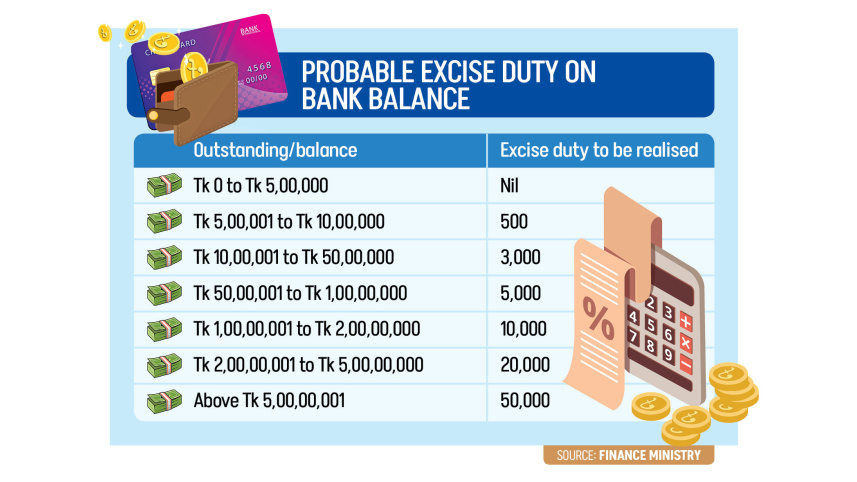
Annual excise duty on bank deposits ranges from Tk 500 for balances between Tk 5 lakh and Tk 10 lakh to Tk 50,000 for deposits exceeding Tk 5 crore, with other slabs in between.
Currently, the government earns nearly Tk 6,000 crore annually from the excise duty through banks.
“If the exemption is implemented, these depositors would benefit from the new relief, though the government could face a revenue shortfall of around Tk 500 crore,” said the official.
Towfiqul Islam Khan, additional research director of the Centre for Policy Dialogue (CPD), argued that the broader policy itself should eventually be abolished in favour of a more equitable taxation framework.
“Excise duty should be phased out gradually. I don’t think it is a fair taxation mechanism,” he said, adding that it was like a “penalty for keeping money in the bank.”
The economist also called for the introduction of a modern wealth tax regime integrated into a comprehensive tax structure.
“They should eventually phase it out and introduce a modern and just wealth tax system. That should be anchored in a comprehensive tax system,” he said.
PACKAGE VAT MAY BE BACK
A certain amount of value-added tax (VAT) collected from small businesses, popularly known as package VAT, may be reintroduced in the upcoming fiscal year.
The proposal is now under active consideration, as compliance with the existing VAT regime remains weak despite years of reform efforts and digitalisation initiatives, according to finance ministry officials familiar with the matter.
They said the move primarily targets marginal and small businesses in rural areas that struggle to maintain proper accounts and comply with the current VAT framework.
Under the package VAT system, businesses pay a fixed amount of VAT every month, usually through their respective trade associations, instead of maintaining detailed records of transactions and input-output calculations.
“We are yet to fix the VAT rate. It may depend on the business’s infrastructure and turnover size,” said a top official of the finance ministry.
 For all latest news, follow The Daily Star's Google News channel.
The system was scrapped in June 2019 following the implementation of the VAT and Supplementary Duty Act 2012 and the launch of the VAT Online Project, which aimed to modernise and digitise VAT collection.
CPD’s Towfiqul Islam Khan expressed doubts about the government’s proposal to expand “package VAT” collection to the upazila or rural level, questioning both its practicality and administrative capacity.
“Bringing this to the rural level and collecting Tk 500 in this manner would be very difficult. Who would collect it? The local government would not, and the NBR lacks personnel at that level,” he added.
He stressed that the government should prioritise digitalisation in tax administration instead of relying on manual collection systems.
Comments