


Govt moves to trim slow-moving projects

Highlights
- Govt to trim slow development projects
- Projects under 30% progress face axe
- Non-viable spending to be weeded out
The government is tightening oversight of development spending by introducing tougher rules to weed out slow and wasteful projects and hold ministries accountable ahead of implementing a record development budget.
As part of it, the planning ministry has instructed all ministries and divisions to review projects that have achieved less than 30 percent progress and scrap those found to be no longer viable.

It has also directed ministries to investigate project delays, cost overruns, irregularities and take action against those responsible, introduce dashboard-based monitoring systems, appoint qualified project directors and speed up the implementation of projects that are ready to begin.
The directives came after decisions were taken at a meeting of the Executive Committee of the National Economic Council (Ecnec), chaired by Prime Minister Tarique Rahman in May. The planning ministry issued the instructions to ministries and divisions on June 14.
Economists welcomed the move, saying trimming slow and wasteful projects was “long overdue”. However, they said the reforms would make little difference unless ministries implement the directives properly and approve future ones only after ensuring full implementation readiness.
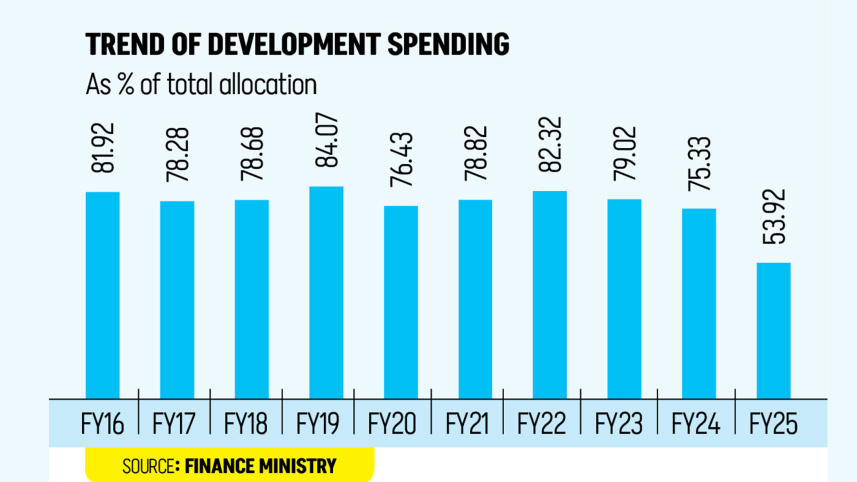
Bangladesh has become progressively worse at implementing its Annual Development Programme (ADP) over the past three fiscal years.
The implementation rate fell from 84.16 percent in FY2022-23 to 80.63 percent in FY2023-24 before dropping to 67.85 percent in FY2024-25. The average implementation rate since FY2008-09 stands at 79 percent, according to official data.
In its letter, the planning ministry said ministries and divisions now can assess whether long-delayed projects are still useful and effective. Based on that review, they may restructure projects, revise their scope or discontinue them altogether.
The ministry has also instructed ministries to accelerate the approval and implementation of new projects included in the “Green Book” of the Annual Development Programme.
The new ADP of the BNP government will take effect from next month, the beginning of fiscal year 2026-27.
The government has approved a record Tk 3 lakh crore ADP for the coming fiscal year, a 50 percent increase from the revised programme for the current fiscal year.
The programme includes about 1,300 projects with specific allocations and another 1,200 new projects with a block allocation of more than Tk 1 lakh crore.
The planning ministry directives also require ministries to identify the causes of delays, cost overruns and irregularities in projects that missed their original completion deadlines.
According to the ministry’s letter, ministries must take action against individuals and organisations responsible for those delays.
To ensure better oversight, every ministry has been instructed to introduce a dashboard-based monitoring system to track project progress regularly.
The government has also said project directors must be appointed solely on the basis of professional qualifications, practical experience and proven skills.
Zahid Hussain, former lead economist of the World Bank’s Dhaka office, said the initiative is a positive step, but decisions on underperforming projects must be based on rigorous assessment.
“I am assuming the decisions will be made through a cost-benefit analysis,” he said.
“For instance, if a project costs Tk 100 and Tk 30 has already been spent, the government must verify whether the ultimate benefits will outweigh the remaining Tk 70 expenditure before releasing further funds,” said the economist.
He explained that if the projected benefits exceed the remaining Tk 70, retaining the project in the ADP is justified; otherwise, it should be scrapped. From that perspective, he said, trimming the ADP was “long overdue”.
 For all latest news, follow The Daily Star's Google News channel.
 However, Zahid questioned whether the reforms would be carried out effectively.
“The real question is whether this decision will be implemented, and if so, whether it will be done properly. Line ministries have their own interests here. As long as a project exists, these vested interest groups reap benefits in various ways.”
He also said that rapidly adding new projects to the ADP could repeat past mistakes. According to him, one of the main reasons for poor ADP implementation and persistent waste is the lack of “implementation readiness” when projects receive Ecnec approval.
“Feasibility studies are often done haphazardly. During the implementation phase, flaws are discovered in the design, and the work and procurement plans are found to be poorly formulated. Consequently, it takes three to four years just to kick-start physical work even after securing approval,” said the economist.
He said Ecnec should approve new projects only after confirming they are fully prepared for implementation.
At a programme in Dhaka yesterday, Zonayed Abdur Rahim Saki, state minister for finance and planning, said that ADP implementation rates have been disappointing and the government is working to overcome this.
He said the government has no interest in undertaking mega projects simply to impress people or create an illusion of development.
“While abruptly halting all the mega projects approved during the previous fascist regime could lead to significant waste and other complications, those projects are now being assessed and rationalised,” he told an event organised by the Debate for Democracy.
Comments