

Govt plans to merge 4 investment agencies
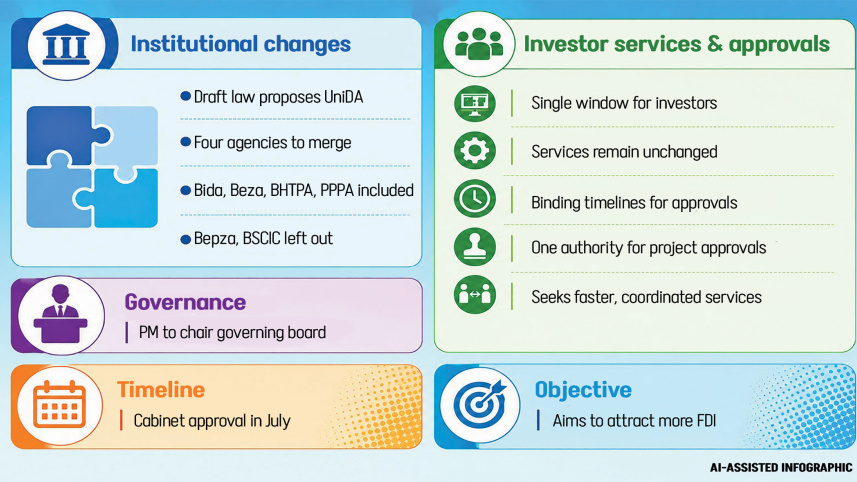
The government is planning to merge four investment promotion agencies into a single authority under a draft law aimed at simplifying investor services, reducing bureaucratic hurdles and improving coordination among state institutions.
The proposed Integrated Investment Development Authority Act, 2026 seeks to establish the Unified Investment Development Authority (UniDA).

The agency would bring the Bangladesh Investment Development Authority (Bida), Bangladesh Economic Zones Authority (Beza), Bangladesh Hi-Tech Park Authority (BHTPA) and the Public-Private Partnership Authority (PPPA) under one umbrella.
The draft law, prepared by Bida, aims to boost domestic and foreign investment, support industrialisation, improve service delivery and ensure more effective use of state-owned industrial and commercial assets.
UniDA would be a statutory body with administrative and financial powers, headquartered in Dhaka, with the authority to open branch offices at home and abroad.
Ashik Chowdhury, executive chairman of Bida, said the proposal was designed to create a single point of contact for investors who now have to approach multiple agencies depending on the nature and location of their projects.
“Investors have repeatedly told us that they want to deal with a single entity instead of navigating multiple organisations for different approvals and services,” he said. “The objective is to reduce hassle for investors and make the entire process more coordinated.”
The merger would not change the services currently offered by the four agencies, Ashik said. “The difference is that the services will be coordinated through one institutional framework.”
Under the draft law, UniDA would be governed by a board chaired by the prime minister or a nominee holding ministerial rank, including key economic ministers or advisers, the Bangladesh Bank governor, heads of the constituent agencies and three private-sector representatives.
An executive council headed by an executive chairman would oversee day-to-day operations. The authority would oversee investment promotion, economic zones, hi-tech parks and public-private partnership projects.
It would formulate investment policies, approve projects, coordinate infrastructure support, monitor approved projects and help remove administrative and legal bottlenecks delaying investment.
If the law is enacted, all private industrial projects not governed by specialised authorities would require registration or approval from UniDA, as would foreign companies seeking to establish branch, liaison or representative offices in Bangladesh.
Once an investment is approved, UniDA would set binding timelines for key services, including land allocation, utility connections, customs clearance and environmental approvals.
The law would also empower the government to declare industrial areas, economic zones and hi-tech parks through gazette notifications, acquire land where necessary under the Acquisition and Requisition of Immovable Property Act, 2017, and transfer unused government-owned industrial and commercial assets for investment projects.
The proposal, however, has drawn concern from some public-private partnership specialists.
Tapas Chandra Bose, a deputy director and researcher on PPPs, said Bangladesh’s low tax-to-GDP ratio and declining access to concessional foreign financing have made PPPs increasingly important for infrastructure development.
He said the PPP Authority’s institutional independence had helped develop a project pipeline worth more than $41 billion, and warned that folding it into a broader investment authority could undermine investor confidence and weaken private-sector participation in infrastructure projects.
He called for wider consultation before the legislation is finalised.
M Masrur Reaz, chairman and CEO of Policy Exchange Bangladesh, questioned whether merging only a few agencies would substantially improve the investment climate, saying the reform overlooks deeper institutional issues.
He said Bangladesh has created multiple agencies with overlapping mandates, with investment-related regulatory services delivered by more than 50 organisations -- yet the proposed merger covers only four bodies, which have fundamentally different functions.
 For all latest news, follow The Daily Star's Google News channel.
 He explained that Beza and BHTPA manage industrial estates, Bida is the country’s main investment promotion agency, and PPPA structures public-private partnership projects.
The priority, he said, should be cutting unnecessary licences, registrations and approvals, rather than relying on institutional mergers alone.
The draft law is in its final stage after stakeholder consultations and is expected to be sent to the Cabinet Division by the end of this month, said Nahian Rahman Rochi, executive member (investment) at Bida.
Rochi said the initiative comes as Bangladesh seeks to attract more foreign investment after several years of relatively weak FDI inflows and amid intensifying competition from regional peers.
“The objective is to create a single, integrated platform for investors without reducing the scope of services currently provided by the existing agencies,” he said.


Comments