


High-tech parks fail to deliver on promise
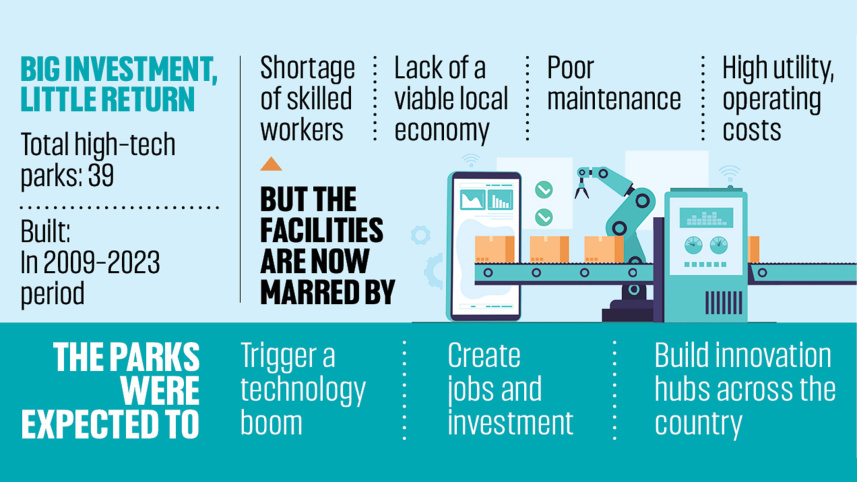
The government built 39 high-tech and software technology parks at a huge cost, but the facilities have failed to deliver the expected investment, jobs and technology growth, according to stakeholders.
They blamed a shortage of skilled workers, weak industry-academia links, poor maintenance, high operating costs and inadequate institutional support for the failure.

Speaking at a virtual discussion titled “Hi-Tech Parks: What is the Mission? What is the Reality?” yesterday, they said the government does not necessarily need to abandon the parks now. Instead, it should focus on making them useful, improving governance and providing the support businesses need.
From 2009 to 2023, the Awami League government built the parks, expecting the infrastructure to drive investment and create a technology boom.
“But results so far clearly show that the assumption was not the right one,” said M Rokonuzzaman, professor of Electrical & Computer Engineering at North South University.
He cited Taiwan, South Korea, Malaysia and Singapore as examples of countries where technology ecosystems grew through stronger links between industry, skills, research and government support.
Faiz Ahmad Taiyeb, former special assistant to the chief adviser, blamed the failure partly on establishing the parks in economically weak areas instead of integrating them with existing commercial hubs.
He said many of the parks were built without considering whether a viable economy already existed around them.
Faiz also questioned the credibility and effectiveness of the training ecosystem, saying the training facilities alongside the parks did not guarantee a steady supply of industry-ready workers.
Rafel Kabir, managing director of DNS Software Ltd, said the parks should have focused on producing core technologies, such as motherboards and chips fabrication.
At the programme organised by the Power and Participation Research Centre (PPRC), entrepreneurs from different parks also spoke about the obstacles they face.
Mohammad Mohidul Islam, managing director of software firm Ongsho at Jashore High-Tech Park, said around 40 companies are trying to stay afloat independently there without effective ecosystem support.
Jashore High-Tech Park was established in December 2017.
Mohidul said the authority treats them as tenants rather than entrepreneurs.
Md Ashafuddoza Shishir, co-founder and chief operating officer of Netro Systems Ltd and Telzen, said ventures from Rajshahi Hi-Tech Park have managed to develop global footprints.
But the direct benefits of operating in the park are limited, he said. “The tangible benefit for companies in Rajshahi park is confined to tax exemptions, as direct authority support for startups is largely absent.”
Farhana A Rahman, chairperson and CEO of UY Systems Ltd, said similar problems are visible at Kaliakoir Hi-Tech Park, where companies were offered plots without the wider services needed to build a functioning business ecosystem.
“We remain trapped in a loop of grandiose promises about high-tech parks, yet despite the building of so many facilities across the country, real progress on the ground is absent,” she said.
“The Kaliakor Hi-tech Park offered land plots but no supportive services. So, many later surrendered their allocations,” Farhana added.
Hossain Zillur Rahman, executive chairman of PPRC and moderator of the discussion, said Bangladesh does not need to abandon the high-tech park model altogether.
 For all latest news, follow The Daily Star's Google News channel.
 He said that the country should rebuild it on firmer foundations, with reliable utilities, accountable governance and support systems that treat companies as partners rather than tenants left to fend for themselves.
“Long-term success requires shifting focus from building physical real estate to cultivating soft infrastructure, skilled human capital, and industry-driven training,” he added.
Comments