


Higher imports raise hopes of stable food prices in Ramadan


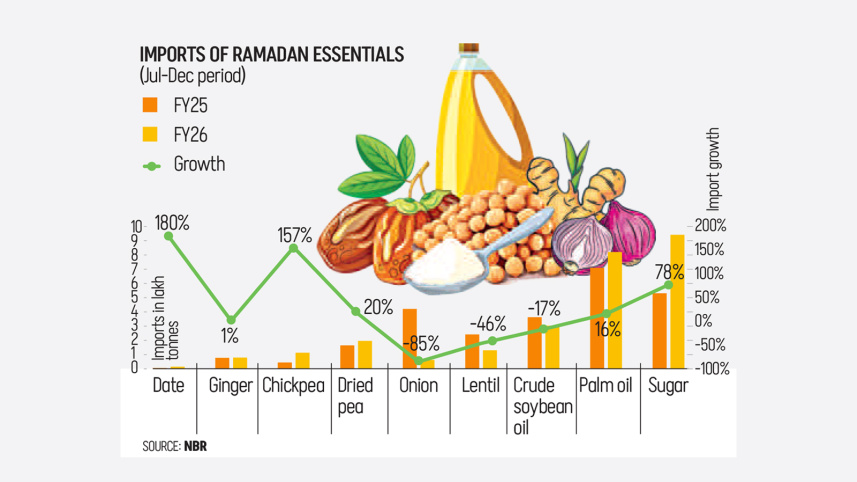
Traders imported more food items during the July-December period last year than in the same period a year earlier, raising expectations of a stable market during Ramadan, which begins in the third week of February.
During the fasting month, demand for several food items, such as lentils, edible oil, chickpeas, onions, ginger, dates and sugar, usually rises.

Imports of these items totalled 26.64 lakh tonnes in the first six months of the current fiscal year (FY) 2025-26, according to the National Board of Revenue (NBR). This was up by 1.04 lakh tonnes, or 4.1 percent, from 25.6 lakh tonnes in the same period last fiscal year.
The figures include goods cleared through sea and land ports, while additional consignments remain in the import pipeline ahead of Ramadan.
SM Muzibur Rahman, head of accounts at Meghna Group of Industries, one of the largest commodity importers and processors, said the company has sufficient stocks of soybean oil and wheat, with steady supplies continuing to arrive.
Rahman said Meghna has not faced any import shortages, ensuring adequate supply to the market.
He added that the company expects no shortages during Ramadan.
Meanwhile, wholesale and retail traders say prices of most essential commodities have remained stable so far. If supply conditions hold, prices of certain items may ease further.
Over the past week, prices of soybean oil, palm oil, onions and turmeric have fallen, while several other commodities have remained steady, according to an analysis of state-run Trading Corporation of Bangladesh (TCB) data.
Mohammad Bablu, a retailer at Karwan Bazar, one of the largest kitchen markets in Dhaka, said prices of most Ramadan essentials have declined compared with three months ago, while overall supply remains strong.
He said chickpeas that sold for Tk 110 three months ago are now at Tk 80 to Tk 90. Sugar prices have also eased, falling from Tk 105 to Tk 95.
Lentil prices have dropped to Tk 80 to Tk 85, down from Tk 100 to Tk 110 three months ago, he said.
Bablu added that edible oil remains the only concern due to highly volatile prices. However, there are no supply shortages.
Abul Hashem, a trader at Moulvibazar, a wholesale hub for sugar and edible oil in the capital, said the market is stable ahead of Ramadan, with no major supply disruptions so far.
He said stability in the coming weeks will depend on refiners and companies maintaining sufficient stock to meet higher Ramadan demand.
Mohammad Sohail, a fruit importer in Dhaka, said imports of dates are progressing smoothly, supported by lower import duties and better dollar availability compared to the previous year.
He said there have been no major difficulties in opening letters of credit, although higher dollar-related costs continue to affect the import bills.
Sohail said prices of dates are expected to fall by an average of Tk 30 to Tk 35 per kilogramme across different varieties. Prices of other high-demand Ramadan fruits, like oranges, are likely to remain stable.
A visit to major retail markets in Chattogram city, including Khatunganj, Reazuddin Bazar and Chawkbazar, showed loose soybean oil selling at Tk 175 to Tk 180 per litre, up by Tk 5 to Tk 8 over the past week.
According to the breakdown of the revenue board data during the first six months of FY26, imports of lentils stood at 1.3 lakh tonnes, down from 2.42 lakh tonnes a year earlier.
 For all latest news, follow The Daily Star's Google News channel.
 Crude soybean oil imports fell to 3.03 lakh tonnes from 3.63 lakh tonnes, while palm oil imports rose to 8.23 lakh tonnes from 7.11 lakh tonnes.
Imports of chickpeas increased to 1.96 lakh tonnes from 1.64 lakh tonnes. Onion imports dropped sharply to 0.62 lakh tonnes from 4.22 lakh tonnes. Ginger imports edged up to 0.78 lakh tonnes from 0.77 lakh tonnes. Date imports rose to 9.45 lakh tonnes from 5.32 lakh tonnes, while sugar imports increased to 26.64 lakh tonnes from 25.6 lakh tonnes.
In an observation, the commerce ministry said that a review of local production, imports and letters of credit shows rising import activity in line with Ramadan-related demand for essential commodities.
The ministry said price movements of import-dependent essentials remain limited, pointing to overall market stability.
It added that Bangladesh Bank data shows foreign currency supply for imports and exchange rates remain stable.
As domestic production of onions and lentils will overlap with Ramadan, prices of these items are also expected to remain steady, the ministry said.
At a press conference at the Secretariat yesterday, Commerce Adviser Sk Bashir Uddin said prices of some commodities are likely to fall during Ramadan.
Compared with last year, imports of essential goods have risen by 40 percent, making this Ramadan more affordable, he said.
He added that businesspeople assured the government at a meeting that supplies would remain normal throughout the month. Prices are expected to stay under control, with no increases, and some items may even become cheaper.
Comments