


India’s role vital for increased Bangladesh-Nepal trade ties
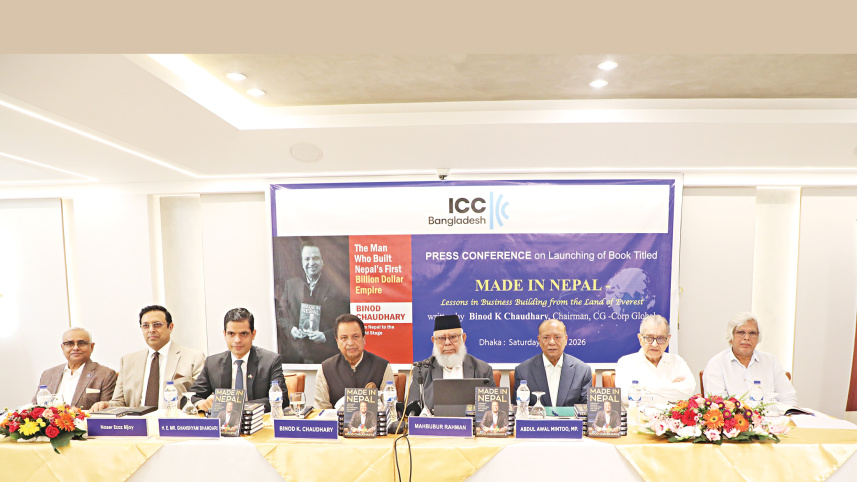
Nepal’s first billionaire, Binod K Chaudhary, yesterday said Bangladesh and Nepal could significantly deepen economic ties, particularly in energy and cross-border trade, which can be largely facilitated by stronger regional cooperation involving India.
“We would like to enter into a much bigger economic engagement with Bangladesh, but without India playing a positive role, that’s not going to happen,” Chaudhary said at a press conference organised by the International Chamber of Commerce Bangladesh (ICCB) in Dhaka.
 For all latest news, follow The Daily Star's Google News channel.
 The event, held at Platinum Grand in Banani, marked the launch of his book “Made in Nepal: Lessons in Business Building from the Land of Everest.”
Chaudhary pointed to Nepal’s growing hydropower capacity as a concrete opportunity, saying Nepal could develop projects specifically targeting the Bangladeshi market, with India facilitating transmission.
India’s evolving stance on cross-border energy cooperation, he added, offers a window for such initiatives.
This becomes necessary due to geography. As Nepal is a landlocked country, trade of this nature depends largely on India’s cooperation.
Binod Chaudhary controls Nepal’s CG Corp Global. The businessman made it to the Forbes billionaire list in 2013. As of yesterday, Forbes estimated his net worth to be $2.1 billion.
Also speaking at the event, Abdul Awal Mintoo, minister of environment, forest and climate change, referred to classical economic theory to stress the value of neighbouring markets.
Drawing on the ideas mentioned in The Wealth of Nations, a classic work of economist Adam Smith, he argued that a country’s prosperity depends significantly on its ability to trade with its neighbours.
He cautioned that reliance on natural resources alone can not be a sustainable path to growth, noting that many resource-rich countries had struggled while trade-driven economies had fared better.
The minister also said strengthening economic ties with adjacent countries should take precedence over distant partnerships when it comes to boosting trade and long-term growth.
Political considerations, he added, should not be allowed to override the economic logic of regional integration.
He said enhanced connectivity, energy collaboration, and trade integration among South Asian nations could unlock substantial economic opportunities, provided countries prioritise pragmatic partnerships over political constraints.
Nepalese Ambassador to Bangladesh Ghanshyam Bhandari said the two countries share similar economic challenges and aspirations, making cooperation in trade and investment both natural and necessary.
The longstanding bilateral relationship, he said, is rooted in geographic and economic interdependence, symbolically linked by rivers flowing from the Himalayas to the Bay of Bengal. He identified stronger engagement between the business communities of the two countries as the practical vehicle for expanding bilateral trade.
The ambassador said Nepal and Bangladesh have the opportunity to define their own economic trajectory through closer regional cooperation, with trade acting as the central pillar of that engagement.
Moderating the event, ICCB President Mahbubur Rahman said businesses in the South Asia region had the potential to compete globally if backed by innovation, long-term vision and sound policy.
Entrepreneurship remains a critical driver of economic growth, particularly for emerging economies like Bangladesh and Nepal, he said. He added that cross-border collaboration and private sector engagement will be crucial in building a more competitive, resilient and globally connected economy in South Asia.


Comments