


Local cashew industry under pressure from cheaper imports
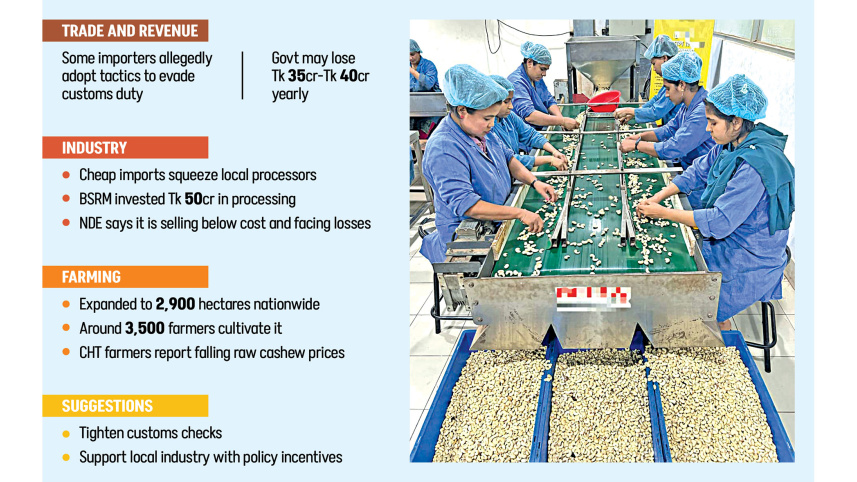
Investors, processors and farmers in the country’s cashew sector are under growing pressure as cheaper imported cashew nuts continue to undercut locally processed products.
Industry estimates show that local processors spend about Tk 1,300 to produce one kilogramme (kg) of processed cashew, excluding profit.

To remain viable, they need to sell at Tk 1,500 to Tk 1,600 per kg depending on quality and market conditions.
However, imported cashews are currently selling at Tk 1,400 to Tk 1,500 per kg, leaving local producers struggling to compete.
“At the current market reality, it is almost impossible for compliant local producers to compete,” said Tapan Sengupta, deputy managing director of BSRM, whose Bangladesh Agriculture Products Limited has invested around Tk 50 crore in cashew processing.
IMPORT PRICING AND TAX CONCERNS
Local producers argue that gaps in customs valuation rules are allowing importers to sell cashews at lower prices, distorting the market, reducing government revenue, and discouraging investment in local cultivation and processing.
According to industry insiders, customs authorities raised the valuation of cashew nuts to $6 per kg in 2023 after detecting irregularities. Cashew imports now face a combined duty and tax rate of 46 percent.
However, customs classify cashew nuts with testa skin -- a reddish-brown outer layer covering the edible kernel -- as intermediate raw materials, since they require minimal additional processing after import. In FY25, the valuation was set at $4.10 per kg.
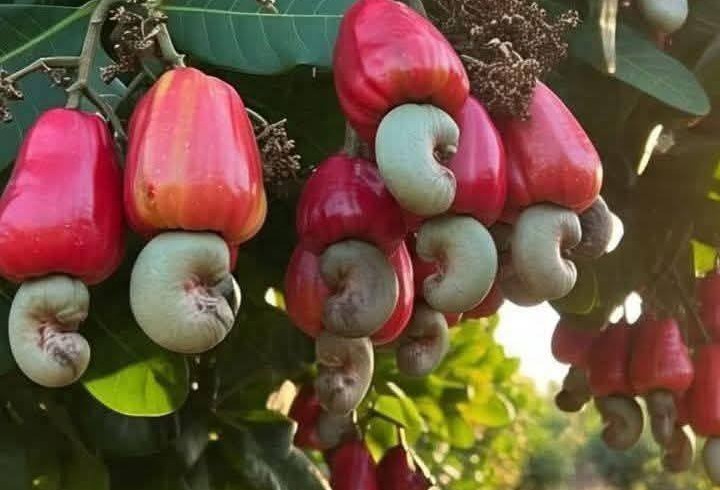
Following this change, importers reportedly shifted towards importing cashews with testa skin to reduce duties and taxes.
Industry insiders estimate that this gives importers a tax advantage of around Tk 101 to Tk 107 per kg, leading to an estimated annual revenue loss of Tk 35 crore to Tk 40 crore for the government.
A National Board of Revenue official said, “We are examining the matter,” but did not comment on whether any decision would be included in the upcoming budget.
The import structure has changed sharply in recent years. Industry data show that imports of cashew nuts with testa skin were almost zero in FY24. This rose to 48 percent in FY25 and reached 87 percent in the first ten months of FY26.
Customs records show that 61 firms imported raw cashews through land ports and Chattogram Port between July 2024 and March 2026, across 239 consignments, with the top 10 importers accounting for 53.5 percent of shipments.
INVESTMENT PRESSURE AND FALLING MARGINS
The sector has attracted investment in recent years as Bangladesh tried to build a domestic cashew industry through plantation expansion in the hill districts and investment in processing facilities.
Md Shamsuzzaman, chief executive officer of NDE, said his company invested about Tk 5 crore to develop an export-oriented cashew processing industry.
However, he said the business is now operating at a loss due to cheaper imports.
“Raw materials cost around Tk 1,100 per kg, while processing and other expenses push the break-even point to nearly Tk 1,400, but processed cashews are currently selling for about Tk 1,250 per kg,” he said.
 For all latest news, follow The Daily Star's Google News channel.
 “When imported products become artificially cheaper, consumers naturally shift towards them,” said Sengupta. “But those prices do not reflect the actual cost.”
“If investors do not see a fair market, they will not continue,” Shamsuzzaman added. “This is a sector that needs patience and consistency.”
FARMERS FEEL THE IMPACT
The impact is now being felt in Rangamati, Khagrachhari and Bandarban, where cashew cultivation has expanded due to suitable soil conditions and storage advantages.
Shahidul Islam, project director of the “Research, Development and Extension of Cashew and Coffee” project under the Department of Agricultural Extension, said cashew cultivation has expanded to about 2,900 hectares across 19 districts since 2021, involving around 3,500 farmers.
He added that Bangladesh produced about 3,000 tonnes of raw cashew nuts in 2025, with more than 90 percent coming from the Chittagong Hill Tracts.
Local producers argue that gaps in customs valuation rules are allowing importers to sell cashews at lower prices, distorting the market and discouraging investment
“At maturity, at least 2.5 tonnes of cashew can be harvested per 0.4 hectare,” he said. “But farmers will only invest if they see a future.”
Farmers say prices have already started falling as processors reduce procurement rates in response to cheaper imports.
Angcheu Marma, a farmer from Roangchari, said raw cashew prices have dropped sharply.
“Raw cashew sold for about Tk 6,000 to Tk 6,500 per maund (40 kg) last year, but this year it has dropped to Tk 4,800 to Tk 5,200 per maund,” he said.
He added that his 200 cashew trees across three acres usually earn about Tk 1 lakh a year, but income is expected to fall this year.
“If we continue to get such low prices, why would we keep producing cashew?” he said.
Comments