


Longer road to recovery as 19 economic indicators worsen
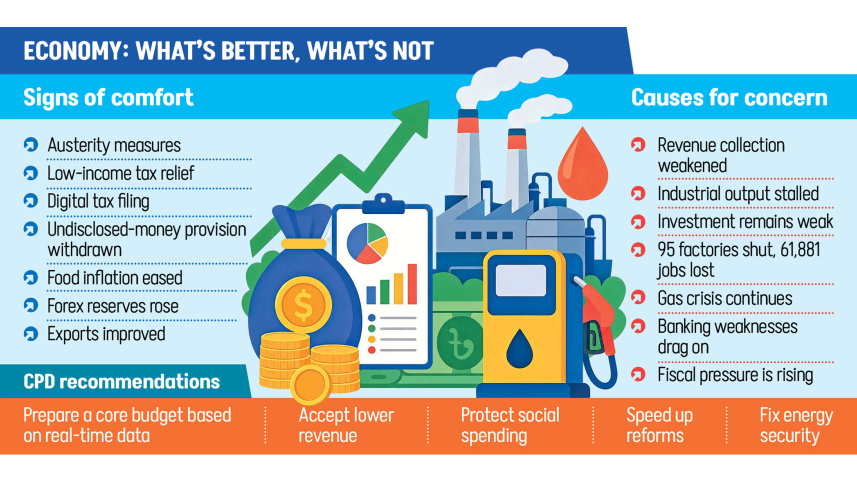
The country’s economic stabilisation remains fragile, and the recovery is likely to take longer than the government expects, said Debapriya Bhattacharya, distinguished fellow of the Centre for Policy Dialogue (CPD).
“Although several government leaders have said the recovery will take one to two years, the country is heading for a prolonged recovery,” he said while presenting a paper at a CPD media dialogue on the government’s performance over the past six months at its office yesterday.

Over the past six months, CPD found that 19 of 31 economic indicators deteriorated, and many of the negative trends were structural.
Debapriya said a longer recovery will require a core fiscal budget and the effective implementation of an integrated and coordinated reform package.
Assessing the government’s performance, the economist described the economic situation over the past six months as “mixed”, with negative trends outweighing positive ones. Many of those negative trends are entrenched and structural, he said.
The CPD assessed 31 economic indicators. Of these, 12 improved, including foreign exchange reserves, while 19 deteriorated over the past six months.
Among the indicators, revenue growth, government bank borrowing, remittance growth, overseas employment and the balance of payments all worsened.
By contrast, export growth, food inflation and implementation of the annual development programme improved compared with the same period a year earlier.
According to CPD, the government inherited weak banks, poor revenue mobilisation, fiscal constraints, subdued investment and an adverse global environment. The US-Israel war on Iran and volatility around the Strait of Hormuz have also sent energy shock waves across the world.
The local think tank reviewed 362 observations across nine areas to assess the government’s performance. Some measures offered grounds for optimism, while others raised concerns.
Among the positive measures were austerity efforts, the abolition of duty-free vehicle entitlements and the introduction of an AI-based traffic management system.
The launch of e-Return, withdrawal of the budgetary provision allowing undisclosed money to be legalised, expansion of bonded warehouse facilities and a waiver of agricultural loans of up to Tk 10,000 also offered some relief.
However, the government has taken no concrete steps to assess public debt stress. Meanwhile, 95 factories permanently shut down across three major industrial belts -- Gazipur, Savar-Ashulia and Narayanganj-Narsingdi – during the January-August period this year, resulting in 61,881 direct job losses.
According to CPD, the abrupt cancellation of the tenure of the previous central bank governor, reportedly without prior notice, and his replacement, amid potential conflict-of-interest concerns, have also raised questions about central bank independence and the basis for senior institutional appointments.
In the energy sector, the government decision to withdraw a proposed electricity tariff increase for low-income and low-use residential consumers was positive. The decision to invite international bids for offshore oil and gas exploration was also encouraging, said CPD.
But the prolonged gas crisis has exposed weaknesses in crisis management and supply planning, it noted. Technical disruptions at Moheshkhali LNG terminals, difficulties in securing replacement LNG cargoes and problems accepting cargoes have prolonged supply shortages.
According to CPD, the shortages are disrupting gas-dependent industries, including textiles, steel, paper, particleboard and ceramics.
On the fiscal front, the think tank said the government should prepare for a revenue shortfall of about Tk 1.30-Tk 1.40 lakh crore in fiscal year 2026-27, as the target is unrealistically high.
CPD said the government is unlikely to exceed the programmed budget deficit limit of 3.6 percent of GDP. The question, therefore, is how public spending can be recalibrated. Historically, no more than Tk 40,000 crore could be cut from non-ADP spending, which accounts for about two-thirds of the total budget allocation.
It said two other areas could put pressure on spending -- a decision on implementing a new pay scale and growing demands for subsidies.
 For all latest news, follow The Daily Star's Google News channel.
 To support economic stabilisation, CPD Distinguished Fellow Debapriya recommended a core budget for October 2026 to June 2027 based on real-time data and a credible fiscal framework.
This would provide a shorter outlook for FY2026 and a near-term outlook for FY2027, he said.
According to him, the core budget targets should be aligned with the Five-Year Strategic Framework for Reform and Development for July 2026 to June 2031.
Debapriya called for an integrated reform package focused on capacity and efficiency in energy security, banking, the proposed bifurcation of the National Board of Revenue (NBR), public spending, rationalisation of the annual development programme, logistics, digitalisation and the wage commission.
“Deliver a credible energy-security package instead of repeated emergency, no-tender imports. Review power purchase agreements to cut the subsidy burden; intensify offshore gas exploration,” he said.
The economist also urged the finance minister to fulfil his responsibility by placing the relevant reform action plan and key economic issues before parliament for scrutiny.
These include the pay scale, banking-sector restructuring, power-sector reform and broader institutional reforms, he added.
Prof Mustafizur Rahman, distinguished fellow of CPD, and Towfiqul Islam Khan, additional director for research at the think tank, were also present.
Comments