


New IMF loan may come next January, say officials

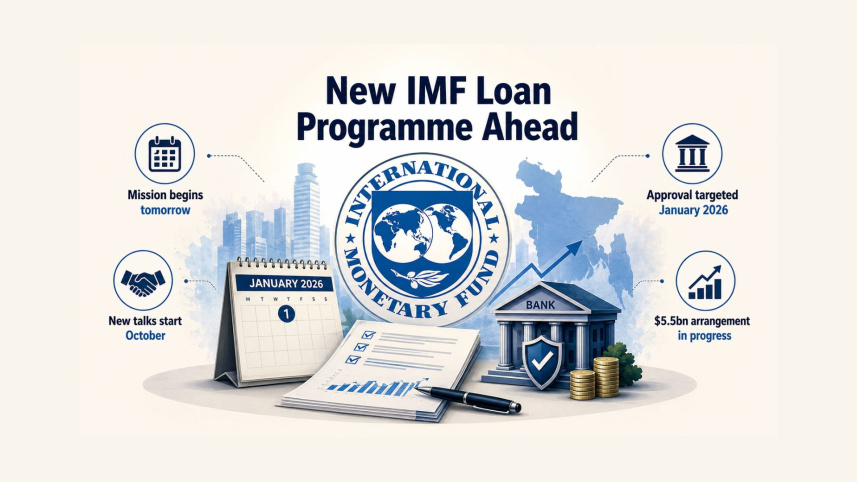
A new International Monetary Fund (IMF) loan programme, prioritising revenue collection growth and banking sector reforms in Bangladesh, may commence next January.
Starting today, a fact-finding mission led by Ivo Krznar, the IMF’s mission chief for Bangladesh, will hold discussions with the Bangladesh Bank, the finance ministry and other relevant agencies to gather updates on reform programmes and government plans to that end.

A finance ministry official, speaking on condition of anonymity, confirmed the matter to The Daily Star recently.
The official said the mission will be brief, lasting up to five days, compared to previous IMF loan or instalment review missions that typically lasted at least 15 days.
They said preliminary discussions on the new loan programme will begin this October, on the sidelines of the IMF-World Bank Annual Meetings in Thailand, with the mission visiting Bangladesh immediately afterwards. Discussions on the core reform programme and loan amount will start in late October or November.
The official added that, subject to satisfactory progress, the new loan proposal will go before the IMF Board for approval in January.
Another finance ministry official, also speaking on condition of anonymity, said last Thursday that the current fiscal year’s budget has already been aligned with the IMF’s reform programme.
For instance, the official said the IMF’s stipulation is that the tax-to-GDP ratio reach 9.2 percent, and the budget deficit stay below 4 percent of GDP. Previously, the main budget allowed for a deficit of up to 5 percent, though actual implementation typically kept it below 4 percent.
The latest mission will examine GDP growth assumptions, revenue measures, expenditure ceilings, subsidy policy, the Annual Development Programme and capital spending, civil servant numbers and new hiring, pay scales, and allowance formulas, according to the official.
It will also review the government’s Family Card programme and its consolidation with other welfare initiatives, electricity capacity charges and tariff adjustments, funding for the Bank Resolution and Recovery Framework (BRRF), and external public debt, the official added.
According to ministry officials, the new programme may be designed by balancing unfinished reforms from the previous programme with the priorities of the new government.
The IMF, earlier in May, agreed to Bangladesh’s request for a new loan programme to replace the existing $5.5 billion arrangement.
In a statement issued last month, the lender said a final decision would require approval from its Executive Board.
“Any new arrangement would need to be based on Bangladesh’s balance-of-payments needs and strong policy commitments anchored by a credible reform agenda, and would be subject to the IMF’s policies and Executive Board approval,” Krznar said in the statement.
IMF staff are engaging with Bangladeshi authorities on their reform agenda and policy priorities as part of the fund’s consideration of next steps, he said, adding that the upcoming staff visit would allow the IMF to assess recent economic developments, engage on policy priorities, and evaluate the outlook and reform challenges.
“Discussions about the parameters of a potential new IMF-supported programme, including its size and related reform commitments, would take place in the context of a subsequent programme negotiation mission,” he added.
The latest development follows a May 21 virtual meeting between Finance and Planning Minister Amir Khosru Mahmud Chowdhury and IMF Deputy Managing Director Nigel Clarke. On May 25, the finance minister said the government and the IMF had agreed to a new three-year programme to replace the existing package.
The IMF approved $4.5 billion for Bangladesh in January 2023 under three facilities -- the Extended Credit Facility (ECF), Extended Fund Facility (EFF), and Resilience and Sustainability Facility (RSF). The package was expanded by $800 million in May last year under the interim government, bringing the total to $5.5 billion. Bangladesh has so far received $3.6 billion across five tranches.
The sixth tranche has been pending since November last year, when the IMF suspended discussions, resuming talks with the new government after the February election. Under the previous schedule, the fifth and sixth tranches, together worth $1.3 billion, were due by June, with a final tranche expected in December.
Discussions on a replacement programme began during the IMF-World Bank Spring Meetings in April, when the lender signalled that no further tranches would be released without visible progress on economic reforms. Virtual talks have continued weekly since, over the proposed loan amount and accompanying reform conditions.
 For all latest news, follow The Daily Star's Google News channel.
 While noting that the current arrangement has provided an important policy anchor during a difficult period, Krznar acknowledged that the macroeconomic and political context has changed substantially since it was approved in 2023.
Authorities now face a more complex set of challenges, he said, with banking-sector weaknesses and low revenue mobilisation underscoring the need for a renewed and sustained reform effort.
Comments