


PM asks all to join forces as innovation fair kicks off
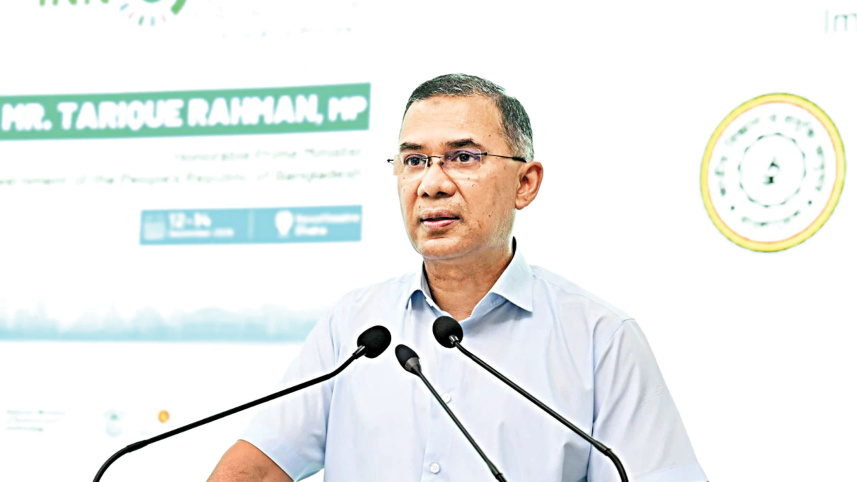
The three-day Bangladesh Innovation Fair 2026 kicked off yesterday in Dhaka, showcasing more than 1,000 innovations in technology, business, education, healthcare, agriculture, environment and other sectors.
Prime Minister Tarique Rahman inaugurated the fair at Novo Theatre in the capital, calling upon citizens, business leaders, young entrepreneurs and researchers to join forces to build a prosperous Bangladesh that reflects the aspirations of its people, reports UNB.

“On behalf of the government, I seek cooperation from all of you. Your support is essential for the state,” Tarique said.
According to organisers, public and private research organisations, 73 universities, researchers, students, startups and small and medium enterprises are participating in the fair, which aims to connect local innovation with policy support, industry, investment and market opportunities.
Organisers said many promising technologies and ideas are developed at the grassroots level but fail to reach the market due to a lack of policy support, initial funding and institutional cooperation.
INNOVATION ECOSYSTEM NEEDED FOR $1TN ECONOMY
Speaking at the event, Muhammad Anisuzzaman Talukder, professor of electrical and electronic engineering at Bangladesh University of Engineering and Technology (BUET), said innovation must move beyond individual research projects and become part of a coordinated national economic strategy if Bangladesh is to achieve the $1 trillion target.
The first priority should be sector-specific investment in innovation, followed by stronger collaboration among industry, academia and the government, Anisuzzaman said.
The government should also develop platforms through which local and international researchers can work together to solve problems facing the country, he added.
Proposing the establishment of a National AI Institute as one such platform, he said, “Those who have talent in our country can work on the platform.
“At the same time, Bangladeshis working abroad and international collaborators can use it to work together on solving different problems in the country.”
The BUET professor also called for changes in how research institutions are evaluated.
Bangladesh’s universities and government research institutions have thousands of researchers and laboratories equipped with expensive equipment, but their research outcomes often remain below international standards, he said.
The government tends to evaluate institutions using the same standards regardless of their research capacity and maturity, he said.
The professor also stressed the need to strengthen intellectual property protection as Bangladesh prepares for LDC graduation in 2026.
The Department of Patents, Designs and Trademarks should be strengthened and digitalised, with greater technical expertise, he said.
The National Skills Development Authority (NSDA) should also work more closely with universities to bridge the gap between academic education and industry requirements, he added.
Anisuzzaman also said government research and innovation initiatives were fragmented among different ministries and sometimes overlapped.
He proposed establishing a national body, possibly called a National Science and Innovation Foundation, to coordinate such initiatives and direct resources towards national priorities.
“This is completely missing at present,” he said.
 For all latest news, follow The Daily Star's Google News channel.
 Bangladesh also needs more universities focused on research rather than undergraduate education to develop an innovation-driven economy, he added.
Comments