


Safe, rewards-driven digital payments shape Ramadan shopping


Ramadan shoppers are increasingly leaving their wallets at home. Across the country, festive spending is shifting from cash-heavy, last-minute rushes through crowded marketplaces to strategically planned, digitally executed, and reward-driven shopping experiences.
“We see increased card usage across groceries, lifestyle, electronics, dining, and holiday travel. To maximise savings, today’s customers actively seek discounts, cashbacks, and flexible payment options,” Nazeem A Choudhury, deputy managing director at Prime Bank PLC, told The Daily Star in a recent interview.

Around 74 percent of all transactions at the bank now flow through digital channels, with usage on its internet banking app, MyPrime, surging by 141 percent during peak festive periods.
“Customers increasingly prefer cards, banking apps, and mobile financial services (MFS) over cash, especially during peak shopping periods like Iftar, Sehri, and Eid shopping,” he noted.
Digital transactions reduce the risks and inconvenience associated with carrying cash, particularly in crowded marketplaces. “In addition, cardholders benefit from exclusive discounts, cashback offers, and instalment facilities, which make digital payments more rewarding.”
To capture that appetite, Prime Bank is running Ramadan and Eid offers that include cashback of up to Tk 10,000 and discounts of up to 35 percent across electronics, lifestyle, furniture, groceries, ticketing, and leading online platforms. Restaurant platter deals round out the offer for cardholders.
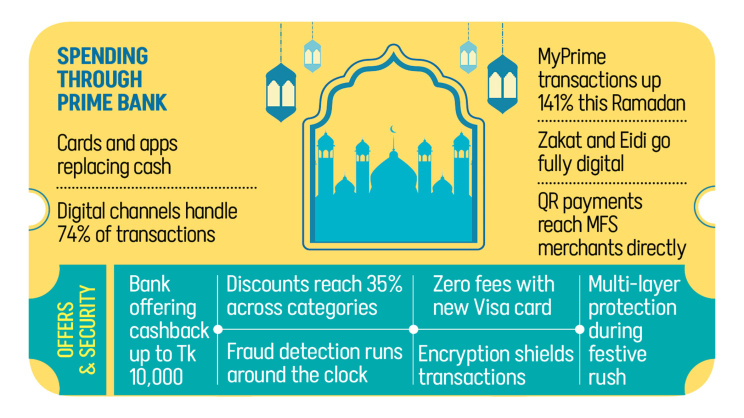
Choudhury informed that the bank has also launched ZERO, a Visa Signature credit card positioned on a no-fee model, with no issuing fee, annual fee, MFS wallet transfer fee, over-limit fee, transaction alert fee, or EMI processing fee.
The infrastructure behind the festive rush runs deeper than offers alone. According to Choudhury, MyPrime is tightly integrated with MFS providers, allowing customers to transfer funds from their Prime Bank accounts into MFS wallets and vice versa.
A Bangla QR payment feature, enabled through the integration of the National Payment Switch Bangladesh (NPSB), lets users scan and pay MFS merchants directly, he added.
For more spiritually significant transfers, the bank has also built dedicated functionality into MyPrime.
“MyPrime is integrated with Prime Bank’s Core Banking Solution (CBS) and multiple external payment channels to facilitate effortless Zakat and Eidi transfers,” he said. “Customers can easily donate Zakat to a wide range of verified Zakat funds directly from the app.”
Besides, Eidi transfers can be sent peer-to-peer within Prime Bank, pushed through real-time interbank transfers via NPSB, or routed to MFS wallets, effectively covering every recipient scenario a user might face.
On the security side, the bank has layered protections across the system.
Choudhury said, “Prime Bank ensures robust security on MyPrime, even during peak traffic like Eid. Every transaction is protected by multi-layered controls, including device binding and 2FA/OTP (two-factor authentication/one-time password).”
“Our backend utilises secure APIs, data encryption, and tokenisation for safe partner integrations, backed by continuous real-time monitoring and proactive fraud detection,” he added.
 For all latest news, follow The Daily Star's Google News channel.
Comments