


Source tax, AIT to deliver 83% of income tax

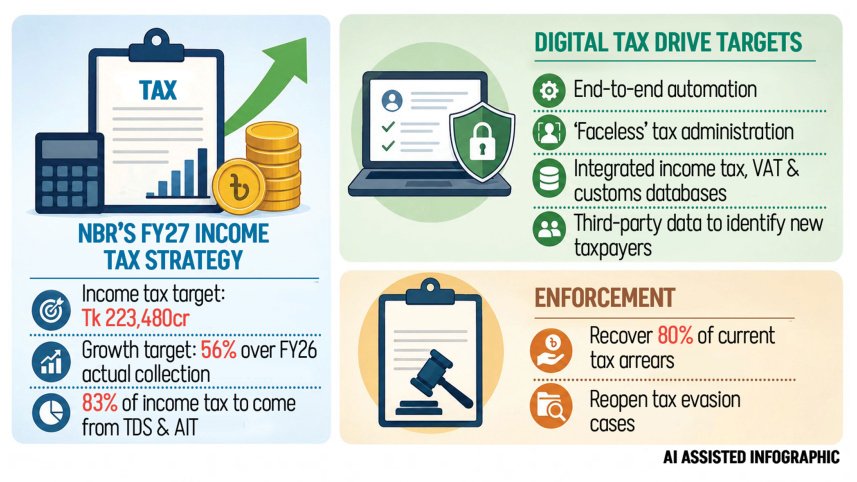
The National Board of Revenue (NBR) plans to collect more than four out of every five taka in income tax through tax deducted at source and advance income tax (AIT) in the current fiscal year, extending a strategy that already delivered over 85 percent of income tax collection in FY2025-26.
The NBR is targeting 56 percent growth in income tax collection over FY26’s actual receipts and is counting on Tk 1.86 lakh crore from source tax and AIT combined, backed by tighter monitoring and enforcement, according to officials familiar with the matter.

Of that, Tk 1.54 lakh crore is expected from source tax, a 51 percent rise over last year’s collection, and Tk 32,000 crore from AIT, up 54 percent year-on-year.
NBR officials presented the strategy, which aims to secure 83 percent of income tax from source tax and AIT, to Rashed Al Mahmud Titumir, adviser to the prime minister on finance and planning, at an internal meeting on Monday.
The target underscores the scale of the challenge facing Bangladesh, which has one of the lowest tax-to-GDP ratios in South Asia, limiting the government’s ability to fund development spending and social protection without resorting to more borrowing. The NBR has set a longer-term goal of lifting the ratio to 15 percent by 2030, with a 10 percent milestone in the medium term.
To get there, the authority is pushing to modernise tax administration through end-to-end automation and a “faceless” system meant to limit direct interaction between taxpayers and officials, with the aim of improving transparency and compliance.
As part of the initiative, the income tax, VAT and customs wings will be digitally integrated. Officials say this will allow the NBR to cross-match data from government agencies and third-party sources to identify high earners and businesses currently outside the tax net, without raising tax rates.
Revenue officials expect automation to improve taxpayer services while strengthening enforcement. A fully digital filing and assessment process is also expected to reduce discretionary decision-making and enhance administrative efficiency.
The NBR is also tightening arrears recovery, instructing field offices to recover at least 80 percent of outstanding tax arrears, and is targeting Tk 3,000 crore in travel tax collection, about 41 percent higher than last year’s actual figure.
Additional revenue is expected from stronger enforcement against evasion, reopening closed tax cases, and faster resolution through Alternative Dispute Resolution and pending High Court cases, officials added.
“We are optimistic that tax collection will increase from the various measures introduced in the last budget,” an NBR official said yesterday. “For example, the 0.20 percent business-to-business tax deducted at source and the advance income tax on vehicles have already started contributing to revenue.”
But economists and business leaders have long argued that the growing reliance on source tax burdens businesses, raising operating costs and adding to inflationary pressure.
A study by the Business Initiative Leading Development (BUILD), a public-private dialogue platform, found that source tax is imposed under 111 separate provisions, 40 of which are entirely non-refundable. Even among the 71 provisions that are technically refundable, businesses have recovered just 0.29 percent of taxes deducted. This means 99.71 percent of source tax effectively functions in practice as a minimum tax rather than an adjustable advance payment, the study found.
BUILD argues businesses pass this unrecoverable cost on to consumers through higher prices, compounding inflation.
 For all latest news, follow The Daily Star's Google News channel.
Comments