


Superstore scene heats up as newcomers join the race

- Retail sector shifts as superstores eye urban growth
- Foreign investment pours into Bangladesh’s modern retail market
- Metro rail stations become new hubs for superstores
For generations, Bangladeshis began their mornings at wet markets, checking hilsa by the gills, poking gourds for tenderness and haggling over banana blossoms before heading home with heavy bags.
But rapid urbanisation and changing lifestyles have altered that routine. Few city dwellers now have time for early market trips, and many are no longer confident about selecting fresh fish.
 For all latest news, follow The Daily Star's Google News channel.
 Around 25 years ago, the country’s first superstores arrived to serve urban shoppers.
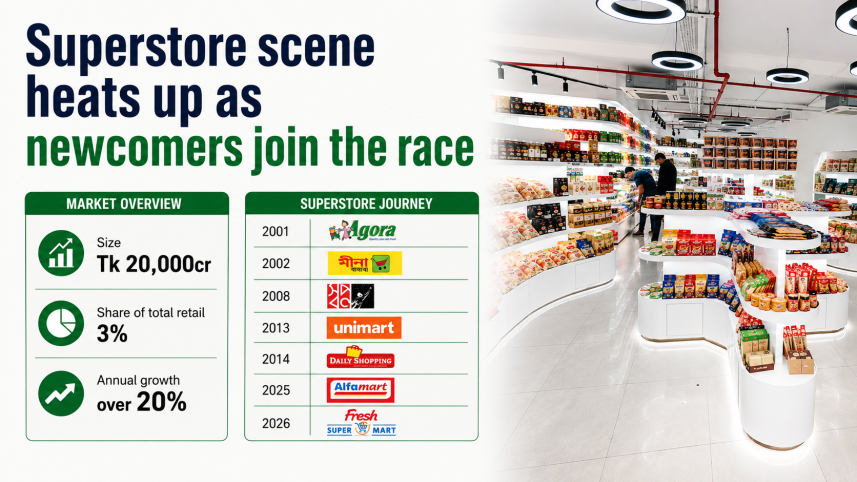
Over the years, modern retail followed a similar model across different chains, focusing on quality products, fresh groceries and convenience. With this recipe, the sector’s share of the wider market has remained at about 3 percent, or Tk 20,000 crore, over the past two and a half decades.
However, following a sales boost during the pandemic and the recent withdrawal of the additional value-added tax (VAT) on superstore purchases, more local and foreign firms are competing for a share of the retail segment with an estimated growth of 20 percent annually.
Unlike earlier models, many new entrants are adopting different approaches. For instance, Fresh Super Mart, a new brand from Meghna Group of Industries, has been opening stores at metro rail stations in Dhaka.
Like modern cities such as Tokyo and London, Fresh Mart says it is following footfall patterns rather than opening outlets only in residential neighbourhoods.
Currently, there are 30 major superstore brands in the country, according to the Bangladesh Supermarket Owners Association.
The sector basically started in the major cities, but franchise models from ACI’s Shwapno and Pran Group’s Daily Shopping have pushed it into some upazila towns.
Many urban consumers now buy monthly groceries, including rice, vegetables, fish, meat and household goods, from superstores. However, most still combine supermarket visits with traditional wet market shopping, especially for fresh produce.
Roksana Afroz, a resident of Dhaka’s Badda area, said she mainly buys products that are easier to find in superstores than in local shops. “In grocery stores, there is usually a limited variety of packaged goods and the brands are limited to a few specific ones. However, super shops make a wider range of products easily available.”
“Since I do not have to pay extra VAT, I can buy products at the same price, and sometimes even get discounts. In some cases, certain vegetables are also cheaper than in the market, and there is no hassle of bargaining,” she added.
She also said imported goods offer added assurance in superstores. “Additionally, for imported products, the importer’s seal ensures confidence and allows for safe purchases.”
Shahjahan Ali, a resident of Mirpur in Dhaka, said he uses both superstores and kitchen markets depending on need. He said superstores offer more stable pricing.
As an example, he said edible oil prices recently increased by Tk 10 to Tk 20 per litre in the open market without notice, while superstores continued selling at earlier rates.
He added that superstores save time as most essentials are available under one roof. However, he still prefers traditional markets for vegetables and leafy greens.
PROMISE OF CONVENIENCE, QUALITY AT THE CENTRE
The country’s first retail chain, Agora, was established in 2001 by Rahimafrooz Superstores Ltd. Its tagline was “Quality you can trust”.
A year later, Gemcon Group launched Meena Bazar, promising freshness to everyday life.
Shwapno, now the market leader with 902 outlets and a 53 percent share of modern retail, was launched by ACI in 2008. Its slogan is “best shopping with your hard-earned money”.
Pran introduced Daily Shopping in 2014, focusing on convenience. Since then, the sector has expanded steadily, with new outlets opening regularly.
During the pandemic, supermarket sales received an additional boost as online delivery services gained popularity.
Sabbir Hasan Nasir, managing director of Shwapno, said most consumers in Bangladesh prefer to shop close to home. Therefore, the company follows a neighbourhood-based model through multiple retail formats.
Nasir said Shwapno has expanded from 37 outlets in 2012 to 902 outlets at present, with rapid growth after the Covid pandemic.
Pran’s Daily Shopping began in January 2014 with just seven outlets and 30 employees in Dhaka. Initial investment stood at about Tk 1 crore, said Firoj Alam, general manager of Daily Shopping.
The chain has now expanded to 112 outlets and plans to open about 35 more.
Alam said the growth shows changing consumer habits. The company now employs about 1,000 people, with total investment rising to around Tk 90 crore.
He said superstore usage has increased from less than 1 percent of the population to about 3 percent, and could rise to 6 percent as incomes grow and habits change.
Pricing transparency is one of the key reasons customers choose superstores, according to Alam.
“Another advantage is customers enjoying greater freedom. In traditional wet markets, vendors select products for buyers, but in superstores, customers can personally choose and inspect the products they want,” he said.
He added that the removal of the 5 percent value added tax on superstore purchases has made organised retail more competitive and accessible.
Shameem Ahmed Jaigirder, chief operating officer at Meena Bazar, said they wanted to build a direct and sustainable link between small farmers and consumers.
“We still want to empower farmers by ensuring fair value for their produce while delivering fresher and safer products to customers. Our ‘Back to Root’ initiative shows our long-term commitment to strengthening local agriculture and building a more transparent food supply chain,” he said.
GROWING MARKET DRAWS FOREIGN INVESTMENT
As modern retail gains popularity, foreign firms are taking notice, either through joint ventures with local brands or by opening outlets directly.
This year, Shwapno has signed a partnership with Japan’s Mitsui & Co Ltd. The partnership is meant for reducing financing costs and improving services.
Separately, Indonesian retail giant Alfamart entered Bangladesh in October 2025. In a joint venture with Kazi Farms Group, it launched a chain of compact superstores targeting urban and semi-urban consumers.
Japan’s Mitsubishi Corporation is one of Alfamart’s existing shareholders. The first phase of the project involves foreign investment of $50 million, followed by a further $70 million in a second phase.
“So far, we have opened one store in Gulshan and another in Uttara,” said Kazi Zahin Hasan, director of Kazi Farms Group.
Firoj Alam of Daily Shopping said rising competition from local and international brands is a positive development. “We see this competition positively because it prevents monopolies, encourages service improvement, and gives customers better choices in terms of quality and pricing,” he said.
MEGHNA NOW OPENING STORES BY RAIL TRACKS
As competition intensifies, retailers are rethinking how and where they operate. Instead of waiting for shoppers, many are moving closer to high-footfall urban spaces.
Under an agreement with the Dhaka Mass Transit Company Limited, Meghna Group Industries (MGI) will run nine Fresh Super Mart outlets at metro stations for five years from January 2026.
The locations include Motijheel, Bangladesh Secretariat, Dhaka University, Mirpur 10, Mirpur 11, Pallabi, Uttara Centre and Uttara North stations.
Tanveer Ahmed Mostafa, director of Meghna Group Industries, said the stores will offer a modern retail environment focused on daily essentials, including dairy, frozen foods, groceries, household items, health and beauty products, café items, ready-to-eat food and over-the-counter pharmacy goods.
He said metro stations have become key retail points due to heavy commuter traffic. “Thousands of commuters pass through daily, often needing quick purchases.”
Mostafa said that MGI wants to build a neighbourhood-style retail experience rather than large destination supermarkets.
“We are not building a destination superstore. We are creating a network of small-format stores suited to how the city moves today; quick breakfast and coffee on the way in, essentials on the way home, and a familiar face at the counter,” he said.
The group already runs four outlets at Tejgaon, Meghnaghat and the Meghna Industrial Zone, with another planned at its Gulshan office.
Meghna data shows outlets at Dhaka University and Mirpur 10 are showing promising sales.
Md Deen Islam, in-charge of the Dhaka University metro station outlet, said the store carries about 30 product categories and has seen consistent sales since opening.
He said there are two peak periods each day. The first runs from 8am to 12pm, driven by office workers, students and commuters. The second runs from 4pm to 8pm, as people return home.
Islam added that the outlet has developed a base of repeat customers, particularly for snacks, desserts and ready-to-eat items. “A significant portion of our customer base, nearly 40 percent, consists of Dhaka University students, which reflects the strong connection between the outlet and the campus community,” he said.
Comments