


Telecoms turn to AI to save energy, other costs
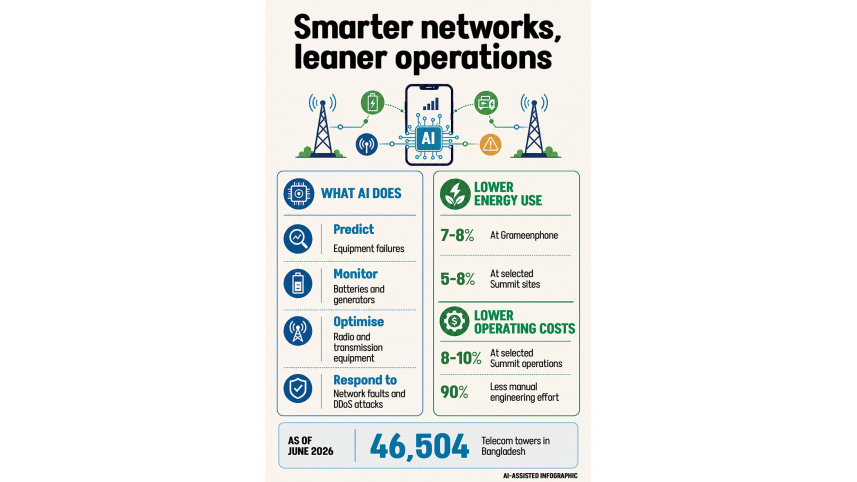
Artificial intelligence is moving deeper into the day-to-day management of Bangladesh’s telecom infrastructure, helping operators and tower companies cut energy use and operating costs.
The technology is being used to switch network equipment on and off according to traffic, monitor batteries and generators, predict equipment failures and automate network operations. It is also reducing the need for field visits.

The potential savings are significant because of the sheer scale of the infrastructure. Bangladesh had 46,504 telecom towers in June 2026, according to BTRC data. Of these, 11,788 were associated with Grameenphone, 3,910 with Banglalink, 3,469 with Teletalk and 2,189 with Robi.
Tower-sharing companies also operate thousands of sites, including 16,979 operated by edotco and 5,539 by Summit Communications.
SAVING ENERGY, MONEY
One of the most direct ways AI is cutting costs is by reducing the electricity needed to operate mobile networks and towers.
Telecom equipment traditionally remained powered continuously to ensure capacity was available whenever customers needed it. AI allows networks to analyse traffic patterns and adjust resources according to demand.
At Grameenphone, AI-based autonomous network management has generated 7-8 percent energy savings.
“In the autonomous network, we are actively working with energy efficiency. Our target was 7 percent, and we have achieved 7 percent to 8 percent savings so far,” said Syed Shakil Ahmed, head of AI Strategy and Development.
The system analyses traffic patterns at the cell level and identifies periods when demand falls. Network resources can then be reduced in real time, lowering power consumption without affecting the customer experience.
“AI helps identify the sweet spot to reduce power and to what level,” Shakil said.
Tower companies are applying similar technology to the power infrastructure supporting mobile networks. AI-assisted systems analyse electricity consumption, battery performance, generator use, fuel consumption and grid availability.
Summit Communications Managing Director Arif Al Islam said preliminary operational estimates at selected tower sites and applicable operational areas indicate 5 percent to 8 percent lower energy consumption through AI-assisted remote monitoring, predictive maintenance, automated monitoring, optimised work scheduling and fewer unnecessary site visits.
At edotco Bangladesh, AI is being used to forecast requirements for batteries, power systems, solar solutions and backup energy resources based on network traffic, power availability and site-specific conditions.
“By using AI-driven analytics, we can make faster and more accurate planning decisions, optimise resource allocation, reduce unnecessary capital expenditure and improve energy efficiency across our tower portfolio,” said Al Batuni Mohammad Sayed Ahmed, country managing director of edotco Bangladesh.
AI is also being used to optimise generator runtime and encourage greater use of renewable energy.
CUTTING COSTS ELSEWHERE
The financial gains from AI extend beyond energy. Companies are using it to automate repetitive tasks, reduce emergency maintenance and limit physical intervention.
Summit Communications estimates that selected operations have achieved 8-10 percent lower operating expenditure through AI-assisted remote monitoring, predictive maintenance, automated monitoring, optimised work scheduling and fewer unnecessary site visits.
Arif Al Islam also said automated DDoS attack detection and mitigation -- tasks that previously required an engineer to manually analyse traffic and implement fixes and could take several hours -- can now detect, decide and mitigate an attack in under one minute.
 For all latest news, follow The Daily Star's Google News channel.
 According to Summit, the system has reduced the associated manual engineering effort by approximately 90 percent, while the protected services have maintained around 99.95 percent uptime.
Summit stressed that the resulting 100 percent saving applies only to that particular cost category and should not be interpreted as a 100 percent reduction in overall operating expenditure.
AI is also changing how tower maintenance is planned. Instead of relying mainly on periodic inspections, engineers can use real-time information and historical patterns to identify equipment likely to fail.
This allows maintenance teams to intervene before a fault becomes an emergency, reducing repair costs and unnecessary field visits.
At edotco, AI-enabled monitoring is being used for predictive fault detection, automated event analysis, root-cause identification and intelligent ticket management, Sayed Ahmed said. Banglalink is also using AI to reduce energy and maintenance costs. Its systems predict site, power and transmission failures, allowing the operator to deploy additional batteries or take other protective measures before an outage occurs.
AI-powered alarm correlation and root-cause analysis are being used to reduce mean time to repair, while predictive maintenance helps forecast equipment failures and reduce emergency maintenance. The operator is also using AI to optimise radio and transmission equipment according to the time of day.
“We optimise equipment which helps us to reduce fuel, battery, and grid power usage to lower energy costs,” said Taimur Rahman, chief corporate and regulatory affairs officer.
“We see AI not as a headline but as an enabler of smarter infrastructure management, higher service reliability, and better decisions,” said Summit’s Arif.
Comments