The unfinished histories of Partition

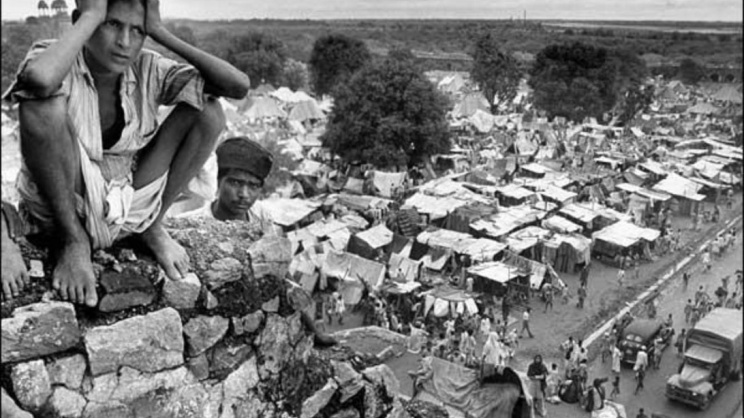
The Partition of India in 1947 continues to be one of the most consequential and contested events in modern South Asian history. The imperial cartography of British rule transformed the political geography of the subcontinent, creating the new state of Pakistan, altering the territorial imagination of India, and generating one of the largest forced migrations of the twentieth century. Yet Partition was not merely a political event. It was also a profound human catastrophe involving communal violence, displacement, abduction, dispossession, separation, and death. Its consequences extended far beyond the drawing of a boundary between two newly independent states.
Almost eight decades on, Partition relentlessly resists authoritative closure, rendering any attempt to foreclose its meaning premature. It has been narrated as the culmination of Muslim political aspirations, the failure of Indian nationalism, the consequence of British colonial policy, an administrative catastrophe, a civilizational rupture, a political compromise, a historical contingency, and a tragedy of ordinary people caught in the violent transition from empire to nation-state. The very abundance of these interpretations raises a question that is historiographical rather than merely historical: why does the same historical event produce such different histories?
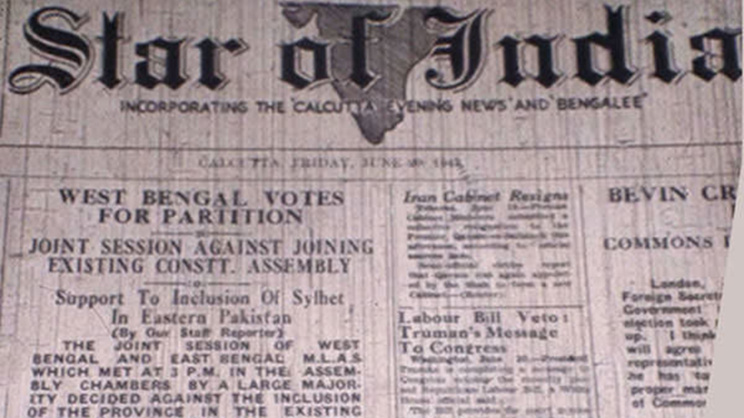
The problem begins with the word Partition itself. It denotes division, separation, and rupture. Yet it also conceals the processes through which the division occurred. Partition was not accomplished by a single act on 14–15 August 1947. It emerged through decades of political negotiation, constitutional experimentation, communal mobilization, colonial administration, competing nationalisms, and the eventual collapse of political accommodation. The final territorial division was followed by mass migration and violence on an extraordinary scale.
One might therefore invoke, cautiously, the metaphor of parturition: Partition as a painful birth. A new political order emerged from the dissolution of an older one. Pakistan was born, but the birth was accompanied by displacement, violence, and death. India became independent, but its independence was inseparable from territorial rupture. The metaphor should not be pushed too far, but it captures something important: Partition was simultaneously an ending and a beginning, a death and a birth.
It is precisely this ambiguity that makes Partition such a fertile field for historiography. Was it the birth of nations or the death of a shared political world? Was it liberation from colonial rule or the catastrophic consequence of colonial withdrawal? Was Pakistan the inevitable realization of Muslim nationhood or the contingent outcome of political negotiations? Was Partition imposed from above or produced through political forces operating from below? The answers depend in large measure upon the historiographical position from which the event is viewed.
One might therefore invoke, cautiously, the metaphor of parturition: Partition as a painful birth. A new political order emerged from the dissolution of an older one. Pakistan was born, but the birth was accompanied by displacement, violence, and death. India became independent, but its independence was inseparable from territorial rupture. The metaphor should not be pushed too far, but it captures something important: Partition was simultaneously an ending and a beginning, a death and a birth.
The British and Imperial narrative
The earliest British interpretations of Partition frequently approached the event through the language of constitutional difficulty, communal antagonism, administrative crisis, and the apparent inability of Indian political leaders to reach agreement. Within this narrative, British rule could appear as the force attempting to mediate among competing communities while gradually confronting an increasingly ungovernable political situation.
Such an interpretation had an obvious political utility. It could portray the British departure as the reluctant conclusion of an imperial responsibility rather than as the culmination of a colonial system whose policies had contributed to political fragmentation. The failures of Congress, the Muslim League, and other political actors could be foregrounded, while the structural effects of colonial governance remained less visible.
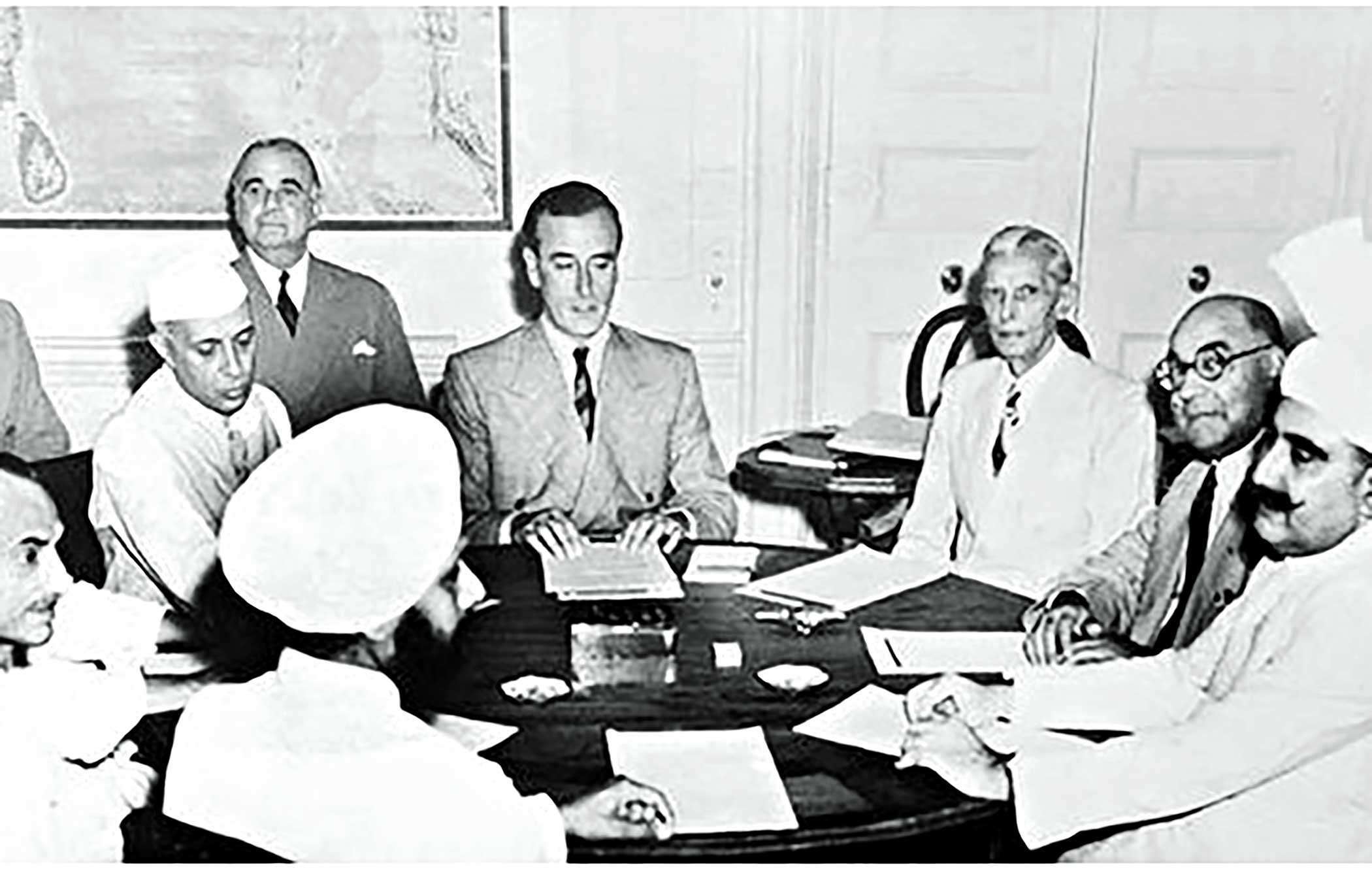
Later scholarship has complicated this interpretation. Colonial rule did not merely encounter communal divisions that already existed in finished form. Through censuses, administrative classifications, electoral arrangements, representative institutions, and political practices, the colonial state helped organize social differences into increasingly consequential political categories. Religion did not suddenly become politically meaningful in the twentieth century, but colonial institutions altered the ways in which religious identity could be represented, counted, negotiated, and mobilized.
The transfer of power itself has consequently become an object of historical scrutiny. The speed with which British authority was withdrawn, the timing of independence, the hurried demarcation of boundaries, and the administrative inadequacies surrounding population movement have all raised questions about British responsibility for the violence that followed.
The British historiographical narrative has therefore changed. What might once have been presented primarily as an administrative withdrawal from an impossible political situation can now also be examined as the final act of a colonial process whose institutional legacies profoundly shaped the circumstances of Partition and its aftermath. The paradox did not end in 1947. The territorial division produced by Partition continued to shape the political and social trajectories of India and Pakistan, even as the forms of that inheritance differed across the two states. The trauma of displacement, violence, and lost homelands remained embedded in their competing national memories. Partition therefore constituted not merely a rupture between two states but an enduring condition through which both continued to imagine themselves and each other.
The Indian nationalist narrative
Indian nationalist historiography has traditionally produced a different account. In its more conventional form, Partition appears as the tragic fragmentation of an India imagined as a historical, territorial, and civilizational whole.
Yet this formulation itself requires qualification. India existed long before British rule as a geographical, cultural, and civilizational conception, but not as a unified modern nation-state corresponding to the territorial entity that emerged from colonial rule. The distinction matters because the retrospective imagination of an already unified India can turn Partition into the apparent destruction of a pre-existing national unity rather than a rupture within a historically evolving political geography.
The work of historians such as Romila Thapar is important to this broader historiographical problem because it complicates the tendency to project the modern nation backward onto the premodern past. The historical idea of India has had multiple geographical, cultural, political, and civilizational forms. Treating these earlier formations as equivalent to the modern nation-state risks turning a complex historical inheritance into a teleological national narrative.
Within the conventional nationalist account of Partition, however, the demand for Pakistan and the political strategy of the Muslim League occupy a central place. The failure of negotiations between the Congress and the League becomes one of the principal explanations for the eventual division. Partition thus appears as the price paid for the failure of Indian unity.
The suffering of Hindus and Sikhs displaced from territories that became part of Pakistan has understandably occupied an important place within this memory. Refugee experience, loss of property, communal violence, and the destruction of established communities became powerful components of the Indian national memory of Partition.
Within the conventional nationalist account of Partition, however, the demand for Pakistan and the political strategy of the Muslim League occupy a central place. The failure of negotiations between the Congress and the League becomes one of the principal explanations for the eventual division. Partition thus appears as the price paid for the failure of Indian unity.
But the nationalist narrative can also produce its own exclusions. If India is treated as an already constituted national unity, Muslim political aspirations can appear primarily as a force of fragmentation rather than as part of the contested political history of late colonial India. Such a perspective risks making the emergence of Pakistan appear self-evidently illegitimate or historically anomalous rather than asking why a substantial section of Muslim political leadership came to regard a separate state as necessary.
The historiographical problem, therefore, is not to dismiss Indian nationalist memory but to recognize its particular location. It represents one historical experience of Partition, not the totality of Partition.
The Pakistani and Muslim nationalist narrative
Pakistani and Muslim nationalist historiography has traditionally begun from a different premise: the political insecurity of Muslims within a Hindu-majority India.
The Two-Nation Theory provides the conceptual foundation for much of this narrative. Muslims were understood not merely as a religious minority but as a distinct political nation. The demand for Pakistan could consequently be represented as the culmination of a long struggle to secure Muslim political autonomy and protection.
From this perspective, Pakistan was not simply the product of India's failure to remain united. It was the political realization of Muslim self-determination. Partition could therefore be remembered as a moment of national achievement and liberation from the possibility of permanent political subordination.
Yet here too the national narrative can become teleological. If the creation of Pakistan is treated as the inevitable destination of Muslim politics, the uncertainties and alternatives of the pre-Partition period disappear. Muslim political opinion was never completely homogeneous. Regional interests differed; class interests differed; political parties differed; and Muslim intellectuals disagreed profoundly over the meaning of nationalism, representation, and sovereignty.
It is therefore misleading to treat "the Muslim position" as a singular historical entity. The political history of Muslims in British India was contested and internally diverse. The eventual creation of Pakistan should not erase the historical contingency through which that outcome emerged.
For the same reason, the categories "Hindu history" and "Muslim history" are inadequate descriptions of the historiography. It is more precise to speak of Indian nationalist and Pakistani/Muslim nationalist historiographies, while recognizing the diversity within each.
The Cambridge School and the revision of nationalist history
Later historiography challenged the simplicity of nationalist narratives by directing attention toward political negotiations, regional interests, and the contingent character of political decision-making. The so-called Cambridge School, associated with historians such as Anil Seal and others, questioned interpretations that treated Indian nationalism primarily as the expression of an overarching ideological movement. Instead, it emphasized local political networks, patronage, factional competition, and the operation of political interests within colonial institutions.
Applied to the history of nationalism, and by extension to Partition, this approach complicated the conventional nationalist story. Political actors were not always simply representatives of monolithic communities. They operated simultaneously through region, class, locality, patronage, political ambition, and institutional opportunity. Political mobilization could therefore emerge from intersecting interests rather than from a single, coherent nationalist consciousness.
Applied to the history of nationalism, and by extension to Partition, this approach complicated the conventional nationalist story. Political actors were not always simply representatives of monolithic communities. They operated simultaneously through region, class, locality, patronage, political ambition, and institutional opportunity. Political mobilization could therefore emerge from intersecting interests rather than from a single, coherent nationalist consciousness.
Such revisionism was valuable precisely because it destabilized the assumption that “Hindus,” “Muslims,” “Congress,” and “the League” functioned as internally homogeneous historical actors. It encouraged historians to look beneath the level of national leadership toward the regional and local political structures through which larger political movements were constituted.
Yet revisionism also had its limitations. If nationalism is reduced excessively to elite competition and political manoeuvring, the ideological, emotional, and popular dimensions of mass politics can disappear. Political actors did pursue interests, but they also inhabited political ideas, collective identities, and moral worlds that cannot be reduced to patronage or factional advantage. The challenge, therefore, is to understand political interests without reducing history to political opportunism.
This tension prepares the ground for the later revisionist and postcolonial historiography of Partition, which retained the Cambridge School's suspicion of monolithic political categories while moving beyond elite political networks toward contingency, political imagination, violence, displacement, memory, gender, testimony, and the experiences of ordinary people.
The revisionist and postcolonial turn
Revisionist and postcolonial historiographies have complicated the older national narratives by shifting attention from the supposedly inevitable logic of Partition toward contingency, political negotiation, political imagination, communal violence, displacement, memory, gender, and the experiences of ordinary people. The result has not been a single alternative interpretation but a proliferation of approaches to what Partition was, how it happened, and what it continued to mean thereafter. The work of Ayesha Jalal, Venkat Dhulipala, Yasmin Khan, Gyanendra Pandey, Urvashi Butalia, Mushirul Hasan, and Ramachandra Guha illustrates this widening historiographical field.
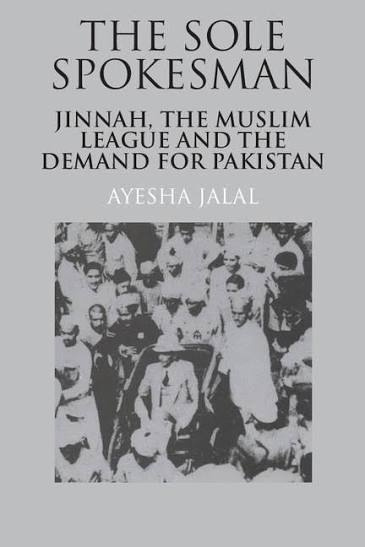
Ayesha Jalal's The Sole Spokesman represents an important challenge to the teleological interpretation of Pakistan as the predetermined destination of Muslim politics. By placing Muhammad Ali Jinnah and the Muslim League within the complex constitutional negotiations of late colonial India, Jalal emphasizes political strategy, bargaining, and contingency. Jinnah's political objective cannot simply be reduced to an uncomplicated demand for a separate sovereign state from the outset. The creation of Pakistan therefore appears less as the inevitable culmination of a pre-existing Muslim separatism than as the eventual outcome of a complicated and increasingly constrained political process.
Jalal's intervention unsettles both nationalist certainties. It complicates an Indian nationalist narrative in which Pakistan appears primarily as the product of Muslim intransigence, while also complicating a Pakistani nationalist narrative in which the creation of Pakistan can appear as the inevitable realization of an already fully formed Muslim national consciousness. In Jalal's account, history retains its contingency. Political actors make choices within circumstances that they do not fully control, and outcomes that later appear inevitable were not necessarily inevitable to those living through them.
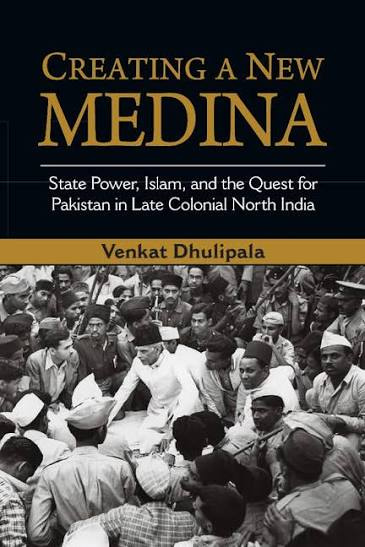
Venkat Dhulipala's Creating a New Medina, however, complicates any interpretation that treats Pakistan merely as a negotiating device or an abstract political demand. Dhulipala examines the political discourse surrounding Pakistan and argues that, by the late colonial period, Pakistan had acquired a substantive ideological and political meaning among important sections of Muslim political society. The imagined state was not simply an empty bargaining counter; it had become an increasingly articulated political project.
The tension between Jalal and Dhulipala is historiographically productive, but they should not be treated as simple opposites. Jalal does not deny that Pakistan had political meaning, just as Dhulipala does not eliminate the contingency of the political process through which Pakistan emerged. Their differing emphases demonstrate precisely why Partition cannot be reduced to a single causal narrative. Pakistan could simultaneously function as a strategic instrument within constitutional negotiations and as an increasingly concrete political aspiration among those who supported it. Historiography here does not merely add information; it changes the historical object itself.
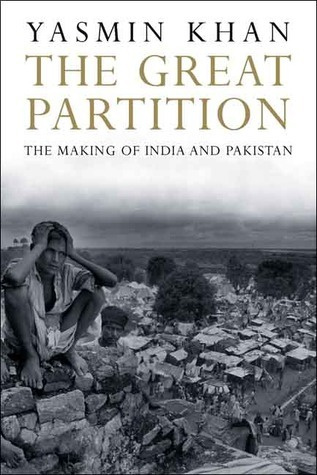
Yasmin Khan's The Great Partition shifts the focus from the intentions of political leaders to the process through which Partition was actually implemented. The political settlement had to be translated into boundaries, administrations, population movements, security arrangements, and new territorial regimes. Khan brings together political decision-making and the rapidly escalating human consequences of the transfer of power. Partition thus appears not simply as a constitutional event but as a process in which political decisions interacted with administrative disruption and uncertainty, communal mobilization, migration, and violence.
This perspective also complicates the temporal boundaries of Partition. Partition did not occur at one precise moment between 14 and 15 August 1947. The political division preceded independence, while its territorial, demographic, and psychological consequences continued long afterward. The drawing of the border was therefore not the end of Partition but one moment in a much longer process.
Applied to the history of nationalism, and by extension to Partition, this approach complicated the conventional nationalist story. Political actors were not always simply representatives of monolithic communities. They operated simultaneously through region, class, locality, patronage, political ambition, and institutional opportunity. Political mobilization could therefore emerge from intersecting interests rather than from a single, coherent nationalist consciousness.
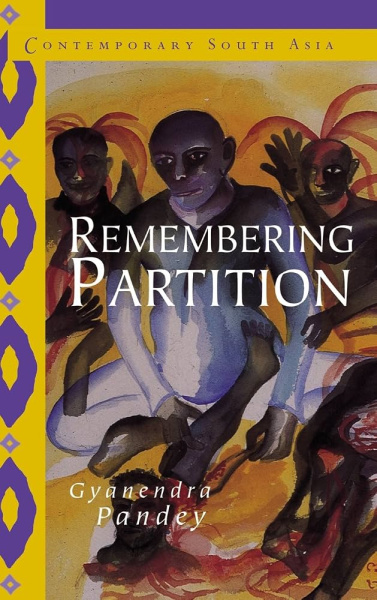
If Jalal reopens the question of political contingency, Dhulipala examines the political imagination of Pakistan, and Khan reconstructs the process through which Partition became a lived reality, Gyanendra Pandey shifts the historiographical emphasis toward violence, memory, and the construction of communal identity. In Remembering Partition, Pandey is less interested in treating Partition simply as the final settlement of a constitutional dispute than in examining how communal violence and its subsequent remembrance shaped the historical consciousness of South Asia.
Pandey asks how historically constituted differences were intensified, transformed into political antagonisms, and subsequently incorporated into national memories. “Hindu” and “Muslim” therefore cease to be entirely self-evident historical subjects and become categories whose political meanings must themselves be historicized. The violence of Partition was not simply an eruption between two timeless communities; it was also part of a historical process through which communal identities were politically intensified and subsequently remembered.
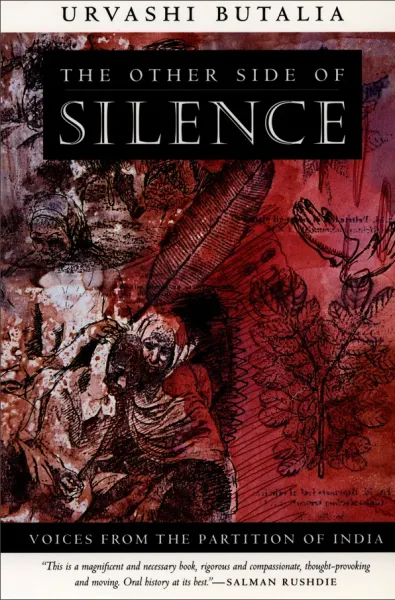
Urvashi Butalia's The Other Side of Silence moves the historiographical intervention still further. If Jalal reconsiders the political negotiations of elites, Dhulipala interrogates the political imagination of Pakistan, Khan reconstructs the implementation of Partition, and Pandey examines communal violence and memory, Butalia turns toward the intimate history of Partition. Through oral testimony and personal narratives, she brings women, children, families, refugees, and other marginalized voices into a historical account that cannot be reconstructed adequately from official political archives alone.
Butalia demonstrates that Partition had a history that was simultaneously national and intensely personal. A political agreement between leaders could become, at the level of everyday life, the loss of a home, the disappearance of a family member, an act of abduction, a forced migration, or the destruction of a community. The boundary that appeared on a political map could become a permanent psychological boundary in individual memory.
This movement from political history to lived experience is more than an expansion of subject matter. It changes the epistemology of Partition history. If official archives record what governments decided, oral histories can reveal what those decisions meant to people who had no role in making them. The archive of Partition therefore becomes plural: governmental documents coexist with testimony, memoir, family memory, literature, and silence.
The urgency of this historiographical recovery has become greater with the passing of time. The generation that directly experienced Partition is now disappearing, taking with it memories that were never fully recorded in official archives. Their recollections—of homes abandoned, journeys undertaken, violence witnessed, neighbors lost, borders crossed, and lives reconstructed—constitute an irreplaceable historical archive. Oral history is therefore not merely a supplementary source for Partition historiography; it is an urgent act of historical preservation. As the generation of witnesses passes away, the opportunity to recover these memories diminishes with it. To collect their testimonies now is to preserve not only individual experiences but also fragments of a social history that might otherwise disappear from the historical record.
Mushirul Hasan's scholarship contributes another dimension by challenging the idea that Partition can be explained simply through an undifferentiated Muslim separatism. His work places Muslim politics within the wider processes of political mobilization, representation, constitutional negotiation, and colonial rule, while emphasizing the diversity of Muslim political responses to nationalism and the demand for Pakistan. Muslim political history cannot therefore be reduced to a single trajectory leading inevitably toward Pakistan.
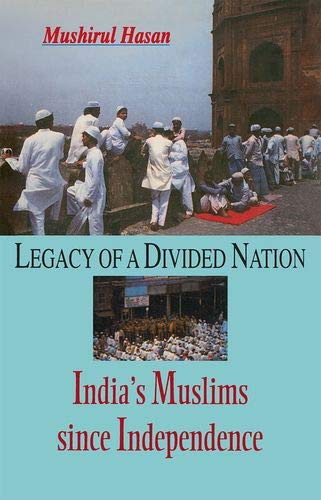
Hasan's later work, particularly Legacy of a Divided Nation, extends the inquiry into the post-Partition predicament of India's Muslims. It demonstrates how Partition continued to shape political identities, communal relations, and the struggle over secularism in independent India. The significance of this intervention extends beyond the immediate history of 1947: it suggests that Partition survived as a political and social presence within the history that followed it.
Ramachandra Guha's histories of independent India extend the historiographical horizon beyond Partition itself. His India After Gandhi is not primarily a history of Partition, but it is useful for understanding how the consequences of Partition entered the political and social history of the new Indian republic. Refugee settlement, communal politics, Kashmir, relations with Pakistan, and the construction of Indian national identity all unfolded in a political landscape already transformed by Partition.
Guha therefore allows the historiographical lens to extend from Partition itself to the difficult history of the Indian republic that emerged from it. Partition did not simply produce two states and then recede into the past. Its consequences became embedded in the political and social movements, institutional structures, territorial anxieties, and national narratives of the postcolonial period.
Urvashi Butalia's The Other Side of Silence moves the historiographical intervention still further. If Jalal reconsiders the political negotiations of elites, Dhulipala interrogates the political imagination of Pakistan, Khan reconstructs the implementation of Partition, and Pandey examines communal violence and memory, Butalia turns toward the intimate history of Partition. Through oral testimony and personal narratives, she brings women, children, families, refugees, and other marginalized voices into a historical account that cannot be reconstructed adequately from official political archives alone.
Taken together, these historians progressively expand and complicate the historical object called Partition. With Jalal, Partition becomes a problem of political contingency; with Dhulipala, of political imagination and the substantive idea of Pakistan; with Khan, of implementation, migration, administration, and violence; with Pandey, of communal construction and memory; with Butalia, of lived experience, gender, silence, and testimony; with Hasan, of political diversity within Muslim society and the post-Partition predicament of Indian Muslims; and with Guha, of Partition's continuing presence in postcolonial Indian political and social history. Taken together, these perspectives transform Partition from a discrete event confined to 1947 into a historically contingent, socially differentiated, and temporally extended process whose meanings continued to evolve in the political, social, and mnemonic life of the subcontinent.
The cumulative effect is to destabilize the older binary narratives of Hindu versus Muslim, India versus Pakistan, and victim versus perpetrator. Partition emerges instead as a complex process whose meanings cannot be contained within a single national narrative.
This movement from elite political history toward political imagination, social history, memory, gender, violence, lived experience, and postcolonial consequence also changes the question itself. Instead of asking only why Partition occurred, historians increasingly ask: What did Partition mean to those who experienced it? How was violence remembered? How did displaced communities reconstruct their identities? What happened to those whose voices never entered the official archive? How did Pakistan become imaginable? How did the implementation of Partition transform political decisions into mass displacement? And how did subsequent generations inherit memories of an event they had not themselves witnessed?
Partition consequently becomes both an event in 1947 and an unfinished historical process.
The plurality of these interpretations makes possible a deeper historiographical question. If Jalal can emphasize contingency while Dhulipala emphasizes political purpose; if Khan reconstructs administrative processes while Butalia recovers intimate testimony; if Pandey examines memory while Hasan and Guha trace aspects of Partition's consequences into postcolonial political life, then what precisely constitutes the historical object called “Partition”?
It is at this point that the historiography of Partition leads naturally to a more fundamental question: if historians can organize the same historical rupture into such different narratives, how does historical narrative itself produce meaning?
From the history of Partition to the historiography of Partition
The proliferation of these narratives reveals an important distinction between history and historiography.
History concerns the events, processes, people, institutions, and experiences of the past. Historiography concerns how those events are subsequently interpreted, organized, narrated, and contested.
This distinction does not make historical facts fictitious. Millions crossed borders; communities were shattered; people were killed, abducted, dispossessed, and separated from their families. Borders were drawn; states were born. The facts are not invented. What is constructed is the narrative that makes those facts intelligible—and the meaning assigned to them.
But facts do not automatically arrange themselves into a historical narrative.
The historian must select, connect, emphasize, interpret, and explain. One set of events can therefore enter radically different narratives.
The same political negotiations can be narrated as evidence of British responsibility, Indian political failure, Muslim political determination, or historical contingency. The same migrations can be described as refugee movements, demographic transformation, ethnic cleansing, communal catastrophe, or the painful birth of new nations. The same deaths can become evidence of victimhood, national sacrifice, communal hatred, or the failure of political imagination.
The plurality of Partition historiography therefore cannot be reduced to disagreement over factual accuracy. It also involves disagreement over meaning.
And it is here that Hayden White becomes particularly relevant.
The plurality of Partition historiography therefore cannot be reduced to disagreement over factual accuracy. It also involves disagreement over meaning.
Hayden White and the emplotment of Partition
Hayden White challenged the assumption that historical writing simply reproduces the past in a transparent narrative form. His argument does not require us to deny the reality of historical events; rather, it directs attention to the way historians select, order, connect, and interpret those events in constructing a coherent account of the past. Historical events do not arrive already arranged as a story. They acquire narrative coherence through the historian's acts of selection, organization, and interpretation. White calls this process emplotment: the configuration of events into recognizable narrative structures through which they become intelligible as a particular kind of history.
Historical writing, in this sense, shares an important structural feature with storytelling, even though it remains constrained by evidence, archives, and historical referentiality. The historian does not invent the events, but neither does the historian merely reproduce them. The historian decides which events matter, how they are related, where a narrative begins and ends, what is treated as cause or consequence, and ultimately what kind of story the past is made to tell.
Partition provides an unusually powerful demonstration of White's insight. The historical reality of Partition is not in question; what varies is the narrative configuration through which that reality is organized, interpreted, and made meaningful.
The same historical rupture can therefore be emplotted as tragedy, liberation, betrayal, political failure, or national emancipation. Within an imperial narrative, Partition may appear as the tragic consequence of irreconcilable Indian political divisions and the difficulties of British withdrawal. Within an Indian nationalist narrative, it may become the tragedy of a civilization and nation violently divided. Within a Pakistani nationalist narrative, it may be narrated as the culmination of a struggle for Muslim political self-determination. Within revisionist and postcolonial historiographies, it may instead emerge as a contingent political rupture whose meanings were produced through negotiation, violence, displacement, memory, and the lived experiences of those who endured it.
The historiographical difference, therefore, lies not simply in competing descriptions of what happened, but in the narrative structures through which what happened is organized into historical meaning. Emplotment does not make the past fictional. It reveals why the same body of historical events can sustain radically different interpretations: historical narratives are never produced in isolation but are themselves intertextual constructions, shaped by prior histories, political discourses, collective memories, literary representations, and competing narratives of the past. Partition's historiography is therefore not merely a contest over what happened; it is also a contest among the texts, memories, and discourses through which what happened has been remembered and represented.
This shifts the historiographical question from simply asking what happened? to asking how historical accounts make what happened intelligible. What does a particular historiography foreground, and what does it push into the background? Whose suffering becomes visible, and whose disappears? Whose agency is recognized, and whose is diminished? Which political decisions become causes, and which are recast as consequences? Which deaths enter collective memory, and which remain at the margins of the archive? And, perhaps most fundamentally, who gets to narrate the catastrophe?
White's contribution is therefore not to reduce history to fiction, nor to suggest that all historical interpretations are equally valid. Rather, he makes visible the narrative work through which historical knowledge is produced. Historiography is not a transparent window through which the historian simply looks back at an already intelligible past. It is a mode of representation through which the past is selected, ordered, connected, and made meaningful.
Partition makes this problem particularly acute because its historical reality remains inseparable from the competing narratives through which India, Pakistan, and the communities divided by Partition have subsequently remembered it. The facts of Partition may be historical; their configuration into history is historiographical.
Beyond national histories
The more recent historiography of Partition has consequently moved beyond the nation-state as the exclusive framework of historical interpretation. The nation-state remains indispensable to understanding Partition, but it cannot contain the full range of experiences and meanings that the event generated.
Partition was experienced differently according to one's location within the social and political order. A refugee crossing a newly created border experienced it differently from a political leader negotiating constitutional arrangements; a woman subjected to abduction experienced it differently from an administrator recording population transfers; a family losing its ancestral home experienced it differently from a state celebrating independence. Those who directly endured Partition also experienced it differently from the generations that inherited it as memory.
White's contribution is therefore not to reduce history to fiction, nor to suggest that all historical interpretations are equally valid. Rather, he makes visible the narrative work through which historical knowledge is produced. Historiography is not a transparent window through which the historian simply looks back at an already intelligible past. It is a mode of representation through which the past is selected, ordered, connected, and made meaningful.
These differences are not incidental. They reveal that Partition was simultaneously political and personal, national and intimate, territorial and psychological. No single archive can therefore encompass its historical experience.
The archive of Partition is consequently plural. Official documents preserve the decisions of governments and political elites; oral histories recover memories that official records often exclude; family narratives preserve experiences that may never have been formally documented; and literature, memoir, film, poetry, and testimony provide other forms through which Partition has been remembered and represented. The historical record is thus not merely an accumulation of documents but a contested field in which different forms of evidence preserve different dimensions of the past.
Memory complicates this field further because it is neither uniform nor static. What one generation remembers as displacement, another may remember as survival. What one community remembers as liberation, another may remember as dispossession. What one national history celebrates, another may mourn. Partition therefore survives not only in archives but in competing memories, and those memories continue to shape the meanings attached to the event.
This plurality also helps explain why Partition resists definitive historical closure.
Partition and the problem of historical closure
The desire for a definitive account of Partition is understandable. Historians seek evidence, establish chronology, identify causation, and construct explanations. Yet every explanation leaves questions unresolved.
If British colonial policy contributed to communal division, how should responsibility be apportioned between colonial institutions and indigenous political actors? If political leaders failed to reach an agreement, what alternatives were actually available to them? If Muslim political insecurity contributed to the demand for Pakistan, how was that insecurity historically produced? If nationalist politics intensified communal polarization, how should responsibility be distributed among competing organizations and constituencies? If Partition was contingent rather than inevitable, when—and through what decisions—did alternative possibilities narrow or disappear? And if Partition was politically negotiated, how should we understand the extraordinary violence that accompanied its implementation?
These questions do not demonstrate the impossibility of historical knowledge. They demonstrate its provisional and revisable character. Historical interpretations remain accountable to evidence; they can be tested, challenged, refined, and rejected. Historical truth may therefore be plural without becoming arbitrary. Different narratives can illuminate different dimensions of the same past without all being equally persuasive.
The point is not that there is no history of Partition, but that there is no single narrative capable of exhausting it.
This is perhaps the deepest lesson of Partition historiography. The plurality of accounts is not simply an obstacle to historical understanding; it is itself evidence of the complexity of the historical object. Partition was not one experience, one memory, or one meaning. Its historiography remains plural because the event itself was plural in its causes, consequences, experiences, and afterlives.
Partition as an unfinished history
The plethora of Partition historiography is therefore not merely an accumulation of competing interpretations awaiting reduction to a final authoritative account. Its plurality is historically meaningful. Partition fractured territory, sovereignty, communities, families, identities, and memories; the histories written about it inevitably bear the imprint of those fractures.
The borders were drawn in 1947, but the historical consequences did not end there. Survivors carried memories across borders; displaced communities reconstructed their lives; states incorporated Partition into competing national narratives; subsequent generations inherited memories of displacement and violence; and political movements in India and Pakistan continued to operate within a landscape shaped by the territorial, demographic, and psychological consequences of Partition.
The metaphor of parturition therefore returns with a different significance. Partition gave birth to new states, but that birth did not resolve the contradictions that produced it. Those contradictions persisted in displaced memories, contested borders, national identities, communal narratives, and the political imagination of the two states. Partition was consequently not simply a rupture between India and Pakistan; it became an enduring condition through which they continued to imagine themselves and each other.
The metaphor of parturition therefore returns with a different significance. Partition gave birth to new states, but that birth did not resolve the contradictions that produced it. Those contradictions persisted in displaced memories, contested borders, national identities, communal narratives, and the political imagination of the two states. Partition was consequently not simply a rupture between India and Pakistan; it became an enduring condition through which they continued to imagine themselves and each other.
Partition was thus not only a division of territory. It was also a division of memory—and memory, unlike territory, cannot be settled by a boundary commission.
This is why Partition continues to resist closure. Every historiography illuminates some dimensions of the past while leaving others in shadow. The historian's task is not to eliminate those shadows by imposing a final narrative, but to interrogate how they were produced, whose experiences they conceal, and what new evidence or interpretation might bring them into view.
Here Hayden White's insight acquires its fullest force. To write the history of Partition is not simply to recover what happened; it is to decide how what happened will be organized, connected, and made meaningful. Yet those narratives do not emerge in isolation. They are themselves intertextual, shaped by prior histories, political discourses, collective memories, literary representations, and competing accounts of the past. The historiography of Partition is therefore not only a record of how historians have interpreted an event; it is an ongoing conversation among texts, memories, archives, identities, and historical perspectives.
Partition divided a subcontinent.
Historiography continues to divide—and sometimes to reconnect—the meanings of that division.
Perhaps Partition is best understood, finally, as a historical palimpsest. The borders drawn in 1947 did not erase the histories that preceded them, just as the narratives subsequently written about Partition did not erase earlier memories, identities, affiliations, and experiences. Each generation has written over the event, inscribing new political meanings, memories, and interpretations upon it, while traces of earlier narratives remain beneath the surface. What appears to be a settled historical text thus remains layered, overwritten, and never entirely erased.
The palimpsest also captures the relationship between history and historiography. The past is not rewritten because what happened can simply be changed; it is rewritten because successive generations encounter the traces of that past from different historical locations and inscribe new meanings upon them. Partition's historiography is therefore cumulative without being conclusive: each interpretation adds another layer without necessarily eliminating those that came before.
The historiography of Partition is therefore not only a record of how historians have interpreted an event; it is an ongoing conversation among texts, memories, archives, identities, and historical perspectives. They do not begin from an empty page, nor do they end as definitive accounts. Instead, they begin and end as part of an intertext—each history emerging from prior narratives and becoming, in turn, a text for those that follow.
Dr. Faridul Alam, a former academic, writes from New York City.
Send your articles for Slow Reads to slowreads@thedailystar.net. Check out our submission guidelines for details.

Remembering Sumit Sarkar, a historian who questioned orthodoxy
In conversation with William Dalrymple / ‘Britain didn't conquer India’
Sheikh Mujib’s killing: What the newspapers told and what they omitted
Mirrors of Empire / The bureaucrats and intellectuals who shaped the Mughal Empire
To feel Bengali, to think beyond Bengal: Dipankar Gupta in conversation
Bangladesh's visual history / The enduring allure of vintage photographs
The enduring legacy of the 2nd Bangladesh Liberation War Course
In conversation with Harbans Mukhia / Beyond kings and dynasties: Rethinking medieval Indian history
Reading Ardhakathanak / What a 17th-century merchant's autobiography reveals about Mughal governance