


Trade deficit widens 17.4% in July-January
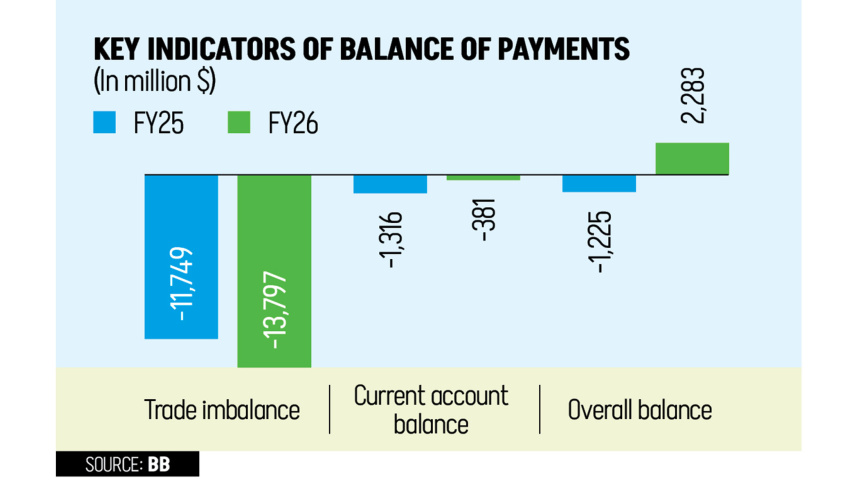
Bangladesh’s trade deficit, the gap between what it buys and sells abroad, widened by 17.44 percent in the July-January period of fiscal year 2025-26, due mainly to higher imports and weaker export earnings.
The deficit reached $13.79 billion during the seven months, up from $11.74 billion in the same period a year earlier.

According to Bangladesh Bank (BB) data, import bills rose 4.6 percent year-on-year to $39.88 billion. Export earnings, meanwhile, slipped 1.1 percent to $26.09 billion.
The widening gap has raised concerns at a time when the US-Israel war on Iran has rattled global oil markets and disrupted shipping routes. Since tensions escalated in the Middle East, the Bangladeshi currency, the taka, has begun to weaken. A softer currency could raise import costs and place further strain on the trade balance.

At the same time, exports have not shown clear growth, while war-driven inflation may reduce demand in Bangladesh’s major export markets.
Despite the wider trade gap, the country’s current account deficit narrowed.
This measure, which tracks the net flow of money in and out of the country through trade in goods and services as well as income flows, stood at $381 million in July-January of FY26. A year earlier, it was $1.31 billion.
The financial account also strengthened during the period.
Supported by higher net foreign direct investment, the surplus in the account, which records cross-border flows from investment, loans, aid and other financial transactions, climbed to $2 billion from $331 million a year earlier.
Taken together, the changes pushed Bangladesh’s overall balance of payments (BoP) into a surplus of $2.28 billion. In the same period last year, the country posted a deficit of $1.22 billion.
In an article, Sadiq Ahmed, vice chairman of the Policy Research Institute of Bangladesh (PRI), said the fall in exports has raised concerns about the country’s BoP outlook.
He added that strong remittance inflows have provided a key support. Remittance earnings rose sharply, bringing in $9 billion more in FY2025 than in FY2022.
However, Ahmed warned that foreign exchange reserves may fall in the second half of FY26 because of weaker exports and rising imports. Still, unless there is a major policy setback or a prolonged Iran war, reserves are expected to stabilise at around $30 billion.
He added that declining exports, rising external debt and debt servicing, and the Iran war raise questions about the sustainability of the current BoP position.
To address these risks, Ahmed recommended diversifying exports, saying double-digit export growth will not be possible without it.
“One key requirement is flexible exchange rate management that avoids appreciation of the real effective exchange rate,” he added.
His second priority was removing anti-export biases in trade policy and improving the country’s investment climate.
 For all latest news, follow The Daily Star's Google News channel.
Comments