


Two months in, NBR weighs return to old VAT system

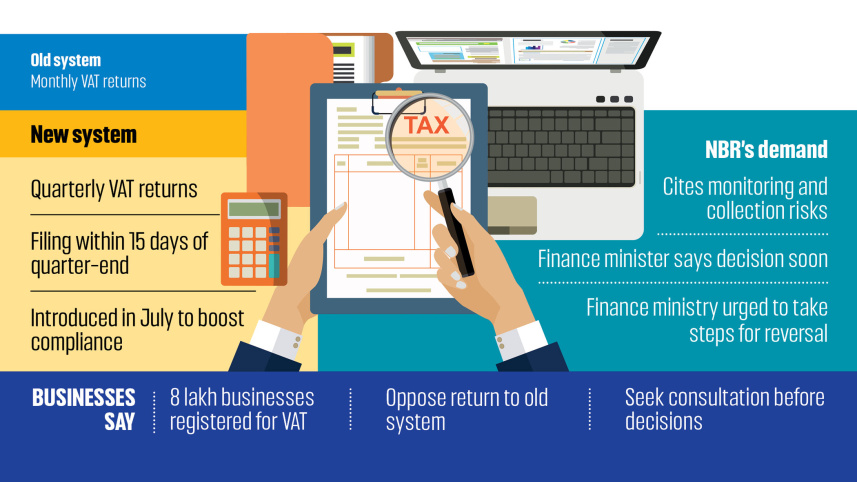
The government may revert to monthly value-added tax (VAT) returns and payments from the current quarterly system launched this July amid concerns over monitoring difficulties, operational complications and increased collection risks arising from the new arrangement.
Following adverse feedback from field-level offices, the National Board of Revenue (NBR) has requested the finance ministry to take steps to reverse the provision, according to officials familiar with the matter.

“We have completed preparations on our side. The decision now awaits Prime Minister Tarique Rahman’s approval,” said an NBR official, seeking anonymity.
The development comes as VAT collection, which accounts for nearly 38 percent of the NBR’s total revenue, fell by about 21 percent year-on-year in the first two months of FY2026-27, according to provisional data.
The revenue board collected Tk 9,302 crore in VAT in July, down from Tk 11,547 crore a year earlier. Collection fell further in August to Tk 8,362 crore, compared with Tk 11,081 crore in the same month last year.
As a result, VAT collection during July-August stood at Tk 17,663 crore, down from Tk 22,628 crore in the corresponding period of the previous fiscal year.
The NBR, however, does not yet have sufficient data to determine whether the new system has affected overall VAT collection, officials said. Businesses have until the end of September to submit their returns for the first quarter under the new arrangement.
WHAT THE NEW SYSTEM OFFERS
Officials explained that the previous system allowed taxpayers to retain the VAT money for up to 30 days and pay it by the 15th of the following month.
Under the new quarterly system, businesses can now retain the VAT collected from consumers for up to three months before making the payment.
“Now that the period has been extended to three months, large businesses can keep the VAT collected from consumers and earn interest on it or use it in other ways,” an official of the Dhaka Commissionerate said, seeking anonymity.
The official said the three-month payment window gives businesses an opportunity to earn interest on VAT they have already collected from consumers but have yet to remit to the government.
“Suppose you have Tk 200 crore in one month and another Tk 200 crore in the next -- Tk 400 crore in total. If you put that money into Treasury bonds, DPS or FDRs, you can earn interest from it,” he said.
“But this is actually government money. You have already collected it from consumers against each invoice,” he added.
Another official, also seeking anonymity, said the government could not afford to let public funds remain with businesses for an extended period, particularly as it has to pay interest on its own borrowings.
FIELD OFFICES SEEK RETURN TO MONTHLY SYSTEM
According to the Dhaka Commissionerate official, the NBR does not yet have all the systems and monitoring tools in place that are needed to properly manage the quarterly VAT mechanism.
“We are facing problems both in monitoring and in terms of risk,” he said. “We used to track revenue collection monthly by circle, division and unit. That monitoring tool is no longer available to us.”
“One weakness of our department is that we have not yet established a system to deposit VAT into the treasury immediately against each invoice. This is a systemic weakness on our part,” he added.
“We demand that the return should also be submitted monthly. Both the return and payment should be monthly,” the official said.
 For all latest news, follow The Daily Star's Google News channel.
 Another official of the Rangpur Commissionerate also called for a return to the monthly system.
When asked why the NBR had not addressed the monitoring and collection issues before launching the new system, NBR Acting Chairman Ahsan Habib declined to comment.
BUSINESSES OPPOSE RETURN TO MONTHLY PAYMENTS
Businesses, meanwhile, have warned that restoring monthly VAT payments would run counter to the government’s efforts to reduce compliance burdens and improve the ease of doing business.
Mohammed Amirul Haque, managing director of Premier Cement Mills, also criticised the NBR’s potential move to reverse the quarterly VAT payment system without adequate consultation with businesses.
“Their (NBR) main issue is consultation with businesses. If there is a problem, (they should) sit down with us. Ask us, ‘What is the modus operandi? How can we do it?’” he said.
He questioned the rationale for reverting to monthly payments after introducing the quarterly system in the name of ease of doing business.
“They introduced the quarterly system in the name of ease of doing business. Now, if they suddenly say everything has to be done every month, what is the justification? They did not consult us in the first place,” he said.
Amirul said compliant businesses should not be penalised because some non-compliant companies might misuse the system.
“If a non-compliant company takes advantage of the quarterly system to evade taxes, you cannot punish the compliant companies for that,” he said.
He also questioned the NBR’s argument that quarterly payments create monitoring difficulties.
“If receiving government revenue every three months creates a monitoring problem, then why have you been holding advance income tax for years? Does that not create monitoring difficulties?” he said.
Some NBR officials have suggested a compromise: businesses could continue filing VAT returns every three months but would have to pay the VAT they collect into the government treasury every month.
Responding to a question from reporters on Tuesday, Finance Minister Amir Khosru Mahmud Chowdhury said the government would discuss the complications arising from the quarterly VAT return system and take a decision soon.
Currently, Bangladesh has more than 8 lakh businesses registered for VAT and holding Business Identification Numbers, according to the NBR.
Comments