


Urea supply concerns surface ahead of Aman season

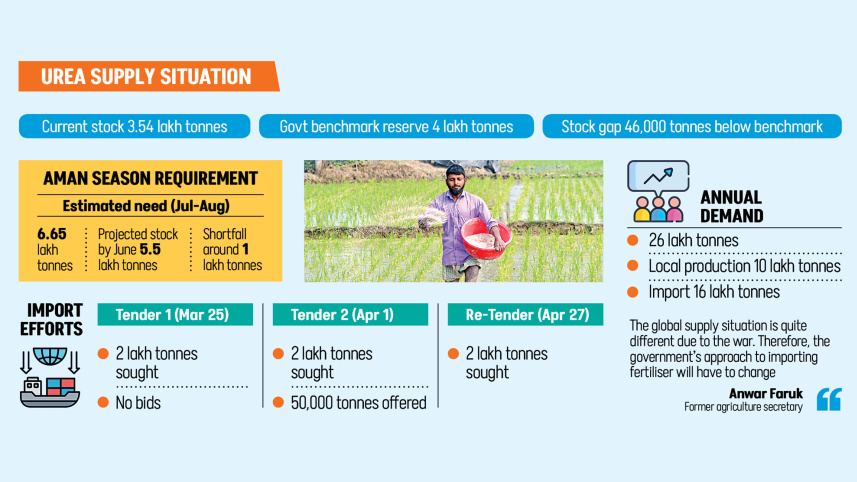
- Urea shortfall of 1 lakh tonnes by July
- Reserve falls below benchmark ahead of Aman season
- Middle East war disrupts fertiliser import supply chains
The country may face a shortfall of around 1 lakh tonnes of urea in July for the Aman planting season unless the government is able to secure fresh import commitments in the coming weeks, after two consecutive international tenders failed to attract adequate supply.
The agriculture ministry currently holds 3.54 lakh tonnes of urea, below its benchmark reserve level of around 4 lakh tonnes, according to officials.

Even with domestic urea plants back online in May, projected availability of the fertiliser by the end of June is expected to reach about 5.5 lakh tonnes.
But the Aman season will require an estimated 6.65 lakh tonnes of urea, leaving a shortfall of around 1 lakh tonnes just weeks before farmers begin preparing seedbeds for the country’s second-largest rice crop.
To meet the demand and replenish fertiliser stocks, the government floated two tenders on March 25 and April 1, seeking a total of 4 lakh tonnes of urea. Officials said one tender drew no bids, while the other received only a partial offer of 50,000 tonnes.
A fresh re-tender was issued on April 27 for 2 lakh tonnes.
Officials at Bangladesh Chemical Industries Corporation (BCIC), the state-run fertiliser importer, said suppliers have been reluctant to commit amid uncertainty surrounding maritime traffic through the Strait of Hormuz following the Iran war.
Bangladesh usually sources a large portion of its imported urea from Gulf producers under government-to-government (G2G) arrangements, rather than through open tender.
Floating an international tender for urea is therefore “unusual”, said a senior chemical corporation official, adding that the last time Bangladesh resorted to large-scale open bidding was during the Covid pandemic, when global supply chains were severely disrupted.
“The re-tender reflects procurement pressure,” the official said, adding that stock levels remain “below a comfortable level” ahead of peak seasonal demand.
Two domestic fertiliser plants, Karnaphuli Fertilizer Company Limited (Kafco) and Shahjalal Fertilizer Company Limited (SFCL), resumed full operations on May 1 after closure due to gas supply concerns.
Md Fazlur Rahman, chairman of the BCIC, said that combined domestic output and existing stocks are projected to raise total urea availability to around 5.5 lakh tonnes by June 30.
While that represents an improvement in urea stocks from earlier months, it still falls short of the 6.65 lakh tonnes estimated for the Aman season, which runs from July to August and accounts for nearly 40 percent of annual rice output.
Bangladesh requires over 26 lakh tonnes of urea annually, of which around 10 lakh tonnes come from local plants and the remainder is imported, mainly from Saudi Arabia, the United Arab Emirates and Qatar.
The Boro season, which accounts for about 60 percent of annual urea use, usually drives demand to the peak during the November-March period. Officials say fertiliser consignments from the Middle East take up to 180 days from contracting to distribution at the farm level.
So, it is necessary to procure early to avoid supply disruptions. The current delay risks cascading into the next farming cycle if fresh contracts are not secured soon.
Much of the country’s imported urea transits through the Strait of Hormuz, a narrow shipping corridor critical to global energy and commodity flows. Since the US-Israel war on Iran on February 28, the strait remains closed and heightened geopolitical tensions across the entire Middle East continue disrupting shipping schedules.
Anwar Faruk, former agriculture secretary, said the global supply situation is quite different due to the war in the Middle East. Therefore, the government’s approach to importing fertiliser will have to change.
“It will not work if you think about it in a typical way. It will have to be given top priority. There is not much time. This must also be understood, as the issue of food security is linked to fertiliser,” he said.
Jahangir Alam Khan, an agri economist, said the immediate shortfall is manageable, but the country needs to address structural vulnerability in fertiliser sourcing.
 For all latest news, follow The Daily Star's Google News channel.
 “We need to diversify supply sources instead of depending mainly on Gulf nations,” he told The Daily Star.
Another economist, Abdul Bayes said diplomatic engagement, including maintaining ties with Iran, may be necessary to ensure the smooth passage of fertiliser shipments through the Hormuz.
He said that transparent and timely tendering is critical to preventing cost escalation and ensuring stable supply.
Disruptions in fertiliser, fuel and other agricultural inputs linked to Gulf tensions could pose risks to food production if not managed carefully, he added.
Officials say efforts are underway to secure supplies from countries less exposed to Middle East shipping risks.
BCIC Chairman Rahman said potential alternative sources include Malaysia, Brunei, Russia, Vietnam, Egypt and Azerbaijan, subject to commercial viability and diplomatic clearance.
Separately, BCIC has initiated steps to import 80,000 tonnes of urea from the Middle East under a government-to-government arrangement. However, a tender to hire vessels reportedly received no response.
On condition of anonymity, a senior official at Bangladesh Agricultural Development Corporation (BADC) said that Saudi Arabia has committed to supplying two monthly shipments totalling 80,000 tonnes once conditions stabilise. A shipment from Morocco is expected in May.
According to the Food and Agriculture Organization (FAO), urea prices have risen by as much as 19 percent in recent weeks amid Middle East tensions. Prolonged disruption could raise import costs further and increase food prices globally.
Comments