


Why Bangladesh, a global top producer, still imports fish

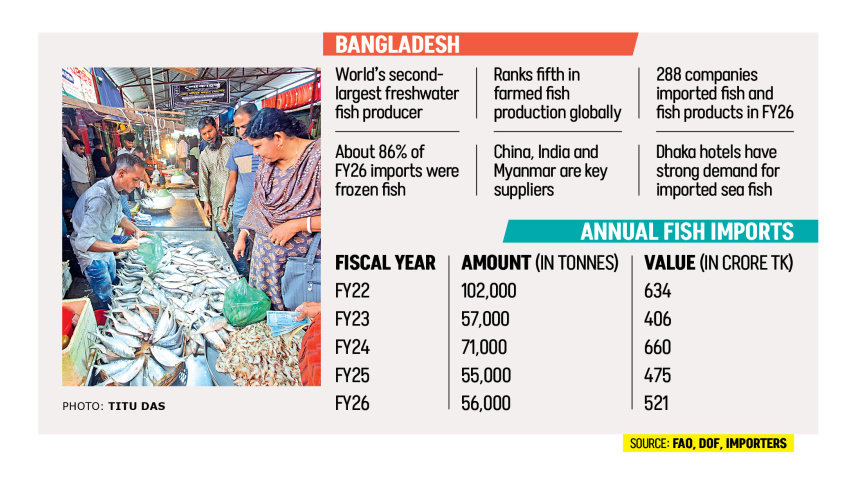
By most measures, Bangladesh is one of the planet’s great fish-producing nations. It ranks second in the world for fish caught in rivers, lakes and wetlands, and fifth for farmed fish production, according to a June 2026 report by the Food and Agriculture Organization (FAO).
The country’s production now exceeds 50 lakh tonnes, surpassing the annual demand for around 48.93 lakh tonnes, according to the Department of Fisheries (DoF) data.

Yet, government data shows that the country regularly imports thousands of tonnes of fish every year.
The reasons, according to government officials and importers, come down to variety. Some fish Bangladeshis want to eat aren’t available domestically in enough supply, or at all. Imports are needed to meet the demand of the processing industry, hotels and restaurants, and specialised markets.
WHAT COMES, HOW, AND FROM WHERE
Around 288 companies are currently registered to import fish and fish products into the country, according to DoF data.
The agency reports that Bangladesh imported 56,000 tonnes of fish, worth Tk 521 crore in fiscal year 2025-26. In the previous FY25, the figure stood at 55,000 tonnes worth Tk 475 crore. The amount was 71,000 tonnes, worth Tk 660 crore, in FY24, and 57,000 tonnes, worth Tk 406 crore, in FY23.
The fish importers bring in most often include rui, pangas, rupchanda, tuna, shad, mullet, dorab, and mackerel, along with dried fish like loitta and puti.
Most of it, 86 percent last fiscal year, arrives frozen – deeply chilled below -18°C, halting decay and extending shelf life for months. The rest comes chilled or on ice – kept just above freezing at 0°C-4°C using melting ice, offering superior texture for short-term use.
DoF data show that the main countries selling fish to Bangladesh are China, India, Myanmar, Japan, Oman, Pakistan, the UAE, South Korea, and Thailand.
WHY IMPORT
Importer Md Saheed Ali brings in a wide mix, marine fish – hilsa, rui, katla, Indian mackerel, horse mackerel, tuna, catfish, and chandana hilsa – from Yemen, Oman, Dubai, China, Pakistan, Myanmar, and India.
He also imports certain types of Hilsa, known locally as ruposhi or lafa, from as far as Uruguay.
Saheed’s customers are spread across the country. He said that some of the imported fish, including loitta, sell well mainly because they’re cheaper, which matters a lot to middle and lower-income families.
He stated that imports fill a real gap in what’s available domestically right now.
Another importer, Mohammad Rakibul Islam Rokon, brings in rui, katla, bhetki, and hilsa from India and Myanmar. He sells to markets across Dhaka, where demand for these fish stays high and steady.
The imports help meet the growing demand for these popular fish varieties among residents and ensure a steady supply in local markets, he said.
Hotels and restaurants are a major buyer of imported fish. A review of menus at several of Dhaka’s international hotels and Western-style seafood restaurants shows a similar reliance on imports.
A menu of Pan Pacific Sonargaon’s Jharna Grill, obtained from the hotel’s website, shows the pattern explicitly. The restaurant’s own menu copy describes its “Pacific-inspired cuisine” as built on ingredients including “Vietnamese prawns, Canadian salmon and Singapore crab.” Its seafood section features a Norwegian salmon steak, alongside a separate “Imported Steaks” section for its meat offerings.
The Westin Dhaka’s Seasonal Tastes restaurant ran a seafood festival in April and May this year built around “Authentic Chilled Norwegian Salmon,” alongside seafood paella and terrine.
 For all latest news, follow The Daily Star's Google News channel.
 An official of the luxury hotel,seeking anonymity, told The Daily Star, that demand runs high for imported seafood: chilled salmon, smoked salmon, tuna fillets, Chilean sea bass, and pangas fillets.
The hotel goes through about 2,300 kilogrammes of imported fish every month, he added.
A Sheraton Dhaka official, who also asked not to be named, said the hotel has a similar level of demand for imported sea fish, with consumption of approximately the same quantity each month.
Md Barkatul Alam, who oversees fish inspection and quality control at DoF, told The Daily Star that Bangladesh doesn’t need to import to survive, since it already produces enough, but imports help fill specific gaps in the market.
He noted that imports help meet demand for particular species and products and support different segments of the domestic market and fish-based industries.
NEED BETTER REGULATORY OVERSIGHT
The DoF official, however, stressed that a stricter regulatory oversight is needed to ensure the quality of imports.
“As the sources and types of imported fish and fishery products diversify, it is important to continuously strengthen our regulatory system so that only safe, quality and fit-for-human-consumption products enter the domestic market,” Barkatul said.
Stating that Bangladesh already has an administrative and institutional system for controlling fish imports, he said there is scope to make it more integrated and more science-based.
The objective, he said, should be to protect consumers while also ensuring fair trade and safeguarding the interests of domestic fish producers and responsible businesses.
Right now, regulatory oversight mostly comprises issuing no-objection certificates or conducting a limited number of tests, he said.
The system should cover the entire control chain, from assessment of exporting countries and establishments, pre-import verification and health certificate verification to risk-based border inspection, laboratory testing, traceability and post-clearance surveillance, he added.
The DoF official also suggested lining up Bangladesh’s rules with global trade standards, specifically the World Trade Organization’s food-safety agreement, which requires decisions to be based on science, not guesswork.
The Fish and Fish Products (Inspection and Quality Control) Rules, the Import Policy Order and other relevant regulatory and administrative arrangements should also be updated and strengthened where necessary, he said.
Comments