


Foreign aid use slumps

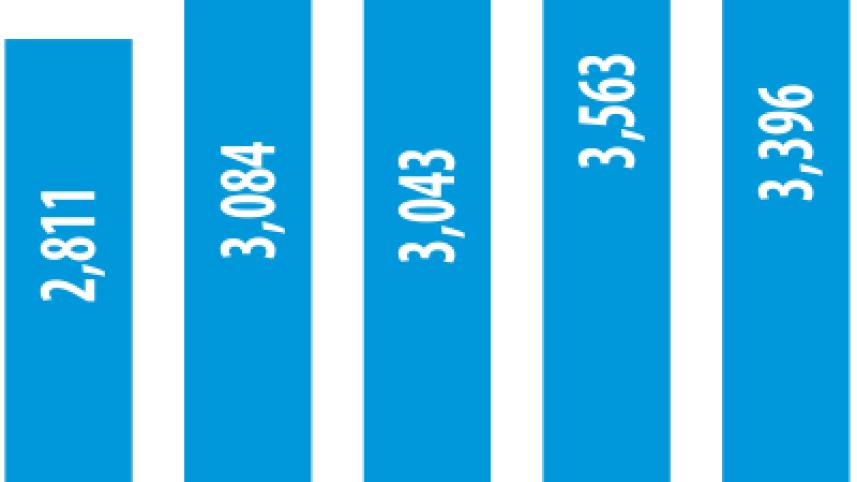
Foreign aid disbursement slid 4.78 percent last fiscal year even though a huge amount is ready for use and is now sitting idle in the pipeline.
In fiscal 2016-17 foreign aid disbursement stood at $3.39 billion, according to statistics from the finance ministry. The government had targeted to utilise more than $4 billion of foreign aid last fiscal year.

The government typically deems expending one-fifth of the amount at the start of a fiscal year to be a satisfactory outcome.
On July 1 last year, the amount of foreign aid in the pipeline was $21.87 billion, and the ministries and divisions could manage to use only 15.54 percent of the sum during the course of the year.
In recent years, the capacity of the ministries and divisions in spending foreign aid has increased slightly but it is yet to reach the targeted level.
In fiscal 2008-09 the amount of aid utilisation was less than $2 billion; it crossed the $3-billion mark in fiscal 2013-14. And for the next three years more than $3 billion was spent.
Over the last one decade, commitment from donors has been on the rise, but the implementation capacity of the ministries and divisions did not increase accordingly, said a finance ministry official.
However, last fiscal year the implementation of many mega projects had ground to a halt following the militant attack in Gulshan. For instance, work on the metro rail, a Japan-financed venture, was stopped indefinitely after seven Japanese nationals who were in Dhaka for the project were killed in the attack.
Besides, the implementation of projects financed by China and India slowed down, which also contributed to the lower foreign aid disbursement number for last fiscal year.
However, foreign aid disbursement from the World Bank, Bangladesh's largest donor, soared more than 27 percent last fiscal year to $1.3 billion.
As of June last year, the WB accounted for 46.2 percent of the country's total outstanding debt of $26.20 billion.
The Asian Development Bank's share was 29.9 percent of the total external debt. Last fiscal year, the Manila-based lender disbursed $758 million, which was $814 million in fiscal 2015-16.
A foreign aid commitment record was set last year after Russia agreed to provide $11.38 billion for the Rooppur Nuclear Power Plant project.
As a result, the total foreign aid commitment for the year came to $17.88 billion, way more than the average of $6-$7 billion in recent years.
When a government signs a loan agreement with a development partner it is considered a commitment and the amount is included in the aid pipeline.
Meanwhile, Finance Minister AMA Muhith has unveiled a plan to utilise an unprecedented amount of foreign aid this fiscal year, with a view to successfully implementing the last full budget of his career.
The government has targeted to utilise $7.6 billion (Tk 60,817 crore) this fiscal year, which is 67.78 percent higher than last fiscal year's goal.
The ambitious target comes as the government feels it has augmented its foreign aid utilisation efficiency sufficiently in the past several years. Some individual countries too have made commitments to large projects.
Traditionally, Bangladesh has been getting large sums of assistance from the WB, the ADB and Japan.
Now India, China and Russia have come forward with big amounts of assistance. Though their interest rate is low, they come with terms and conditions that will ultimately bump up the project costs.
 For all latest news, follow The Daily Star's Google News channel.
 More than half of the aid utilisation targets fixed by Muhith for the current fiscal year will come from individual countries.
As of June last year, Bangladesh's outstanding debt to Japan was $2.95 billion and that to China $1.02 billion.
Comments