


Invest in people
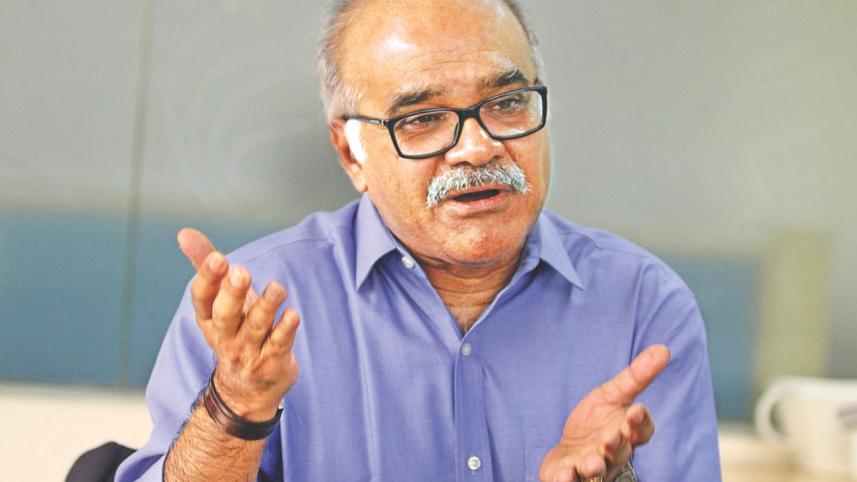
EVERYONE talks about physical infrastructure as a prerequisite for higher economic growth and prosperity, but an internationally renowned human development analyst puts similar importance on social infrastructure for sustainable growth and progress.
Bangladesh needs to focus on both physical and social infrastructure; by neglecting one, sustainable growth and progress cannot be achieved, said Selim Jahan, director of the Human Development Report Office at the United Nations.
 For all latest news, follow The Daily Star's Google News channel.
 A country may have all kinds of good roads, buildings and beautiful production lines with all modern machinery, but if it does not have skilled workers or the social infrastructure, these would remain as just buildings, he added.
He defined buildings, roads, highways and bridges as physical infrastructure, while education and healthcare are some of the examples of social infrastructure.
Investment should be made in both physical and social infrastructure in a balanced way.
"If you don't develop human resources, increase their efficiency, effectiveness and skills, what are you to do with the physical infrastructure? Similarly if you have all kinds of social infrastructure, but if there is no way of marketing your products, no way of mobility from one place to another and no way of connectivity, then it will not work."
Also the lead author of the Human Development Report 2015, Jahan shared his views and experiences in an exclusive interview with The Daily Star recently.
He was in Dhaka to release the report, where Bangladesh's ranking remained static at the 142nd position out of 188 countries.
Rather than focusing on the ranking, he preferred to look at the value of the Human Development Index (HDI). In 1990, the value of HDI in Bangladesh was 0.386, which reached 0.570 in 2014, registering a rise of around 48 percent. "That's a big jump."
"The rank may change or not, depending on how others are doing. If five countries are not included in the index, Bangladesh's position will go up five or six notches. Does it mean that we have made progress? No, because it is a relative thing," he said.
He said Bangladesh's economic growth rate as well as per capita income over the past 20 years was lower than that of India and Pakistan.
But life expectancy and female literacy rates in Bangladesh are better than in India and Pakistan, while the under-five child mortality and school dropout rates are lower than those countries. "We have achieved all these things with a lower growth rate and with a lower per capita income -- that's a huge achievement."
"If we take everything into consideration, we can say that we have done better in translating income and economic growth into human lives and human welfare compared to India and Pakistan."
Jahan said human development is the development of the people, for the people and by the people. Development of the people means developing the capabilities of the people; development for the people means fruits of development should be equitably distributed among different groups of people, and development by the people means peoples' active participation in the decisions, which shape the development process, he said.
Elaborating human development, he defined it as the 'enlargement of choices'.
Every day people make choices in different atmospheres, for example, political choices, social choices and cultural choices, he said. "We make different choices at an individual level, at the community level and at state level. So, we see development as a process of enlarging these choices."
But to exercise the choices, one needs to have capabilities. "You have to be capable of making these choices. You have to be educated, you have to have better health and you have to have political space."
On the other side of the equation is opportunity. "Suppose, you have built your capabilities, but there are very restrictive opportunities, whether it is in terms of participation in the labour markets or participation in the social process or participation in the political process. So you don't have opportunities."
On the debate between development and democracy, Jahan said democracy has an intrinsic value and an instrumental value.
"It has intrinsic value because democracy should be valued for democracy itself. Human rights have an intrinsic value because we have to respect human rights for human rights itself. So, I value democracy for its intrinsic value. There has to be democracy in a society."
But the question is, whether democracy facilitates economic growth or not. "If democracy helps economic growth, that's fine. But if democracy does not have any link with economic growth, that's also fine. Because democracy itself is valuable."
Democratic participation is a part of human development, he said. "Because we are looking at human development where people are not only recipients of the economic fruits or development, but they are also active participants in the process."
He believes democracy is not all about polls. "Democracy is a kind of creating political space where people can participate to voice their concerns and views, where people can participate to shape the things that actually affect their lives."
Jahan is hopeful about Bangladesh as he sees vibrancy and dynamism within the country. "Everybody is doing something. There is a life that is going on. Somebody is selling fruits, somebody is selling clothes and somebody is doing something else. And that's not typical of Dhaka, that's typical of other cities as well."
Although Bangladesh is emerging as a major economic power in the world, three things can make a difference for the country, and empowerment comes first. "Because of the work of the media, NGOs and policies by the government -- women's empowerment is the big issue."
Whether it is social life or human life, women have a large part to contribute. "It's true that there are disparities, cultural norms and social norms that go against women, but we are trying to overcome those things."
Women are more prudent investors and that has been proven in many parts of the world, said Jahan. "If you give a certain amount of money to men, the first thing they will do is either buy a motorbike or buy a cell phone, or do something else. If you give the same amount of money to women, they will first buy food that is more nutritious for their children and secondly, they will send their children to school."
The second thing that will make a difference in Bangladesh in terms of progress is the civil society and the non-governmental organisations. "It's not the NGOs in the traditional sense. The media, academics, the research institutions are a part of the civil society."
Bangladeshis are more conscious of their rights, more educated and more enlightened, he said. "You may be highly educated but may not be enlightened," he said, adding that the civil society and its growth would be a major factor here.
Finally, he said, creativity and innovation would be a driving force for the economic growth and human development of the country.
Jahan suggested the youth equip themselves with the right skills. "In a globalised world, there would be a lot of opportunities for the younger generation if they equip themselves with the right skills."
The right skill is not only good education from a good university. "Nowadays, if you want to work at a globalised work place, you would also have to have good knowledge and a grasp of the global things -- what is happening in different parts of the world, what is happening economically, socially and politically in different parts of the world. That's also a part of your knowledge base."
There is no alternative to hard work, he added.
Hard work is a necessary condition to have that kind of global opportunities, he said. "Nobody can empower anybody else. You empower yourself and you disempower yourself."
Comments