


Weavers face sluggish sales ahead of Eid

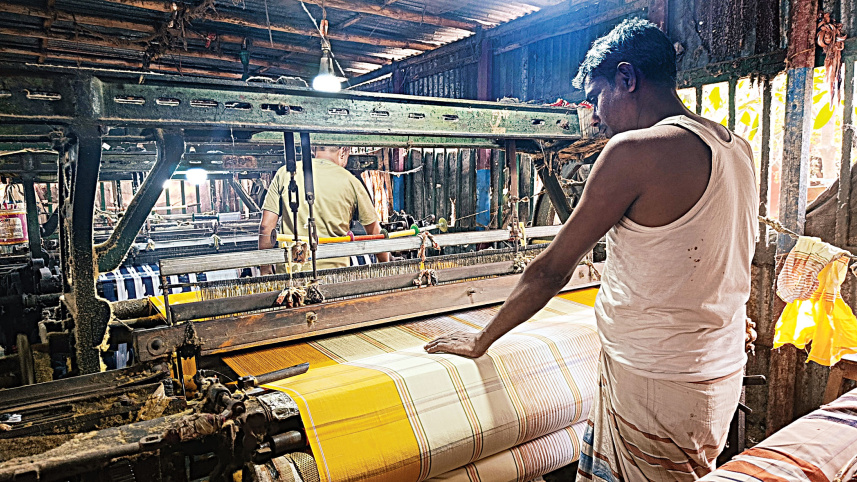
The weeks before Eid-ul-Fitr, the country’s largest religious festival, are traditionally a ripe time for the clothing business. However, loom producers are facing a marked decline in sales this year, owing mainly to two factors -- little presence of foreign buyers and a lack of local wholesale trade.
“A total of 80 crore metres of clothing are manufactured annually by both sectors, including 47.77 crore metres from handlooms. Demand for these clothes typically surges during festival times,” said Md Aiyub Ali, head of planning at the Bangladesh Handloom Board.

The wholesale market typically becomes busy right after Holy Shab-e-Barat, while retail sales spike in the two weeks before Eid. However, the picture is quite different this year.
Visits to the Shahzadpur wholesale market in Sirajganj and the Ataikula wholesale market in Pabna reveal that while manufacturing continues, sales are significantly lower compared to previous seasons.
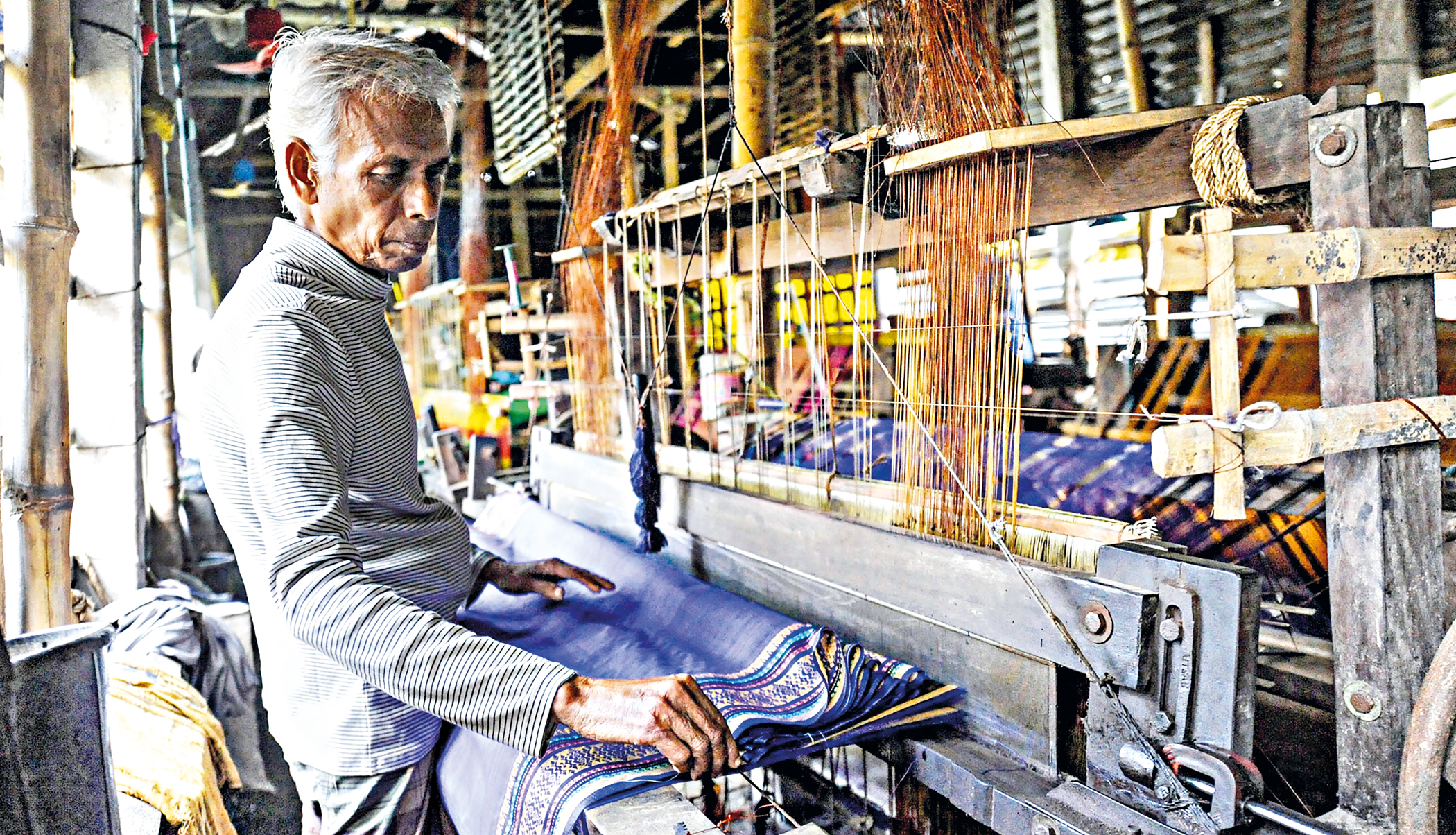
“Last year, I sold a minimum of 150 to 200 full pieces -- each piece producing four lungis -- per week. This year, my highest sale has been only 120 to 150 pieces over the last three to four haats (weekly markets),” said Golam Hossain, a handloom trader in Shahzadpur.
Bodiuzzaman, a manufacturer in Shahzadpur upazila who operates a factory of 40 power looms, echoed his concerns.
“Last year, 90 percent of my production -- over 120 saris and 300 lungis -- sold immediately. This year, I am producing the same amount, but only 70 to 80 percent is selling. The rest is going into stock.”
Eid sales were much stronger two to three years ago when buyers from India and other neighbouring countries frequented these markets, traders noted. This year, foreign buyers are largely absent.
“We are mostly dependent on domestic wholesalers now,” Hossain added.
The sudden spike in raw material costs added to weavers’ grievances. Arif Hossain, a producer in Kulunia, explained that a bundle (100 lbs) of 80-count thread that previously cost Tk 26,000 has soared to Tk 27,300.
“Many weavers borrow money to invest in production, expecting higher returns during Eid,” Haidar Ali, a founder of the Bangladesh Handloom and Powerloom Owners Association, noted.
“But with rising costs and stagnant selling prices, many are failing to see even a minimum profit. A good number of them are leaving this inherited profession because they can no longer sustain themselves.”
HANDLOOMS FADING FROM THE SCENE
Approximately 6 to 7 lakh looms, including both hand and power looms, are currently operating in Bangladesh. Most are concentrated in Pabna, Sirajganj, Tangail, Narsingdi, and the hill districts.
According to the 2018 Handloom Census, around 3 lakh handlooms are in operation, though Ayub Ali noted there is no official current count for power looms.
“The number of handlooms has been declining every year, while power looms are on the rise. Together, they meet approximately 28 percent of the total clothing demand in Bangladesh,” said Ratan Chandra Shaha, deputy general manager of marketing at the Bangladesh Handloom Board.
Haidar Ali stated that about 1 lakh handlooms remain closed at present due to economic factors.
“A lack of efficient manpower and continuous losses are driving the decline,” he said. “The price of raw materials, mainly thread, has increased rapidly, but weavers cannot raise their prices accordingly. Many workers have left the profession due to low earnings, creating a vacuum in the industry.”
Weavers typically prepare a large inventory of cloth targeting the festival market. While the low sales have put a damper on the usual enthusiasm this year, weavers in Pabna and Sirajganj remain busy manufacturing fabrics as Eid draws near. Some weavers are even working double-time in hopes of a last-minute rush.
 For all latest news, follow The Daily Star's Google News channel.
 Shukur Ali, a weaver from Pabna’s Kulunia village, said, “Usually, I produce 5 to 6 pieces per loom. Now, I am preparing 10 daily, earning approximately Tk 500.”
Comments