


Govt to lower economic growth target for unrest
The government is set to revise down current fiscal year's GDP growth projection by 0.5 percentage point to 6.8 percent in light of the dragging political unrest.
The revised growth target will be fixed at today's meeting of the fiscal coordination council.

The meeting will also deal with current fiscal year's revised budget and next fiscal year's budget, said an official from the finance ministry.
Finance Minister AMA Muhith already informed the parliament about the decision to revise down the growth target from the initial 7.3 percent given the tumultuous political scenario, which has been getting in the way of normal economic activities. By how much the target will be brought down was not specified.
At a pre-budget meeting with non-governmental organisations yesterday, the finance minister said the government had great expectations that it would be able to come out of the 6-plus growth trap this year.
“Now, I don't believe it so firmly,” he said at the meeting held at the auditorium of the National Economic Council.
However, he said the disturbances the economy had suffered from the three month-long political unrest are much less than what is being publicised and discussed.
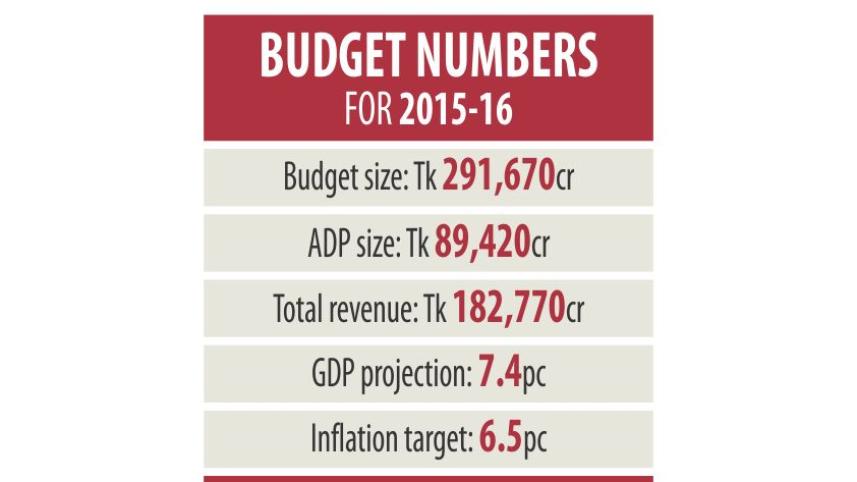
The finance ministry official said the government will set an ever bigger growth target for fiscal 2015-16. The relevant officials will propose a 7.4 percent GDP growth target at the coordination council meeting, he said.
Bangladesh Bank, World Bank, International Monetary Fund and Asian Development Bank have all lowered their GDP growth forecasts due to the political unrest.
The ADB last month revised down Bangladesh's growth forecast to 6.1 percent from 6.4 percent.
“Political blockades and violence in early 2015 will constrain growth,” the Manila-based lender said in the Asian Development Outlook 2015.
The BB also recently said the growth this time would be in the neighbourhood of 6.5 percent.
Meanwhile, the total budget for 2014-15 was cut by 4.2 percent from the original amount and fixed at Tk 240,000 crore. However, the subsidy expenditure, which was around Tk 26,000 crore, would remain the same.
Of the amount, subsidy for fuel was Tk 2,400 crore. As the fuel price fell in international market, the fuel subsidy may decrease by around Tk 2,000 crore.
In the revised budget, the subsidy on power may be nearly Tk 10,000 crore. Originally, it was Tk 7,000 crore.
A power division official said, as electricity generation from government-owned power plants was less, more electricity has to be bought from rental power plants, which would require more subsidy than the original estimate. Besides, Tk 500 crore of additional subsidy will be required for the export sector. The original allocation was around Tk 2,000 crore.
In the revised budget, the government's total revenue earning target may be slashed 12 percent to Tk 162,235 crore.
The National Board of Revenue target may be set at Tk 135,000 crore, with a potential cut of 9.83 percent from the initial Tk 149,720 crore.
The non-tax revenue may be Tk 22,662 crore, which was Tk 27,662 crore in the original estimate.
Also, the non-NBR tax may be fixed at Tk 3,572 crore by reducing Tk 2,000 crore from the original estimate.
 For all latest news, follow The Daily Star's Google News channel.
 As for the budget for next fiscal year, it will be around Tk 291,670 crore, 16.43 percent higher than the original budget of the current fiscal year.
The revenue target for the next fiscal year may remain the same, but the NBR's target might go up substantially: it might be 17.79 percent higher than this year's original estimate and 30.64 percent more than the revised estimate.
The NBR revenue collection has been estimated at Tk 176,370 crore for next fiscal year.
The finance minister also said the next budget would place special emphasis on social development, and the health and education sectors. Energy and transport, which received the most attention in the last five years, would take a backseat.
Comments