


Beyond the Commute: How Hero MotoCorp Is Ushering in a New Era in Bangladesh’s Riding Culture
For over a decade, two-wheelers in Bangladesh were viewed almost exclusively as practical utility tools. These machines were built to weave through Dhaka's infamous traffic jams, get commuters to their jobs on time, and stretch every litre of fuel as far as possible. As the economy expands and disposable income rises, a younger, more ambitious generation of riders is changing the narrative. Today, a motorcycle is no longer utilitarian; rather, it is an extension of personal identity, freedom, and a gateway to weekend adventure.
After 12 years in the local market and recently passing the landmark milestone of one million bikes sold nationwide, Indian two-wheeler giant Hero MotoCorp is doubling down on Bangladesh. Through its long-standing partnership with Niloy Motors, Hero has quietly built a massive local manufacturing footprint that is fundamentally altering what Bangladeshi riders can expect from a two-wheeler.

Built in Jessore
Unlike brands that rely heavily on finished imports, Hero’s strategy in Bangladesh centres on deep local integration. The heart of its operation is a state-of-the-art manufacturing facility in Jessore. Employing over 1,200 local workers, this facility makes Bangladesh one of only two international markets (alongside Colombia) where Hero operates a dedicated manufacturing plant. Almost every Hero bike hitting Bangladeshi roads today is built right here. This allows the brand to tailor its engineering specifically for Bangladeshi road conditions and keep ownership costs manageable.
Highlighting this deep-rooted connection, Harshavardhan Chitale, CEO of Hero MotoCorp, emphasised: "Guided by our 'Hero r Desh Bangladesh' philosophy for the past 12 years, we have deepened our relationship with this nation. Together with Niloy Motors, we invested in a joint venture and built a robust local ecosystem featuring a modern manufacturing plant, an expanded sales and service network, and a dedicated Bangladeshi workforce. We are manufacturing locally, creating employment, and growing alongside the country."
To back up its production scale, Hero and Niloy Motors have built a nationwide ecosystem featuring over 500 touchpoints. This extensive footprint, supported by a reliable supply of genuine spare parts and standard five-year warranties, has given everyday riders the confidence to push their bikes further.
Bringing Dakar DNA to Local Roads
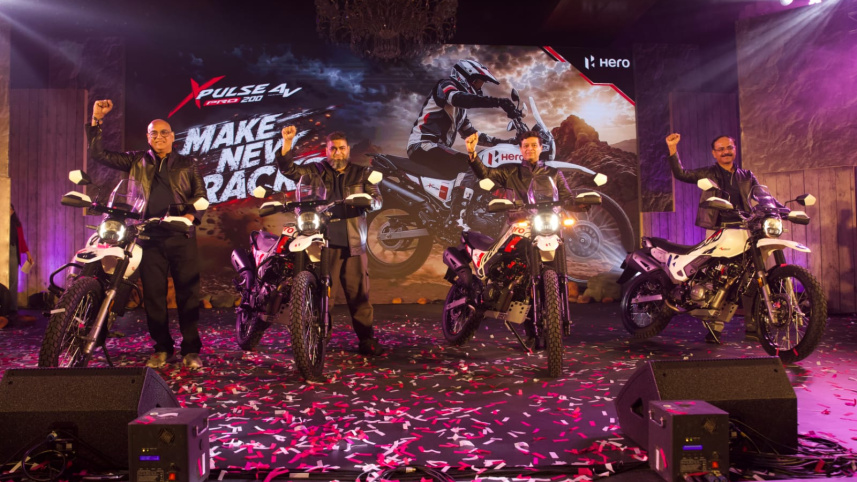
The recent launch of the XPulse 200 4V and XPulse 200 4V Pro marks a major milestone in Hero’s local strategy. Market research shows that more than 10 percent of motorcycle owners are now looking beyond urban commuting, taking 200- to 300-kilometre trips on weekends to explore the countryside. The new XPulse series caters directly to this growing demographic, bridging the gap between weekday city rides and rugged off-road escapes.
The XPulse lineup is equipped with a 199.6cc oil-cooled engine producing 18.9 BHP, three distinct ABS modes (Road, Off-Road, and Rally), and Bluetooth-enabled turn-by-turn navigation. The whole package brings high-end dual-sport capabilities to the local market. The engineering isn't just marketing hype, either. It draws directly from Hero’s global motorsport division, which competes in the gruelling Dakar Rally, and is refined at the company's R&D centre near Munich, Germany, before the motorcycles are finally assembled in Jessore.
Hero offers two distinct flavours of XPulse for local buyers. The standard XPulse 200 4V is for daily use with light trail capability, while the XPulse 200 4V Pro adds fully adjustable suspension with up to 270mm of ground clearance for serious off-road enthusiasts.
"With the launch of the XPulse 200 series, we are committed to driving the country's adventure motorcycling culture forward by delivering world-class engineering tailored for Bangladeshi roads," Chitale said, explaining the vision behind the new launch.
Setting New Standards and Eyeing an Electric Future
Hero MotoCorp has a strong commercial foundation in Bangladesh, and its ambitions extend well beyond off-road enthusiasts.
The company holds a dominant 54% market share in the entry-level segment with trusted models like the HF Deluxe and Splendor+. It also has more than 30% market share in the 125cc segment, led by Xtreme 125, and more than 45% market share in scooters.
Looking ahead, sustainable mobility is clearly on the horizon. Hero has invested heavily in electric mobility globally through its own brand, Vida, as well as through strategic investments and partnerships with other electric mobility companies. Hero is currently evaluating local infrastructure readiness to bring its electric lineup to the domestic market.
Ultimately, Hero MotoCorp’s journey mirrors Bangladesh’s own economic evolution. By combining global engineering, heavy local investment, and a sharp eye on evolving customer lifestyles, the company is proving that the motorcycle can be far more than just a way to beat the morning commute.
 For all latest news, follow The Daily Star's Google News channel.
Comments