


BSEC collected only Tk 33 lakh in fines against Tk 1,500 crore imposed: chairman
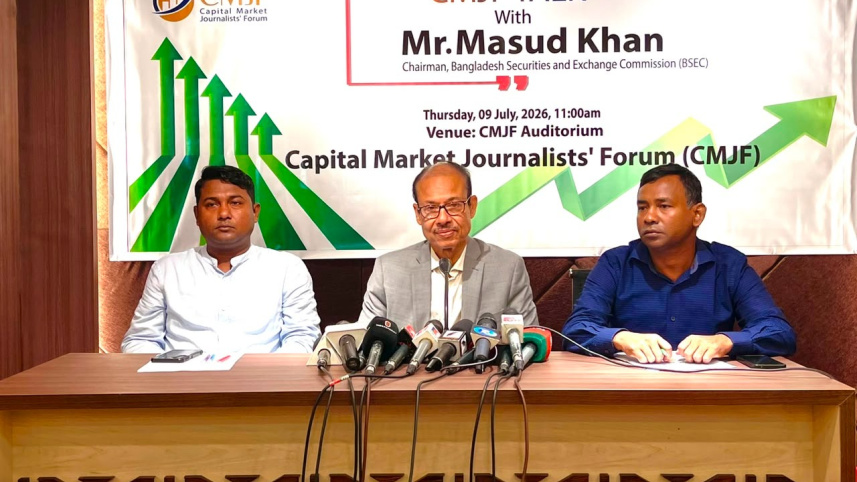
The previous commission of the Bangladesh Securities and Exchange Commission (BSEC) realised only Tk 33 lakh—just 0.02 percent of the Tk 1,500 crore in fines it imposed over around two years, said Masud Khan, chairman of the commission.
"At present, whenever we take punitive action against market manipulation, the accused individuals or institutions seek relief from the High Court. Therefore, we are considering the establishment of a dedicated High Court bench to deal with capital market-related cases more quickly," Khan said.

Initiatives have been taken to allow cases to be filed directly with the Capital Market Tribunal. Relevant laws will be amended to ensure the tribunal can function with full authority, he said.
Moreover, the BSEC is focusing on introducing an artificial intelligence (AI)-powered market surveillance system and ensuring that stock market offenders face imprisonment and financial penalties, he said.
The BSEC chairman made the comments today at a talk organised by the Capital Market Journalists' Forum (CMJF) at its office in the capital. The event was chaired by CMJF President Munir Hossain and moderated by General Secretary Ahsan Habib.
He said the AI-based surveillance system would be introduced within a year to prevent stock market manipulation. "The Dhaka Stock Exchange has already been instructed in this regard," he said.
He also said the BSEC is considering filing criminal cases instead of civil suits in incidents involving irregularities, corruption and market manipulation.
Khan said the previous commission had imposed fines that exceeded the amount manipulators earned through illegal activities in an effort to deter such practices.
However, he noted that although the BSEC imposed fines, enforcement is often stalled by court proceedings.
Khan announced that day-netting facilities may soon be introduced for fundamentally strong listed companies. Once implemented, investors will be able to buy and sell shares of eligible companies on the same trading day.
He said the proposal was recently made by the association of brokerage house owners. However, given the current market conditions, it is not feasible to introduce the facility for all listed shares.
"We are considering introducing the facility initially for high-quality companies, possibly the top 30 companies," he said.
To develop the bond market, the BSEC plans to list bonds on the main board instead of the Alternative Trading Board (ATB). The commission is also actively working to introduce derivatives trading, which Khan said is essential for the market.
Regarding suspended companies, Khan said no country in the world allows trading of shares of companies that have ceased operations.
"Therefore, we will take steps to stop trading in the shares of companies that have halted production," he said, adding that several other initiatives are also being undertaken to improve the market.
He, however, said the regulator will not go for delisting immediately, and that the initiative will be implemented in phases.
He said reforms have already begun in the management of the capital market. The Dhaka Stock Exchange (DSE) has been empowered to strengthen market oversight.
Under the listing regulations, the stock exchange will be able to take regulatory actions without prior approval from the BSEC. Instead, it will inform the commission after making a decision.
Speaking about the mutual fund sector, Khan said the BSEC would amend the mutual fund regulations to strengthen the industry.
He also said the commission plans to introduce a financial adviser certification similar to those in developed markets. Certified advisers will be authorised to provide paid investment advice on stock investments.
 For all latest news, follow The Daily Star's Google News channel.
 Regarding easing the initial public offering (IPO) process, he said the Public Issue Rules would also be revised.
Companies seeking to raise funds through IPOs currently face lengthy delays and extensive documentation requirements. As a result, many businesses prefer bank loans as an easier financing option.
To address this, the IPO process will be simplified, he said.
Khan also said that in the future, large companies such as Unilever and Incepta would be allowed to enter the market through direct listing.
The relevant laws governing direct listing will also be amended so that private sector companies can use this mechanism to list on the stock exchange.
He further said the existing margin loan policy contains so many conditions that it has become difficult for investors to obtain margin financing.
A draft of the revised margin loan regulations will be published next week, he said. Once the new rules are gazetted, obtaining margin loans will become much easier for investors.
Comments