


Cattle graze on Tk 50cr idle land port

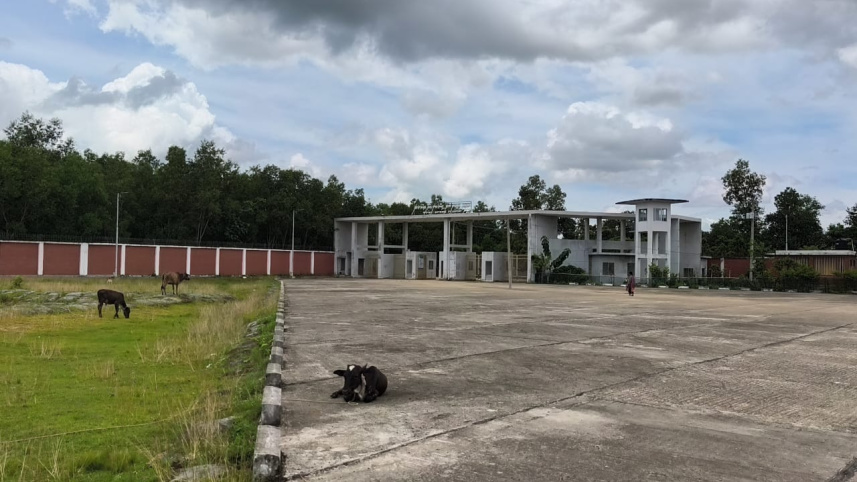
Built at a cost of nearly Tk 50 crore, Balla land port in the north-eastern district of Habiganj now stands largely unused, with parts of its infrastructure overrun by jungle and cattle grazing on the premises.
The port was built to facilitate cross-border trade, but the investment has failed to deliver because the corresponding infrastructure was never developed on the Indian side.

Construction of the land port in the Kedarakot area of Chunarughat upazila was completed in June 2023. But the facility was suspended in August 2025 as there was still no customs station or road connection on the Indian side in the Paharmura area of Tripura state.
Paharmura remains vacant, with no customs station, other infrastructure or road connecting it to the Bangladeshi side.
That has left Bangladesh with a fully built port but no functioning cross-border link, raising questions about why such a large public investment was made before the necessary facilities on the other side were in place.
The project was taken up nearly a decade ago. In 2016, the Bangladesh Land Port Authority declared Balla a land port, and a development project was proposed in fiscal year 2016-17 with an initial estimated cost of Tk 60 crore.
The Executive Committee of the National Economic Council (Ecnec) approved the project on July 1, 2017. The revised cost eventually came down to Tk 49.90 crore, while another Tk 7 crore had already been spent to acquire around 13 acres of land.
Bangladesh then built yards, weighing scales, office buildings, dormitories, boundary walls, roads and other service structures needed to run a land port.
According to locals, the project was taken up because of the “special interest” of a senior government official from Habiganj. The Bangladesh Land Port Authority chairman, however, rejected the claim, saying there was no official reference to support it.
Officials now say there is little they can do except guard the facility.
Speaking on condition of anonymity, a senior official of the Bangladesh Land Port Authority said the manpower appointed for Balla Land Port continues to receive salaries even though there is no port operation.
Tofazzal Sohel, coordinator of Habiganj Sankhubda Nagorik Andolan, a local civil society platform that campaigns against corruption, said those responsible for influencing, approving and implementing the project should be held accountable for wasting public money.
BUILT WITHOUT INDIAN FACILITIES
Balla already had a customs station, about three kilometres from the newly built land port. The station has existed since the British period, and some irregular imports and exports take place through the Balla-Khowai river route.
The route is also used by Bangladeshi and Indian passport holders travelling between the two countries.
But the Khowai river has long made trade difficult. During the rainy season, traders transport goods by boat, while in the dry season workers carry goods on their heads across the river.
Against this backdrop, Bangladesh and India began discussions about developing the Kedarakot area. A joint delegation from the commerce ministries of the two countries visited Kedarakot on June 11, 2012. Officials from the foreign ministries of the two countries also visited the area on several occasions.
Four years later, Bangladesh formally declared Balla a land port.
Mir Siraj, a lawyer and general secretary of Chunarughat upazila BNP, said the Awami League government had wasted crores of taka in a project to showcase development rather than meet genuine needs.
“This port was built without any agreement with the Indian government,” he said.
TRADE HOPES REMAIN UNREALISED
Local businesses say the port could have opened a new route for trade with Tripura and other north-eastern Indian states.
 For all latest news, follow The Daily Star's Google News channel.
 Sajidur Rahman, member secretary of the Chunarughat Businessmen Welfare Association, said that had the port been operational, Bangladeshi products could have been exported to eastern Indian states, including Tripura, more easily.
He said the land port could play a significant role in exporting agricultural products, fish, ceramics, sanitary ware, processed food and construction materials to India.
At the same time, the land port could facilitate imports of onions, ginger, garlic and various fruits from India, he added.
Mohammad Ali, chairman of Gazipur Union Parishad, said the port could transform the local economy if it became operational.
NO OPENING IN SIGHT
Five security personnel and two cleaners are currently stationed at the land port, mainly to guard and maintain the premises, according to Sabuj Chandra Roy, superintendent of the port.
Sabuj said it is difficult to say exactly when the port would become operational.
Mohammad Manzarul Mannan, chairman (additional secretary) of Bangladesh Land Port Authority, said there is no immediate prospect of launching the land port.
“We are merely acting as watchmen. The port cannot become operational unless the necessary infrastructure is in place on both sides of the border.”
Mannan also dismissed claims that the project was undertaken because of the personal influence of a senior government official whose home district is Habiganj.
“There is no official reference to support such a claim,” he said.
Comments